
Table of Contents
Quick Answer
The best AI CRM for realtors in 2026 depends on your team size more than any single “best” product. Follow Up Boss (from $58/month) is the strongest all-around pick for solo agents and teams up to about 100 people who want a clean CRM with genuine AI automation and an open API. Agents on a tight budget usually do better with Wise Agent ($49/month) or Lone Wolf Relationships (from around $33/month). Teams and brokerages that want a website and CRM bundled together tend to land on Lofty (formerly Chime) or BoldTrail (formerly kvCORE), both starting near $449–$500/month.
An AI CRM for realtors isn’t just a contact list with a chatbot bolted on. It scores leads by behavior, drafts and times follow-ups on its own, and flags who’s ready to buy or sell before you’d catch it yourself. Which one is “best” really comes down to your budget, your team size, and whether you want a bundled IDX website or a CRM you can plug other tools into.
What Is an AI CRM for Realtors?
An AI CRM for realtors is customer relationship management software built specifically for real estate that uses machine learning and natural language processing to score leads, personalize follow-up, and automate routine admin work, instead of just storing names and phone numbers.
Think of a regular CRM as a filing cabinet. You put contacts in, you take notes, you set your own reminders. An AI-powered CRM for real estate agents does that same job, but it also watches what happens after the contact goes in: who opened an email, who viewed a listing three times this week, who hasn’t responded in ten days. Then it acts on that information without you having to ask it to.
How It’s Different From a Traditional Real Estate CRM
A traditional CRM is passive. It stores data and waits for you to use it. An AI CRM is active. Here’s the practical difference:
- Traditional CRM: You manually decide who to call today.
- AI CRM: The system tells you which three leads are most likely to convert this week, based on their actual behavior.
- Traditional CRM: You write every follow-up email and text yourself.
- AI CRM: It drafts the message, times it around when the lead is most likely to respond, and sometimes sends it automatically.
- Traditional CRM: You find out a past client is thinking about selling when they call you.
- AI CRM: It flags rising home equity, ownership length, or website activity that suggests a past client might be ready to sell — before they’ve said a word.
Why Realtors Are Actually Switching to AI-Powered CRMs
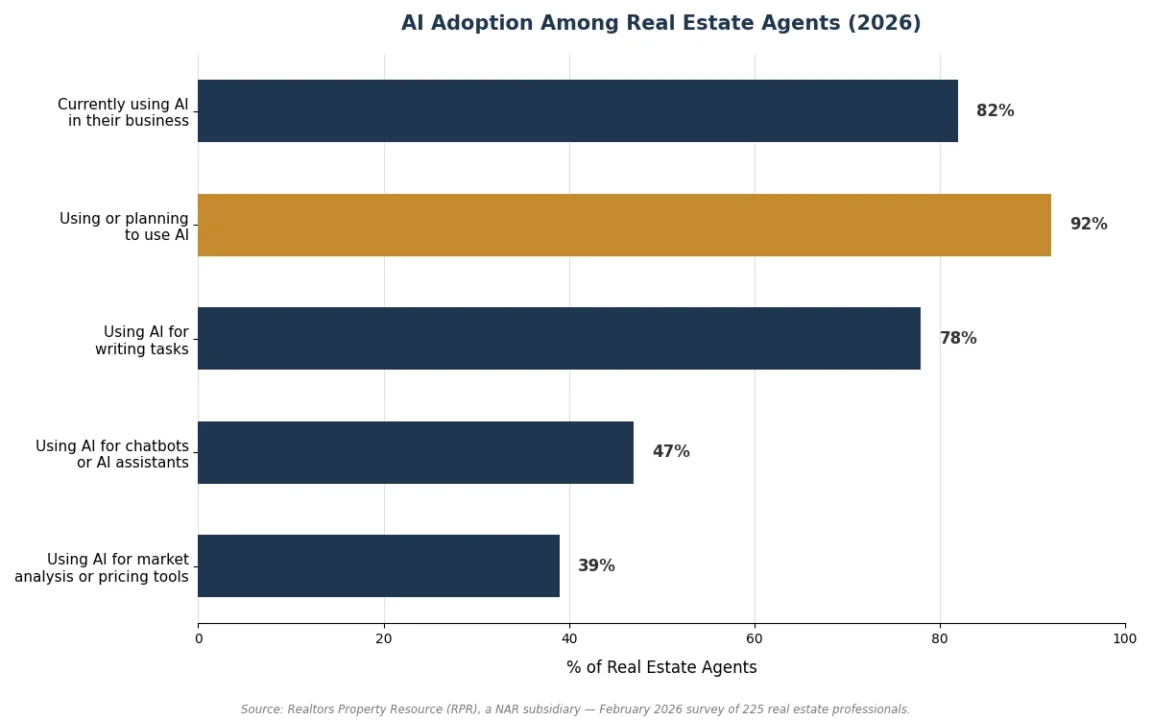
This isn’t just marketing hype from software vendors. According to a February 2026 survey of 225 real estate professionals by Realtors Property Resource (RPR), a data subsidiary of the National Association of REALTORS® (NAR), 82% of agents already use AI somewhere in their business, and 92% are either using it or planning to.
The same survey found agents lean on AI most for writing tasks (used by roughly 78% of respondents), chatbots and AI assistants (about 47%), and market analysis or pricing tools (around 39%). Interestingly, confidence drops sharply once AI touches anything client-facing around pricing or compliance — 63% of agents cited accuracy as their top concern, and 49% worried about compliance or legal issues.
That gap is exactly why a real estate–specific AI CRM matters more than a generic one: it’s built with fair housing rules, MLS data, and real transaction stages in mind, rather than treating a home sale like any other sales pipeline.
Here’s what agents actually gain from switching:
- Faster response times — leads texted or emailed within seconds instead of hours, which matters because response speed is one of the biggest predictors of conversion in real estate.
- Less manual admin work — updating records, sending status updates, and logging calls happens automatically.
- Smarter prioritization — you spend your day on the five leads most likely to close, not the fifty that filled out a form and went cold.
- Round-the-clock lead engagement — a lead who fills out a form at 11 p.m. gets a response before they’ve closed the tab.
- Better past-client retention — the CRM can flag sphere-of-influence contacts worth a check-in call, instead of relying on your memory.
Must-Have Features in an AI-Powered CRM for Real Estate
Every CRM vendor claims to have AI in 2026. Very few have built AI that changes how the day-to-day work actually gets done. Here’s what to actually check for before you buy.
Predictive Lead Scoring
The CRM should rank leads by their real likelihood to convert — based on site visits, email opens, listing views, and response speed — not just whether they filled out a form. A lead who’s viewed the same three houses five times in a week is a different animal than one who downloaded a home valuation guide once and vanished.
Behavior-Based Automated Follow-Up
Look for drip campaigns that adjust based on what a lead actually does, not a fixed calendar that sends message four on day four no matter what. The best systems change the message, channel, and timing depending on whether a lead is browsing daily or has gone quiet.
Conversational AI and Chatbots
A CRM with a built-in AI chatbot or texting assistant can handle the first conversation with a new lead — answering basic questions, confirming budget and timeline, and booking a showing — without an agent lifting a finger at 9 p.m. on a Saturday.
MLS and IDX Integration
The system needs to pull live listing data (price, photos, status changes) directly from your local MLS, and ideally power an IDX website so leads can search properties without leaving your ecosystem. Manual data entry between systems is exactly the busywork AI is supposed to eliminate.
Transaction and Pipeline Management
A good AI CRM doesn’t stop at “lead.” It should track a deal from first contact through closing, with stage-based automation — reminders for inspection deadlines, document requests, and closing-day check-ins.
Team Routing and Mobile Access
For teams, leads should route automatically to the right agent based on location, specialty, or current workload, not a manual assignment or a straight round-robin. And since most of this happens between showings, the mobile app needs to actually work, not just exist.
The 10 Best AI CRM Software for Realtors in 2026
Pricing across this list is often quote-based and changes without much notice, so treat every figure below as a starting estimate to confirm directly with the vendor before you budget.
1. Follow Up Boss — Best Overall AI CRM for Realtors
Follow Up Boss is the CRM most high-volume teams graduate to, and it’s now backed by Zillow Group, which acquired the company in late 2023 for $400 million in cash plus up to $100 million in earnout, while keeping it running as an independent brand. It connects to 200+ lead sources, including Zillow and Realtor.com, so leads from every source land in one inbox instead of ten different apps.
Its AI features draft replies inside your inbox, summarize long lead conversations so you don’t have to scroll back through months of texts, and suggest what to do next with a stalled lead. Because the API is genuinely open, teams also plug in their own AI tools built on OpenAI or Anthropic for custom voice and chat workflows.
- Best for: teams of 5–100 agents who want a clean, sales-focused CRM with room to layer on custom AI later
- Starting price: around $58/month per user on annual billing ($69 billed monthly)
- Standout AI feature: AI-drafted inbox replies, call transcription, and speed-to-lead scoring
2. Lofty (Formerly Chime) — Best for All-in-One AI Automation
Lofty, the rebrand of Chime CRM completed in late 2023, now serves more than 70,000 real estate professionals with a platform built around AI from the ground up rather than automation bolted onto an old system. Its “AI Workforce” includes an AI Copilot that drafts messages and summarizes calls, plus a separate AI Sales Agent that qualifies leads over chat, SMS, and email and books appointments on its own.
One of its more distinctive tools is Homeowner Agent, which scans your existing contact database for seller intent using signals like home equity, appreciation, and years of ownership, then flags who’s quietly ready to sell before they’ve called you.
- Best for: agents and brokerages that want AI built into every step instead of purchased as an add-on
- Starting price: around $449/month for core plans, up to $1,500+/month for enterprise tiers (quote-based, third-party estimate)
- Standout AI feature: AI Sales Agent plus behavior-based Smart Plans and seller-intent detection
3. BoldTrail (Formerly kvCORE) — Best for Brokerages
If you’ve seen “kvCORE” mentioned somewhere, know that Inside Real Estate rebranded it to BoldTrail in mid-2024. It’s the same underlying platform with a cleaner interface and deeper AI layered in, so kvCORE and BoldTrail are effectively the same product under two names.
BoldTrail bundles a CRM, an IDX website, and marketing automation into one login, with integrations across 600+ MLSs in the US and Canada. Its AI-powered Smart CRM prioritizes leads by conversion likelihood and drives its Smart Campaigns, which adjust messaging automatically based on lead behavior rather than sending the same drip to everyone.
- Best for: brokerages that want one vendor covering website, CRM, and lead generation instead of stitching five tools together
- Starting price: around $499/month for solo agents, typically $500–$2,000+/month for teams and brokerages depending on add-ons like BackOffice or Recruit
- Standout AI feature: AI-driven lead prioritization and behavior-based Smart Campaigns
- Heads-up: most reviewers note a real learning curve, often two to four weeks to get comfortable
4. Real Geeks — Best Value for Solo Agents and Small Teams
Real Geeks bundles an IDX website, CRM, and lead capture tools at roughly half the price of premium competitors like BoomTown or CINC. Its entry-level plan runs somewhere between $249 and $299/month for up to two users, plus an onboarding fee, though you should confirm the current number directly since Real Geeks’ public pricing page now routes to a sales conversation.
The AI layer here is an add-on called Geek AI, a texting assistant priced around $100/month on top of the base plan, so budget for that separately if lead qualification by text matters to you.
- Best for: solo agents and small teams who want IDX-plus-CRM without premium pricing
- Starting price: approximately $249–$299/month, plus a one-time onboarding fee
- Standout AI feature: Geek AI texting assistant (add-on)
5. Sierra Interactive — Best for SEO-Driven Lead Generation
Sierra Interactive stands apart because its websites connect directly to the MLS rather than through a third-party IDX feed, and the whole platform is built around organic search rather than paid ads. That’s a meaningfully different growth strategy than most competitors on this list, who lean heavily on PPC.
Its AI layer, sometimes called Sierra AI, handles lead routing and drafts responses, a capability the company added in 2025. There’s also a separate Lead Engage AI texting add-on for teams that want automated qualification by text.
- Best for: teams willing to invest in content and SEO over a 12–24 month horizon rather than chasing quick paid leads
- Starting price: $299.95/month (1 user) on annual billing, scaling to $599.95/month for 5 users; monthly billing costs more and adds a $500 setup fee that annual billing waives
- Standout AI feature: AI-assisted lead routing and response drafting
6. CINC — Best for Guaranteed Lead Volume
CINC (Commissions Inc) doesn’t sell its CRM as a standalone product — every plan includes done-for-you buyer and seller leads bundled with the software, which is why it costs more than most of this list. Its Autotracks feature builds behavior-based drip campaigns that combine emails, texts, and task reminders triggered by what a lead does on your site.
- Best for: top-producing agents and teams who want lead generation and CRM handled by one vendor and don’t mind paying a premium for it
- Starting price: around $899/month for solo agents, $1,500+/month for teams
- Standout AI feature: Autotracks behavior-based nurture automation
7. BoomTown — Best for Scaling Established Teams
BoomTown, also owned by Inside Real Estate (the same parent company as BoldTrail), is positioned for growth-minded teams and brokerages rather than solo agents. It scores well on contact management and transaction management specifically, with a more built-out website builder than some lighter competitors.
It’s a genuine investment: expect a setup fee equal to about one month’s cost and typically a 12-month minimum contract, so this isn’t the platform to try casually.
- Best for: established teams with the budget and lead volume to justify a premium, contract-locked platform
- Starting price: roughly $1,000–$1,500+/month plus setup fee
- Standout AI feature: AI-assisted contact and transaction management at scale
8. Realvolve — Best for Custom Workflow Automation
Realvolve takes a different approach entirely: instead of pre-built drip campaigns, it gives you a blank canvas to design your own multi-step workflows — staging reminders, open house follow-ups, post-closing check-ins — that trigger based on client behavior or deal stage. It also assigns relationship scores so you can see which contacts in your sphere actually need attention.
The tradeoff is a steeper learning curve than with more plug-and-play options, since the flexibility that makes it powerful also makes it more work to set up properly.
- Best for: experienced agents and teams who want deep customization and don’t mind building their own automation
- Starting price: around $94–$99/month
- Standout AI feature: relationship scoring plus fully custom, trigger-based workflow automation
9. Lone Wolf Relationships — Best Budget CRM (and LionDesk’s Replacement)
If you were a LionDesk user, here’s what happened: Lone Wolf Technologies, which acquired LionDesk in 2021, shut the platform down completely by September 2025 and migrated remaining users to its own CRM, Lone Wolf Relationships. Lone Wolf says the newer product has feature parity or better with what LionDesk offered, and pricing was set to land in a similar range.
The CRM includes AI-written templated emails for referral requests, testimonials, and buyer outreach, with the AI able to summarize and modify drafts before you send them. It also syncs with Gmail and Outlook calendars and integrates with EZ Texting for bulk messaging.
- Best for: budget-conscious solo and new agents, especially former LionDesk users
- Starting price: around $33/month on annual billing
- Standout AI feature: AI-drafted referral, testimonial, and buyer outreach emails
10. Wise Agent — Most Affordable Full-Featured CRM
Wise Agent skips the bundled IDX website entirely, which keeps the price predictable and the platform simpler to learn. What you get instead is a genuinely agent-focused toolkit: landing pages, SMS and email campaigns, Facebook campaign tools, and a referral-tracking feature built specifically to keep tabs on clients referred by past customers.
- Best for: agents who want the essentials done well, without paying for a website or lead-gen engine they don’t need
- Starting price: around $49/month
- Standout AI feature: AI-assisted email and text campaigns with dedicated referral tracking
A couple of honorable mentions worth knowing about: Top Producer (also under Lone Wolf) still leads on MLS breadth with direct integration into 320+ boards and an AI-powered email and text composer, typically running $60–$80/user/month. And HubSpot, while not built for real estate specifically, offers a genuinely useful free tier plus AI tools (Breeze) starting around $90/user/month on paid plans — worth a look if you want more marketing flexibility than a real estate–specific tool offers and don’t mind configuring it yourself.
Quick Comparison: AI CRM for Realtors at a Glance
| CRM | Best For | Starting Price* | Standout AI Feature | Built-In IDX Website |
|---|---|---|---|---|
| Follow Up Boss | Teams wanting a clean CRM + open API | ~$58/mo | AI inbox replies, call transcripts | No |
| Lofty (formerly Chime) | All-in-one AI automation | ~$449/mo | AI Sales Agent + seller-intent detection | Yes |
| BoldTrail (formerly kvCORE) | Brokerages wanting one vendor | ~$499/mo | AI-driven lead prioritization | Yes |
| Real Geeks | Budget solo agents/small teams | ~$249–299/mo | Geek AI texting assistant (add-on) | Yes |
| Sierra Interactive | SEO-driven organic lead gen | ~$300/mo | AI lead routing + response drafting | Yes |
| CINC | Guaranteed lead volume included | ~$899/mo | Autotracks behavior-based nurturing | Yes |
| BoomTown | Established teams scaling up | ~$1,000+/mo | AI-assisted transaction management | Yes |
| Realvolve | Custom workflow automation | ~$94/mo | Relationship scoring + custom workflows | No |
| Lone Wolf Relationships | Budget CRM / LionDesk replacement | ~$33/mo | AI-drafted outreach emails | No |
| Wise Agent | Most affordable full-featured CRM | ~$49/mo | AI-assisted campaigns + referral tracking | No |
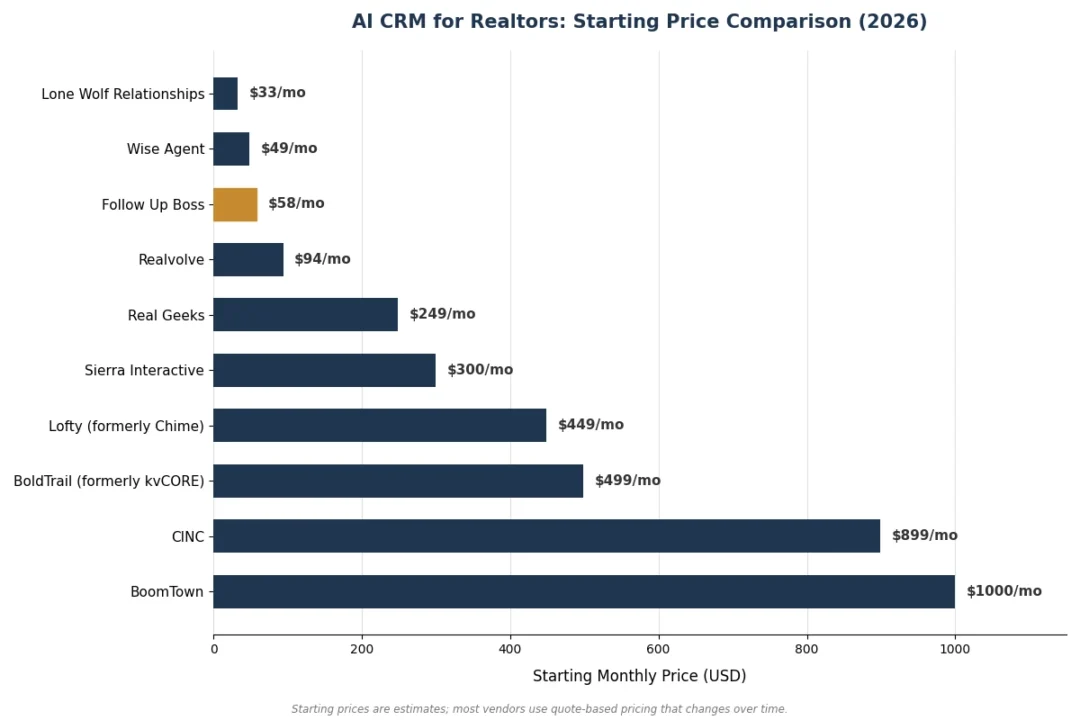
*Most vendors on this list use quote-based or tiered pricing that changes over time — confirm current rates directly before budgeting.
How to Choose the Right AI CRM for Your Business
Solo Agent, Team, or Brokerage?
- Solo agent, tight budget: Wise Agent or Lone Wolf Relationships. Both keep monthly cost predictable while still giving you AI-assisted messaging.
- Solo agent or small team, ready to invest: Follow Up Boss or Real Geeks, depending on whether you already have a lead source or need an IDX website bundled in.
- Team of 5+ with consistent lead volume: Follow Up Boss, Lofty, or BoldTrail — all three earn their price tag once you have enough leads flowing through to actually use the automation.
- Brokerage wanting one vendor for everything: BoldTrail or BoomTown, accepting a longer contract and a real onboarding period in exchange for consolidation.
Budget and the Hidden Costs Nobody Mentions
The number on the pricing page is rarely the number on your invoice. Watch for:
- Setup or onboarding fees, often equal to a month’s subscription
- AI add-ons priced separately, like Geek AI or Lead Engage, that aren’t included in the base plan
- Ad spend, if the platform includes lead generation (this can dwarf the software cost itself)
- Per-seat pricing that multiplies fast once you add agents
Questions to Ask Before You Sign
- Does the AI work from your actual CRM data, or does it sometimes generate generic-sounding answers that don’t reflect your real leads?
- Can you export your contacts, activity history, and automation workflows if you decide to leave?
- Is pricing month-to-month, or does it require a 12-month commitment?
- What’s the realistic all-in monthly cost once add-ons and ad management fees are included?
How Much Does an AI CRM Actually Cost?
Real estate CRM pricing splits fairly cleanly into three tiers:
- Budget tier ($33–$50/month): Wise Agent, Lone Wolf Relationships. Solid AI-assisted messaging, no bundled website, predictable billing.
- Mid tier ($58–$300/month): Follow Up Boss, Real Geeks, Sierra Interactive, Realvolve. Real AI automation, often with an IDX website included, priced per user or per small team.
- All-in-one / enterprise tier ($449–$1,500+/month): Lofty, BoldTrail, CINC, BoomTown. Website, CRM, lead generation, and deep AI automation bundled together, aimed at teams and brokerages with the lead volume to justify it.
As a rule of thumb: if your current CRM has no AI features and you’re spending more than an hour or two a day on manual follow-up, switching can pay for itself in recovered time within the first month or two — but only once you’ve actually configured the AI layer, not the day you sign up.
Common Mistakes Realtors Make When Switching CRMs
- Underestimating switching costs. Migrating contacts, rebuilding drip campaigns, and retraining your team on a new system often cost more in time than a full year of subscription fees. Price out adding AI to your current CRM before assuming you need to switch platforms entirely.
- Signing a long contract before testing the AI specifically. A free trial that only shows you contact management tells you nothing about whether the lead scoring or AI drafting actually fits how you work.
- Skipping AI configuration. Lead scoring rules, routing logic, and drip sequences don’t work well out of the box. Plan for real onboarding time, not a same-day setup.
- Sending AI-drafted messages unreviewed. AI follow-up still needs a human check for tone, accuracy, and fair housing compliance, especially anything touching price, financing, or neighborhood recommendations.
- Choosing based on lead-volume promises alone. A platform that bundles leads is only a good deal if the CRM and AI tools underneath are also ones your team will actually use.
Frequently Asked Questions
What is the best AI CRM for realtors right now?
Follow Up Boss is the strongest all-around choice for most solo agents and teams. Lofty or BoldTrail make more sense if you want a website and CRM bundled together, and Wise Agent or Lone Wolf Relationships are better if budget is your main constraint.
Is kvCORE still around, or has it been replaced?
kvCORE still exists as a product, but Inside Real Estate rebranded it to BoldTrail in mid-2024. It’s the same core platform and the same company under a new name, so if you see “kvCORE” mentioned in an older article, you can read it as BoldTrail.
What happened to LionDesk?
Lone Wolf Technologies, which bought LionDesk in 2021, shut it down completely by September 2025. Former users were migrated to Lone Wolf Relationships, which the company says has feature parity with the old platform.
How much does an AI CRM cost for real estate agents?
Budget tools like Wise Agent or Lone Wolf Relationships run $33–$50/month. Mid-tier options like Follow Up Boss or Real Geeks land around $58–$300/month. All-in-one platforms with AI and a bundled IDX website — Lofty, BoldTrail, BoomTown, CINC — typically start at $449–$900+/month and climb from there based on team size and ad spend.
Can AI in a CRM actually replace an ISA or virtual assistant?
Not entirely, at least not yet. AI can qualify a lead and draft a follow-up text in seconds, but survey data from NAR-affiliated researchers shows agents still worry about accuracy and compliance on anything client-facing, so most teams keep a human reviewing AI-drafted messages before they go out.
Is it safe to use AI-drafted texts and emails with clients?
Generally yes, as long as an agent reviews the message before sending and stays within standard texting and email consent rules. The real risk isn’t the AI itself, it’s hitting send on a draft without reading it first.
Do I need a real estate–specific CRM, or can I use HubSpot or Salesforce instead?
Either can work. A real estate–specific CRM saves setup time because MLS integration, transaction stages, and lead-source connections are already built in. HubSpot or Salesforce make more sense if you want deeper marketing customization and don’t mind building those real estate pieces yourself.
What’s the best AI CRM for a brand-new agent?
Wise Agent and Lone Wolf Relationships are the easiest on a new agent’s budget and both include AI-assisted templates without a steep learning curve. Save the bigger, all-in-one platforms for once you have consistent lead volume to justify the cost.
How long does it actually take to set up an AI CRM properly?
Plan on one to three weeks, not one afternoon. The basic CRM setup is quick, but training the AI layer, like lead scoring rules and routing logic, takes real time, and rushing it is the most common reason agents feel like a new platform “didn’t work.”
Is there a free AI CRM for realtors?
Not a fully built-out one designed specifically for real estate. HubSpot’s free tier covers basic contact management but lacks real estate–specific AI and MLS integration. Most realtors end up paying at least $33–$50/month for something purpose-built for the industry.
Conclusion
There’s no single “best” AI CRM for every realtor, only the best one for where you are right now. If you’re a solo agent or a small team, start with the cheaper, simpler tools — Wise Agent, Lone Wolf Relationships, or Follow Up Boss’s entry tier — and grow into a bigger platform once your lead volume actually justifies the cost, not before. If you’ve already got five or more agents and a real marketing budget, Follow Up Boss, Lofty, and BoldTrail earn their price tags with genuine AI automation, not a chatbot bolted onto an old system.
Whatever you choose, budget real time for setup. The CRMs that disappoint people are almost never bad software — they’re software nobody configured properly. Take the free trial seriously, ask the questions in this guide before you sign anything, and give the platform a full quarter before deciding whether it’s actually working for you.
AI-powered CRM is just one piece of a bigger AI toolkit real estate professionals are building out — alongside AI Chatbot, description-writing tools, home valuation tools, Transaction Coordinator and virtual staging software. Try to get a full package of AI Tools to deal and close more client.