
Table of Contents
Quick Answer
The best AI chatbot for a real estate website depends on what’s actually slowing you down. If leads go cold because nobody follows up fast enough, Structurely or Ylopo AI are built to text, call, and qualify leads around the clock. If you want a chatbot that answers property questions using your live MLS feed, Roof.ai or Realty AI’s Madison do that well. Solo agents and small teams who want something simple and affordable usually land on Tidio or ChatBot.com. And if most of your leads come from Facebook or Instagram DMs, ManyChat is hard to beat.
There’s no single “best” bot for every real estate business — the right pick depends on your budget, your lead volume, and which CRM or MLS system you’re already using. The rest of this guide breaks down exactly how to match a chatbot to your situation.
Key takeaways:
- A real estate chatbot’s main job is speed: answering visitors and qualifying leads before they contact a competitor.
- Look for MLS/IDX data access, CRM sync, and real natural language understanding — not just scripted button menus.
- Pricing ranges from free tiers to $500–$1,500+/month for full AI lead-nurture platforms.
What Is an AI Chatbot for a Real Estate Website?
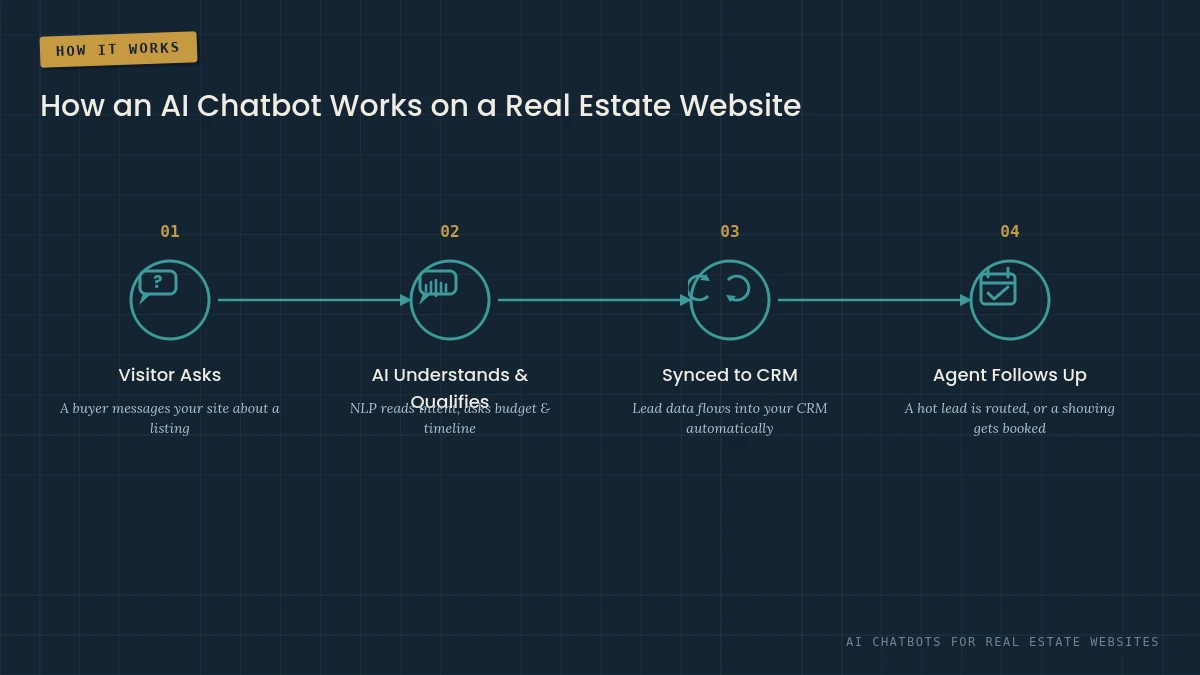
An AI chatbot for a real estate website is a software program that talks with your visitors in real time — answering questions about listings, capturing contact details, and often booking a showing — without a human typing the replies.
The “AI” part matters. Older real estate bots relied on decision trees: click a button, get a canned answer. Modern ones use natural language processing (NLP) and large language models (LLMs) to understand free-form questions, the same way a person would text you “is the house on Maple still available?” instead of picking from a menu.
Most tools built for the industry also connect to your MLS or IDX feed, so the bot can pull live pricing, square footage, and availability instead of giving outdated answers.
How an AI Chatbot Differs From a Basic Live Chat Widget
A plain live chat widget just routes a message to a human. Someone has to be online to respond, or the visitor waits.
An AI chatbot for real estate:
- Responds instantly, 24 hours a day, with no one at the keyboard
- Asks qualifying questions (budget, timeline, financing status) on its own
- Logs answers into your CRM automatically
- Hands off to a human agent only when the conversation needs one
Think of live chat as a phone line and an AI chatbot as a trained assistant who never sleeps and never forgets to ask the right follow-up question.
Why Real Estate Websites Need an AI Chatbot in 2026
Buyers and sellers don’t wait for business hours anymore. A visitor browsing listings at 11 p.m. wants an answer at 11 p.m., not a callback the next morning.
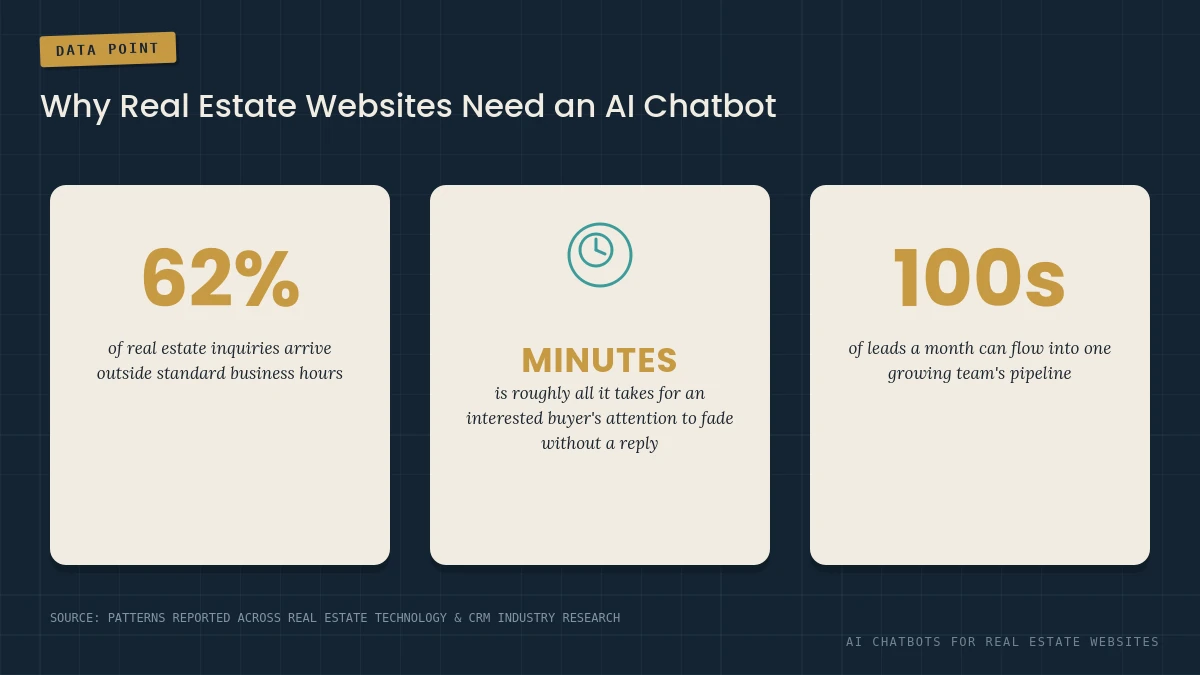
A few numbers explain why this matters:
- A large share of real estate inquiries — many studies put it above 60% — happen outside standard business hours.
- Lead conversion odds drop sharply within the first few minutes of an inquiry going unanswered.
- Agents on multi-agent teams can receive hundreds of leads a month, far more than any one person can respond to instantly.
A chatbot for a real estate website closes that gap. It doesn’t replace an agent — it buys time by capturing interest before it disappears, then hands over a warm, pre-qualified lead instead of a cold form submission.
Beyond speed, chatbots also:
- Cut down repetitive questions agents answer dozens of times a week (price, availability, square footage, pet policy)
- Free up agents for showings, negotiations, and closings
- Give you organized lead data instead of a messy inbox
Must-Have Features to Look for in a Real Estate AI Chatbot
Not every chatbot on the market was built for real estate. Some are generic customer support tools with a real estate template slapped on top. Here’s what separates a genuinely useful one from a gimmick.
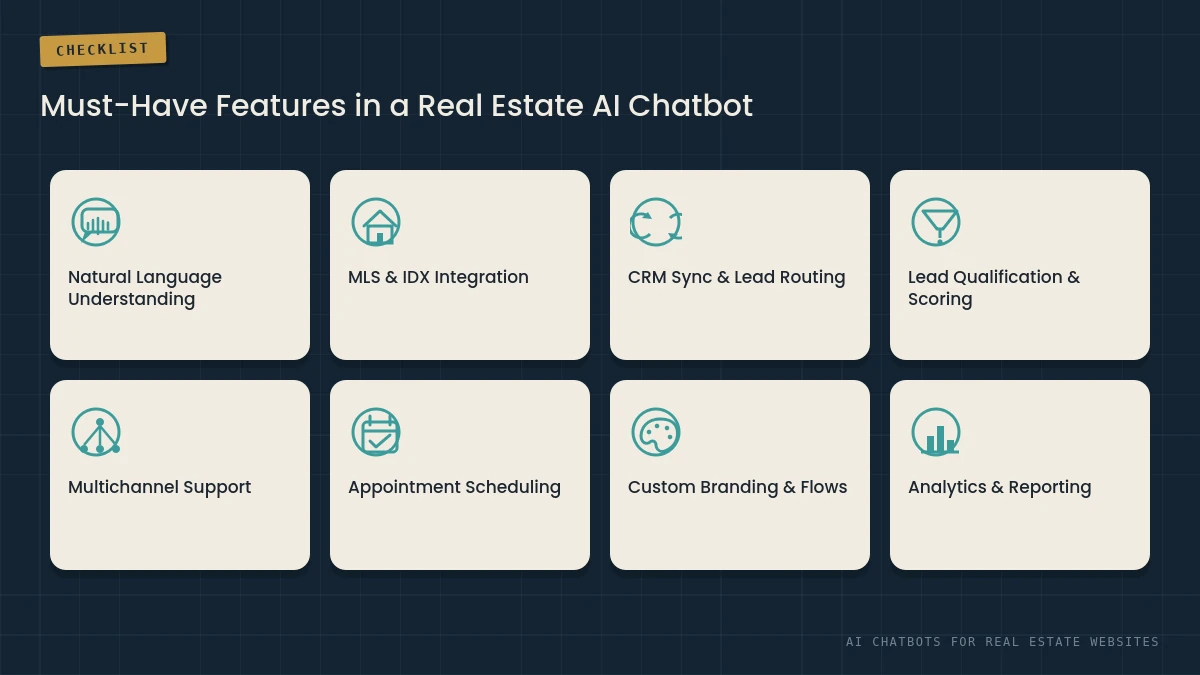
Natural Language Understanding
The chatbot should handle a real question like “show me 3-bedroom homes under $500k near downtown” — not just recognize exact keywords. If a bot only works with pre-set buttons, visitors will get frustrated fast and bounce.
MLS and IDX Integration
A chatbot that can’t see your live listings is guessing. Look for direct MLS or IDX sync so answers about price, status, and availability stay accurate without manual updates.
CRM Sync and Lead Routing
Captured leads should flow straight into your CRM — Follow Up Boss, kvCORE/BoldTrail, HubSpot, Salesforce, or whatever you already use — tagged with the details the bot collected. A chatbot that creates a separate spreadsheet you have to check manually defeats the purpose.
Lead Qualification and Scoring
The best bots ask about:
- Buying or renting, or selling
- Budget range
- Timeline to move
- Pre-approval or financing status
- Preferred neighborhoods or property type
That information lets agents prioritize hot leads instead of cold-calling everyone equally.
Multichannel Support
Your buyers aren’t only on your website. Strong chatbots also work across Facebook Messenger, Instagram DMs, SMS, and WhatsApp, so leads get the same fast response no matter where they reach out.
Appointment Scheduling
A chatbot that can book a showing or a call directly into your calendar — with automatic confirmations — removes an entire back-and-forth email thread.
Branding and Custom Conversation Flows
The bot should sound like your brokerage, not a generic support script. Look for control over greeting text, tone, colors, and the specific questions it asks.
Analytics and Reporting
You want visibility into which pages trigger the most chats, where visitors drop off, and how many chats convert to booked appointments — data you can use to improve your site and your follow-up process.
10 Best AI Chatbots for Real Estate Websites in 2026
Here’s how the leading options compare, based on what they’re actually built to do.
1. Structurely (Aisa Holmes) — Best for AI-Powered Lead Qualification
Structurely’s AI persona, “Aisa Holmes,” works as an AI inside sales agent (ISA). It reaches out to new leads by text, call, or email, asks qualifying questions about timeline and budget, and keeps nurturing unresponsive leads for months.
Best for: Teams and brokerages that get more leads than they can personally follow up with.
Key features:
- Two-way SMS, AI voice agent , and email follow-up
- Real-time live transfer of hot leads to a human agent
- Integrates with Follow Up Boss, Salesforce, HubSpot, BoomTown, and CINC
- Pre-built and customizable conversation scripts
Pricing: Plans generally start in the $150–$300/month range for lower contact volumes, scaling up to $1,000+/month for larger lead volumes. Custom quotes are available for bigger teams.
2. Ylopo AI (formerly rAIya) — Best for Lead Nurture at Scale
Ylopo is a full marketing platform — IDX websites, Facebook and Google ad management, and an AI text/voice assistant that nurtures leads generated through those ads. It’s less a website chatbot and more an end-to-end lead engine, with the AI assistant as one piece of it.
Best for: Teams already running paid lead generation who need automated follow-up to keep up with volume.
Key features:
- AI voice agent that calls new leads within seconds of an inquiry
- AI text nurture that can follow up with leads for well over a year
- Dynamic, MLS-based Facebook and Instagram ad creation
- Works alongside most major real estate CRMs
Pricing: Base platform typically starts around $300–$500/month, with total cost (including ad spend and add-ons) often landing between $900 and $2,000+/month.
3. Roof.ai — Best for MLS-Connected Agent Routing
Roof.ai connects directly to your agent roster and MLS feed, matching website visitors with relevant listings and routing leads to the right agent based on location, specialty, or availability.
Best for: Brokerages with multiple agents who need leads distributed automatically and fairly.
Key features:
- Website, Facebook Messenger, and SMS chat
- Automatic lead routing by geography or specialty
- Built-in workflows for mortgage, relocation, and recruiting use cases
Pricing: Custom quote based on team size and feature needs.
4. Realty AI (Madison) — Best for Live MLS Data in Chat
Realty AI’s chatbot, Madison, is built specifically to answer property questions using live MLS and market data, then move the conversation toward a booked appointment.
Best for: Agents who want visitors to get accurate, real-time answers about specific listings without human intervention.
Key features:
- Live MLS and market data connectivity
- End-to-end flow from chat to CRM entry to calendar booking
- Neighborhood and school district information on request
Pricing: Entry-level plans are commonly priced around $100/month.
5. Tidio — Best Budget-Friendly Option for Small Teams
Tidio isn’t real estate-specific, but its combination of live chat and an AI chatbot builder makes it a solid, affordable entry point for solo agents or small teams that don’t need heavy CRM automation yet.
Best for: Solo agents and small brokerages wanting an easy setup without a big monthly commitment.
Key features:
- Drag-and-drop chatbot builder with real estate-adaptable templates
- Live chat handoff when a human needs to step in
- Works on websites and integrates with common e-commerce and CRM tools
Pricing: Free plan available; paid plans typically start in the $30–$50/month range.
6. ChatBot.com — Best No-Code Builder
ChatBot.com gives agents a visual, no-code way to build a chatbot with a built-in knowledge base — useful for surfacing listing photos, prices, and availability directly inside the chat window.
Best for: Agents who want full control over conversation design without hiring a developer.
Key features:
- Visual flow builder with real estate templates
- Can display listing photos, videos, and virtual tours inside the chat
- Multilingual support
- Deploys to website, Messenger, Slack, and LiveChat
Pricing: Plans generally start around $50/month, scaling to several hundred dollars a month for larger teams.
7. ManyChat — Best for Facebook and Instagram Lead Capture
ManyChat specializes in social media automation rather than website chat. For agents generating leads through Instagram and Facebook content, it automates replies to comments and DMs and guides prospects toward booking a showing.
Best for: Agents whose leads come primarily from social media, not organic website traffic.
Key features:
- Automated Facebook Messenger and Instagram DM flows
- Comment-to-DM automation for social posts
- Broadcast messaging for new listings
Pricing: Free tier available; paid plans start around $15–$30/month depending on contact volume.
8. ProProfs Chat — Best All-in-One Live Chat + Chatbot + Help Desk
ProProfs Chat combines live chat, an AI chatbot trained on your own website content, and a help desk — useful for teams that also want a self-service knowledge base for common buyer and renter questions.
Best for: Teams that want chat, ticketing, and FAQs handled in one platform.
Key features:
- AI chatbot trained on your site and help center content
- Pre-chat forms to qualify buyers before a conversation starts
- Automated tour bookings with email confirmations
- Chat routing and canned responses for human agents
Pricing: Free plan for small teams; paid plans typically start around $20–$50/month per operator.
9. WotNot — Best for WhatsApp-First Markets
WotNot leans into WhatsApp automation alongside website chat, which makes it a strong fit for markets where buyers and renters prefer messaging over email or phone calls.
Best for: Agencies operating in regions where WhatsApp is the primary communication channel.
Key features:
- No-code chatbot builder with WhatsApp flows
- Lead capture pushed directly to your team
- Broad integrations with project management and CRM tools via API
Pricing: Free plan available (limited chats); paid plans start around $49/month.
10. Crescendo.ai — Best for Omnichannel AI With Human Backup
Crescendo.ai combines an AI chat, voice, email, and SMS agent with human support staff who step in when a conversation needs escalation — useful for brokerages that want AI-first responses but not a fully unattended system.
Best for: Brokerages that want AI speed with a human safety net for complex or sensitive conversations.
Key features:
- AI voice agent that can answer questions on mortgages, HOA fees, and lease terms
- Sentiment analysis to flag urgent or frustrated visitors
- Human backup team for escalations when AI reaches its limit
Pricing: Custom quote based on volume and channels used.
Quick Comparison Table
| Chatbot | Best For | Starting Price | Core Channels |
|---|---|---|---|
| Structurely | AI lead qualification & nurture | ~$150–300/mo | SMS, call, email |
| Ylopo AI | Lead nurture at scale + ad-driven leads | ~$300–500/mo | Text, voice |
| Roof.ai | MLS-based agent routing | Custom quote | Website, Messenger, SMS |
| Realty AI (Madison) | Live MLS data in chat | ~$100/mo | Website chat |
| Tidio | Budget-friendly small teams | Free–$50/mo | Website chat |
| ChatBot.com | No-code builder | ~$50/mo | Website, Messenger, Slack |
| ManyChat | Facebook/Instagram leads | Free–$30/mo | Messenger, Instagram |
| ProProfs Chat | All-in-one chat + help desk | Free–$50/mo | Website chat |
| WotNot | WhatsApp-first markets | Free–$49/mo | WhatsApp, website |
| Crescendo.ai | Omnichannel AI + human backup | Custom quote | Chat, voice, email, SMS |
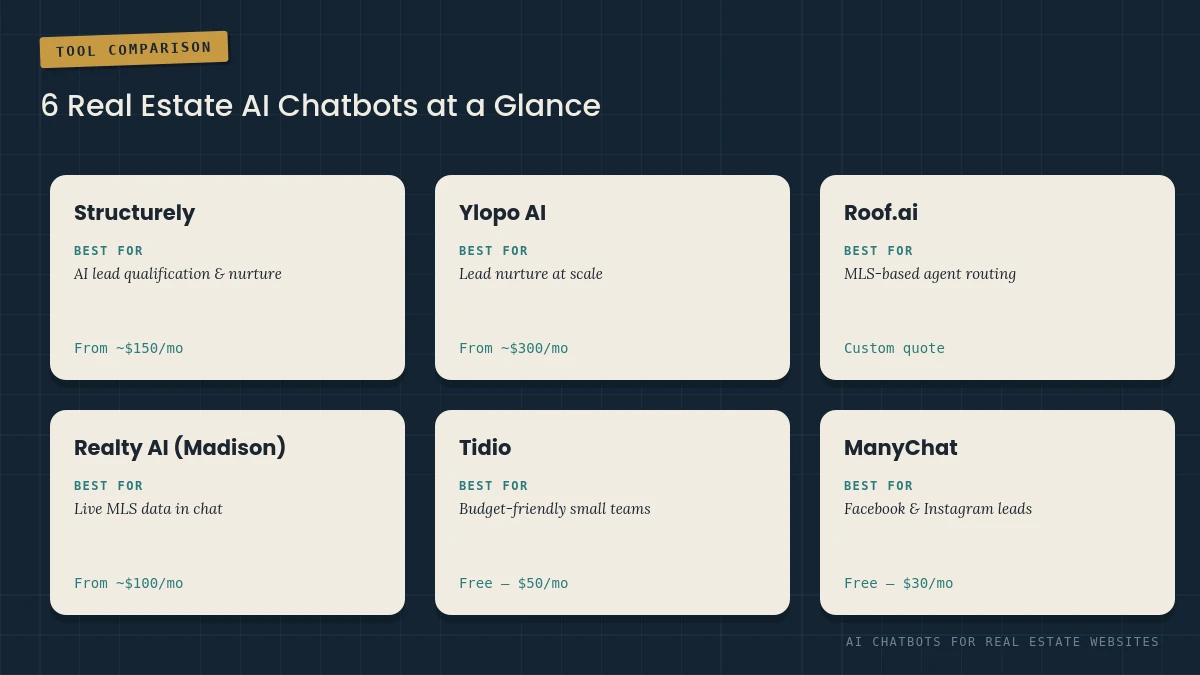
Pricing changes often, so treat these as starting-point estimates and confirm current numbers directly with each vendor before you commit.
How to Choose the Right AI Chatbot for Your Real Estate Website
Match the Tool to Your Lead Volume
A solo agent getting a handful of website inquiries a week doesn’t need a $500/month lead-nurture engine. A team pulling in hundreds of leads a month from paid ads absolutely does. Pick a tool sized for your actual volume, not your future volume.
Set a Realistic Budget
Real estate chatbot pricing in 2026 ranges from free to well over $1,000 a month. Costs usually scale on three factors:
- Number of conversations or leads per month
- Number of channels you want covered (website, SMS, WhatsApp, social)
- Whether it uses full AI/LLM responses or scripted flows
Check Integration Compatibility First
Before you fall in love with a feature list, confirm the chatbot connects to your CRM and your MLS/IDX provider. A chatbot that creates a separate data silo is a tool your team will stop using within a month.
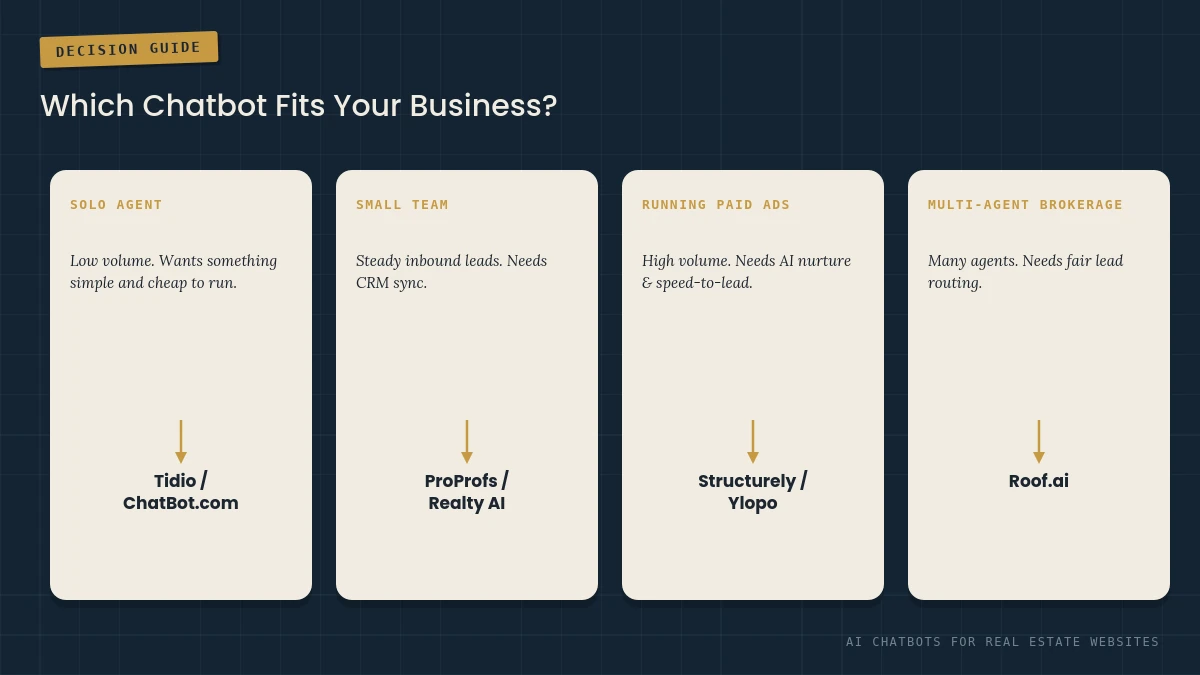
Consider Who’s on Your Team
- Solo agent: prioritize simplicity and low cost — Tidio or ChatBot.com
- Small team with steady inbound leads: prioritize CRM sync and qualification — ProProfs Chat or Realty AI
- Team running paid ads at volume: prioritize AI nurture and speed-to-lead — Structurely or Ylopo
- Brokerage with many agents: prioritize routing and fairness — Roof.ai
AI Chatbot vs. Live Chat vs. Virtual Assistant: What’s the Difference?
These terms get used loosely, so here’s the practical distinction:
- Live chat connects a visitor to a human in real time. No AI involved — if no one’s online, the visitor waits or leaves a message.
- AI chatbot uses NLP to hold a conversation without a human typing, qualifying leads and answering questions automatically, often 24/7.
- Virtual assistant (or AI ISA) goes a step further than a chatbot — it proactively follows up over days or months across text, call, and email, behaving more like an inside sales rep than a reactive chat window.
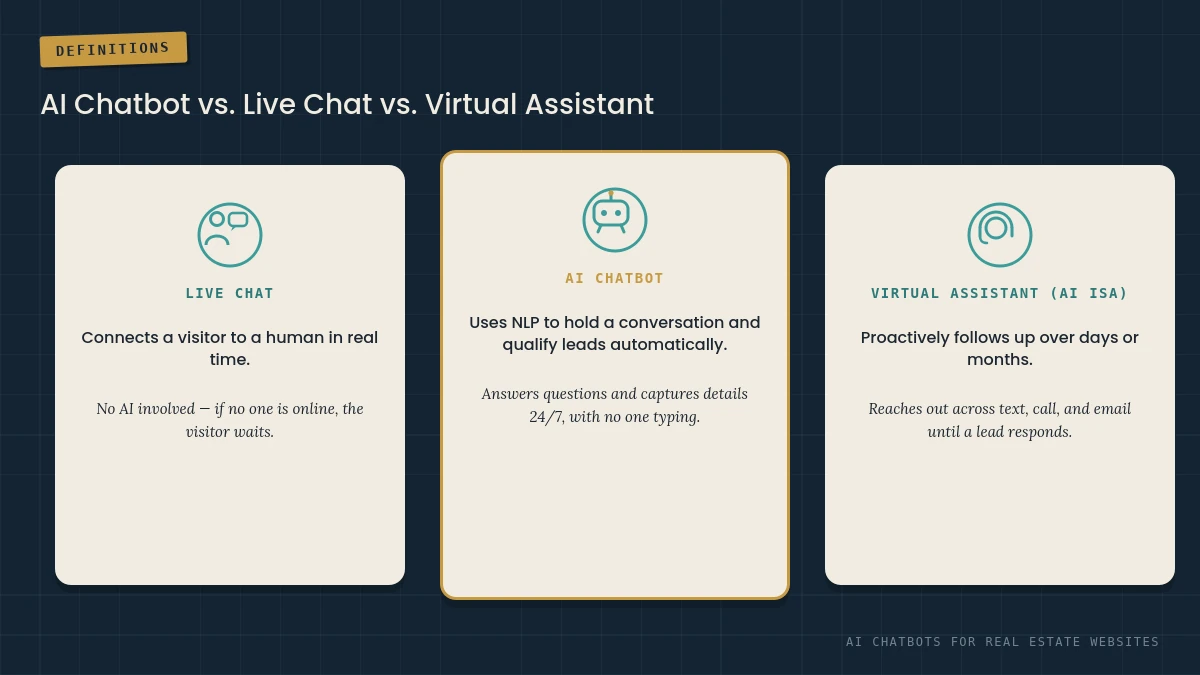
Many real estate tools blend all three: an AI chatbot handles the first response, then hands off to live chat or a human ISA when the conversation gets complex or the lead is ready to talk seriously.
How to Add an AI Chatbot to Your Real Estate Website (Basic Steps)
- Pick a tool that fits your budget, lead volume, and integrations (see the comparison above).
- Connect your CRM and MLS/IDX feed so answers and lead data stay accurate.
- Write your conversation flow, or use the provider’s real estate template as a starting point.
- Set your qualifying questions — budget, timeline, buying vs. selling, financing status.
- Install the chat widget on your site, usually a short embed code your provider gives you.
- Test it yourself with real questions a buyer or seller would ask before it goes live.
- Review conversation logs weekly and adjust the script based on where visitors get confused or drop off.
Common Mistakes to Avoid
- Choosing based on price alone. A cheap chatbot that doesn’t sync with your CRM often costs more in lost leads than a pricier, integrated one.
- Letting the bot go unmonitored. Even the best AI chatbot needs occasional review — check transcripts to catch wrong answers or awkward phrasing.
- Skipping the human handoff. Serious buyers still want to talk to a person eventually. Make sure the bot knows when to step aside.
- Using generic scripts. A chatbot that sounds like a call center, not your brokerage, hurts trust more than it helps.
- Ignoring after-hours performance. Test how the bot handles questions at 2 a.m., not just during a demo call with the sales rep.
Frequently Asked Questions
What is the best AI chatbot for a real estate website?
There’s no universal winner — it depends on your needs. Structurely and Ylopo AI lead in automated lead qualification and nurture, Roof.ai and Realty AI are strong for MLS-connected chat, and Tidio or ChatBot.com work well for agents who want something simple and affordable.
How much does an AI chatbot for a real estate website cost?
Pricing ranges from free (limited features) to $1,500+ a month for full lead-nurture platforms. Most small teams land somewhere between $50 and $300 a month, depending on lead volume and channels.
Can an AI chatbot replace a real estate agent?
No. A chatbot handles first response, answers routine questions, and qualifies leads, but it can’t negotiate a contract, tour a home with a client, or provide the judgment a licensed agent brings to a transaction. It’s a tool that supports agents, not a replacement for one.
Do AI chatbots work with MLS and IDX data?
The real estate-specific ones do. Tools like Roof.ai and Realty AI pull directly from MLS feeds so listing details stay current. Generic chatbots (not built for real estate) usually need manual updates or a separate integration to access that data.
Is a chatbot worth it for a solo agent?
Often yes, especially an affordable one like Tidio or ChatBot.com. Even without a large lead volume, a chatbot catches after-hours inquiries a solo agent would otherwise miss entirely.
What’s the difference between a real estate chatbot and a virtual assistant?
A chatbot typically reacts to a visitor’s message in the moment. A virtual assistant (or AI ISA, like Structurely’s Aisa Holmes) proactively follows up over days or months across text, call, and email until a lead responds or disqualifies itself.
Do these chatbots work on mobile and social media, not just websites?
Most modern tools support multiple channels — website chat, Facebook Messenger, Instagram DMs, SMS, and sometimes WhatsApp — so leads get consistent responses no matter where they reach out.
Final Thoughts
The right AI chatbot for a real estate website comes down to matching the tool to your actual problem. If leads are going cold from slow follow-up, get something built for qualification and nurture, like Structurely or Ylopo. If you just need to stop losing after-hours inquiries without a big budget, Tidio or ChatBot.com will do the job.
A chatbot is also just one piece of a bigger AI toolkit real estate professionals are building out — alongside AI-powered CRMs, description-writing tools, home valuation tools, and virtual staging software. Getting the chatbot right first makes sense, since it’s usually the first AI touchpoint a buyer or seller has with your brand. Start with a free trial, test it with real visitor questions, and expand from there once you see which conversations actually turn into booked appointments.