
Table of Contents
Quick Answer
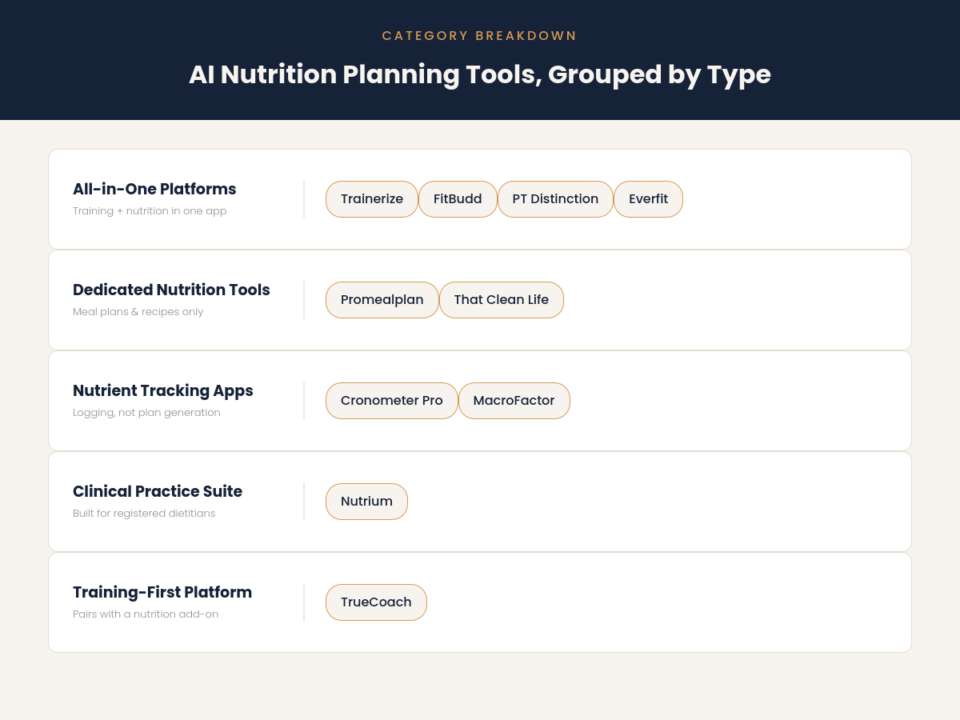
The best AI nutrition planning tools for fitness coaches in 2026 fall into two camps. All-in-one platforms like Trainerize, FitBudd, and PT Distinction combine workout programming with AI-assisted meal planning, so you run your whole coaching business from one app. Dedicated nutrition tools like Promealplan and That Clean Life focus purely on generating macro-targeted, white-label meal plans with deeper recipe libraries.
For most personal trainers, the right setup depends on how central nutrition is to your offer. If you sell workouts with light meal guidance attached, an all-in-one platform is enough. If nutrition coaching is your main product, pair a training app with a dedicated meal-planning tool for better recipe variety and branding control. Below, we break down ten tools, what each one actually does well, what it costs, and how to pick between them without paying for features you’ll never use.
Why Fitness Coaches Are Turning to AI Nutrition Planning Software
Nutrition has always been the part of coaching that eats up the most unpaid hours. Building an individualized meal plan, recalculating macros when a client’s weight stalls, and reviewing food logs every week is repetitive work that doesn’t scale past a handful of clients if you’re doing it by hand in a spreadsheet.
AI nutrition planning tools take over the mechanical parts of that process: calculating calorie and macro targets from a client’s stats and goals, generating a meal structure that hits those numbers, logging food through photo recognition or a searchable database, and flagging when a client’s adherence is slipping. That frees up a coach’s time for the parts that actually need a human, like adjusting a plan around a client’s schedule, food preferences, or a plateau that a formula alone won’t explain.
This isn’t about replacing coaching judgment. It’s about removing the busywork so a trainer can manage more clients without dropping the quality of their nutrition guidance. Whether you call it AI-powered nutrition coaching or just nutrition coaching software for personal trainers, the underlying value is the same: less time spent on repetitive math, more time spent on the client in front of you.
What to Look for in AI Nutrition Planning Tools for Fitness Coaches
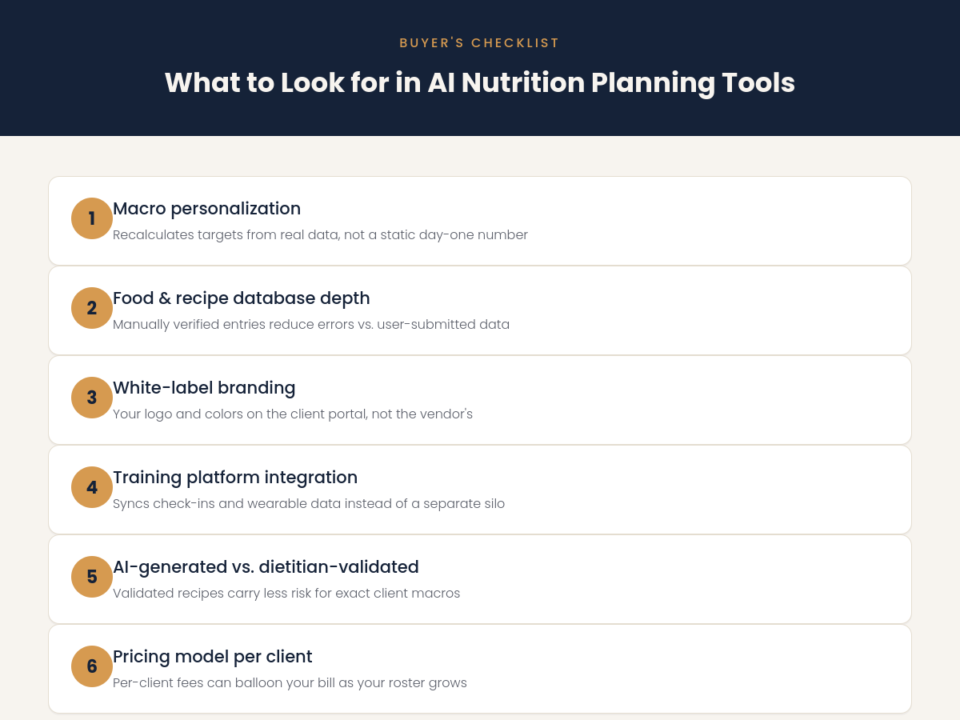
Not every “AI-powered” nutrition app is built the same way. Before you commit to a platform, run it against these criteria.
Macro personalization, not just calorie counting
A basic calculator can spit out a TDEE (total daily energy expenditure) number once. A genuinely useful tool recalculates targets as a client’s weight trend, activity, and adherence data come in, rather than locking in a static number on day one and never revisiting it.
Food and recipe database depth
Look at how large and how accurate the underlying food database is. Some platforms rely on manually verified entries (which takes longer to build but reduces errors), while others pull from user-submitted data, which is faster to grow but noisier. If your clients have allergies or specific dietary protocols, check how granular the filtering actually is before you assume it covers what you need.
White-label branding
If clients are paying you for a premium coaching experience, a meal plan PDF or app screen with someone else’s logo undercuts that. Confirm whether white-label branding (your logo, your colors, your business name in the client portal) is included on your plan or gated behind a higher tier.
Integration with your training platform
If you already run programming through a platform like Trainerize or TrueCoach, check whether the nutrition tool syncs data (like check-ins, progress photos, or wearable data) or whether it’s a completely separate silo your clients have to log into twice.
AI-generated versus dietitian-validated content
There’s a meaningful difference between a large language model generating a recipe on the fly and a recipe that a registered dietitian built and verified for macros. AI-generated recipes are flexible and fast, but they can miscalculate portions or miss an allergen in an edge case. For client work where exact macros matter, dietitian-validated libraries carry less risk.
Pricing model per client
Some platforms charge a flat rate regardless of roster size. Others charge per client, which can quietly balloon your software bill as your business grows. Do the math on what your actual roster size will cost, not just the advertised starting price.
The Best AI Nutrition Planning Tools for Fitness Coaches (2026 Reviews)
1. Trainerize (ABC Trainerize)
Trainerize is one of the most widely used personal trainer platforms, and it is one of the best AI Nutrition Planning Tools for Fitness Coaches, also it’s a solid entry point if you want workouts and nutrition under one roof. Basic nutrition tracking (food logging, macro targets, MyFitnessPal sync) comes included on paid plans. The AI-driven Smart Meal Planner, which generates 7-day plans from a recipe library and builds shopping lists automatically, sits behind a separate add-on.
Key features
- AI Workout Builder included on paid plans
- Smart Meal Planner add-on with 2,000+ recipes and automated grocery lists
- Native video coaching and in-app messaging
- Wearable integrations (Apple Health, Garmin)
Pricing
Plans start around $9 to $23/month for a small roster, scaling up with client count. The nutrition add-on runs roughly $20 to $45/month depending on tier, and payments processing, video coaching, and a custom branded app are separate add-ons too.
Pros
- Mature platform trusted by a large number of coaches worldwide
- Strong workout-building tools alongside nutrition
- Wide range of integrations
Cons
- Full meal planning capability sits behind a paid add-on rather than being included
- Costs stack up quickly once you add nutrition, payments, and branding
- Meal plans lean template-based rather than fully custom to individual macro targets
Best for: Coaches who are training-first and want basic nutrition support bundled in, without needing deep meal-plan customization.
2. FitBudd
FitBudd positions itself as an all-in-one app for solo coaches and boutique studios, with nutrition, workouts, messaging, and a branded website bundled into one subscription rather than sold as separate add-ons.
Key features
- Native nutrition coaching with a large food database, barcode scanner, and macro tracking
- AI assistant for programming and client management
- Branded iOS and Android app with your logo
- Zero-commission payment processing
Pricing
Plans generally run from around $15/month at the entry level up to roughly $79 to $149/month depending on client volume, with nutrition, AI tools, and branding included rather than gated behind add-ons.
Pros
- Nutrition, branding, and payments bundled into one price
- Competitive cost per client compared to add-on-heavy platforms
- Includes a branded website, not just an app listing
Cons
- Meal plan template variety is more limited than dedicated nutrition platforms
- Some users report a learning curve during initial setup
- Macro tracking works better with gram-based targets than percentage-based ones for some users
Best for: Solo trainers and boutique coaches who want nutrition and branding included without stacking multiple subscriptions.
3. PT Distinction
PT Distinction is a training-first platform with a genuinely useful, if lighter, nutrition layer. Every plan, even the entry tier, includes the same feature set: an AI program builder, an AI meal planner, and example nutrition plans you can adapt.
Key features
- AI meal planner and program builder included on every tier (no upsells)
- Custom-branded app on Pro and Master tiers
- Deep workout-building tools (supersets, intervals, circuit logic)
- Food and macro tracking runs largely through a MyFitnessPal integration
Pricing
Three USD tiers: roughly $19.90/month for a small roster, $59.90/month for a mid-size roster, and $89.90/month for a larger one, each with a per-client overage rate beyond the cap.
Pros
- Transparent, flat pricing with no feature upsells
- Strong workout programming tools
- Good value for coaches who want AI tools without a lot of extra add-ons
Cons
- No large native food and recipe database; relies on integrations for day-to-day logging
- Custom-branded app isn’t available on the cheapest tier
- Coaches who sell meal plans as a core deliverable will likely outgrow the nutrition module
Best for: Coaches who are primarily training-focused but want a competent AI meal planner included without paying extra for it.
4. Promealplan
Promealplan is a dedicated meal-planning tool, not an all-in-one coaching platform. It has no workout builder, no payments, and no messaging. Its entire job is generating macro-targeted, white-label meal plans quickly and handing them off to clients as branded PDFs.
Key features
- Generates full weekly meal plans from calorie and macro targets in minutes
- Recipe library validated by registered dietitians rather than AI-generated
- White-label PDFs, branded client portal, and grocery lists on every paid tier
- Available in multiple languages (English, French, Spanish)
Pricing
A free plan covers a handful of meal plans to try it out; paid plans start around $49/month.
Pros
- Precise macro targeting per client rather than generic templates
- Full white-label branding included at every price point, not gated to higher tiers
- Faster to produce a polished, professional-looking meal plan than building one manually
Cons
- Doesn’t replace a training platform, so you’ll be running two tools
- Smaller recipe library than some clinical-focused competitors
- No client check-in or program-management features
Best for: Coaches who sell nutrition coaching as a distinct, branded service and want a fast, professional meal-plan generator to pair with whatever training software they already use.
5. That Clean Life
That Clean Life grew out of a dietitian-run recipe blog, and that background still shows in the product. It’s strongest for coaches and practitioners who want a large, polished recipe library with condition-specific templates rather than a pure AI meal-generation engine.
Key features
- A large recipe library (several thousand professionally developed recipes)
- Condition-specific templates (low-FODMAP, anti-inflammatory, and similar protocols)
- Automated meal-plan generation on higher tiers, pulling from the recipe library based on calorie and macro targets
- Automatic grocery list generation, with some delivery-service integrations
Pricing
Entry plans start around $30 to $35/month, with automated generation and full branding typically requiring the higher Plus tier, around $60/month.
Pros
- Recipe variety and food photography are genuinely strong
- Good fit for coaches working with clients who have specific dietary protocols
- Established platform with a long track record
Cons
- Automation and white-label branding are gated behind the higher tier
- No native mobile app for clients
- Doesn’t calibrate meal plans to exact per-client macros as tightly as a macro-first tool
Best for: Coaches and practitioners who prioritize recipe variety and want to support clients following a specific dietary protocol.
6. Cronometer Pro
Cronometer isn’t a meal-plan generator. It’s a food-logging and nutrient-tracking tool, and the Pro tier lets coaches view and manage client accounts. It earns its spot on this list because of how much micronutrient detail it captures, which matters for coaches working with clients who have specific deficiencies or who compete in physique sports.
Key features
- Tracks upward of 80 nutrients per food, including vitamins, minerals, and amino acids
- A manually verified food database (rather than fully user-submitted)
- Client portal for coaches to review food logs and set targets
- Barcode scanning and recipe import
Pricing
The Pro tier for practitioners runs around $35/month, separate from the consumer Gold subscription.
Pros
- Best-in-class micronutrient tracking depth
- High database accuracy compared to crowd-sourced alternatives
- Clients often keep using it even after they stop working with a coach, which helps long-term habit building
Cons
- Doesn’t generate meal plans or branded deliverables
- Reactive by design: it tracks what a client already ate rather than prescribing a plan
- Coaches who want a proactive meal-planning tool will need to pair it with something else
Best for: Coaches who need precise micronutrient visibility, particularly for physique athletes or clients managing a specific nutrient deficiency.
7. Nutrium
Nutrium is built primarily for registered dietitians and nutritionists rather than personal trainers, but it’s worth knowing about if you work alongside a dietitian or you hold a nutrition credential yourself. It’s less a meal-plan generator and more a full clinical practice management suite.
Key features
- Client scheduling, telehealth video calls, and invoicing built in
- Dietary assessments with micronutrient breakdowns
- Client-facing mobile app for logging meals and messaging
- Multilingual support across several languages
Pricing
Roughly $25/month annually for an unlimited client roster, which is competitive for a full practice-management suite.
Pros
- Genuinely comprehensive for running a clinical nutrition practice, not just meal planning
- Simple, predictable pricing regardless of client count
- Strong international adoption and multilingual support
Cons
- No white-label branding; clients see Nutrium’s name, not yours
- Recipe database leans on community submissions rather than a large curated library
- Built for licensed nutrition professionals, so much of the assessment tooling goes unused by a general fitness coach
Best for: Registered dietitians and nutritionists who also work with fitness clients, or coaches who partner directly with an RD.
8. MacroFactor
MacroFactor is a client-facing app rather than a coach dashboard, but plenty of coaches recommend it to clients who want a more hands-on relationship with their own numbers. Its adaptive algorithm recalculates a client’s actual metabolic rate from logged intake and weight trend data, rather than relying on a static formula set once at sign-up.
Key features
- Weekly recalculated calorie and macro targets based on real weight-trend data
- Manual and barcode food logging with a sizeable database
- No ads, no gamification, built around straightforward data
- Coaching content grounded in published sports nutrition research
Pricing
Around $11.99/month or roughly $72 to $84/year, with no permanent free tier beyond a short trial.
Pros
- The adaptive expenditure algorithm is genuinely more sophisticated than a static calculator
- Clean, distraction-free interface
- Useful for clients focused specifically on body recomposition
Cons
- No coach dashboard or multi-client management, so it’s not a practice tool
- No free tier
- Tracks fewer micronutrients than Cronometer
Best for: Recommending to individual clients who want their macros to adjust automatically based on real progress, especially body-composition-focused clients.
9. TrueCoach Paired With a Nutrition Add-On
TrueCoach built its reputation on clean workout delivery and video form-check feedback, not nutrition. It includes only basic macro tracking, and it’s honest about that rather than pretending to be a full meal-planning tool. Most coaches who use TrueCoach pair it with a dedicated nutrition tool like Promealplan or That Clean Life for the meal-planning side.
Key features
- Side-by-side video review and frame-by-frame feedback for workout form
- Straightforward programming and exercise library
- Basic macro-tracking module
Pricing
Roughly $26 to $30/month for a Starter tier capped around 5 active clients, scaling up to the $135 to $165/month range for a roster of about 50, before adding a separate nutrition tool.
Pros
- Excellent for coaches whose main value proposition is form review and coaching feedback
- Simple, uncluttered client app
- Reliable and well established
Cons
- No real meal-planning functionality; you will need a second tool for that
- Not the right fit if nutrition is a core part of your offer
Best for: Coaches whose primary service is training and technique coaching, who plan to pair the platform with a dedicated nutrition app.
10. Everfit
Everfit is a workout-and-habit-first coaching platform with a free Starter tier, which makes it a common starting point for new coaches. Nutrition is present but clearly secondary: meal planning sits behind a paid add-on, and even then it lacks the AI meal generation, branded PDFs, and advanced macro targeting that dedicated nutrition tools offer.
Key features
- AI-assisted workout builder and a mature exercise library
- Meal Plans add-on with custom recipe storage and weekly plan building
- Habit tracking, in-app messaging, and community forums
- Custom branding available on paid tiers
Pricing
A free Starter plan covers up to 5 clients. Pro pricing scales with roster size, starting around $16/month annually and rising well beyond that at larger client counts. The Meal Plans add-on runs about $33 to $39/month, with automation and payments as separate add-ons on top.
Pros
- Genuinely useful free tier for coaches just starting out
- Strong workout builder and habit-tracking tools
- Modular pricing lets you pay only for the add-ons you use
Cons
- Nutrition module lacks AI meal generation and advanced macro targeting
- Costs climb quickly once meal plans, automation, and payments are all switched on
- No branded PDF output for meal plans
Best for: Coaches who want to start free and add nutrition later, without expecting the meal-planning side to be a core strength.
Quick Comparison Table
| Tool | Type | Starting Price | AI Meal Generation | Best For |
|---|---|---|---|---|
| Trainerize | All-in-one | ~$9-23/mo + add-ons | Template-based, add-on | Training-first coaches |
| FitBudd | All-in-one | ~$15-79/mo | Included | Solo coaches wanting bundled nutrition |
| PT Distinction | All-in-one | ~$19.90-89.90/mo | Included, all tiers | Flat-rate coaches, no upsells |
| Promealplan | Dedicated nutrition | Free tier; paid from ~$49/mo | Macro-targeted generation | Coaches selling branded meal plans |
| That Clean Life | Dedicated nutrition | ~$30-60/mo | Template-based automation | Recipe variety, dietary protocols |
| Cronometer Pro | Nutrient tracking | ~$35/mo | None (tracking only) | Micronutrient precision |
| Nutrium | Clinical practice management | ~$25/mo | No (recipe-based, not AI) | Registered dietitians |
| MacroFactor | Client-facing app | ~$11.99/mo | Adaptive macros, no meal plans | Individual client recommendation |
| TrueCoach | Training platform | ~$26-165/mo by roster | None | Pairing with a nutrition add-on |
| Everfit | All-in-one | Free (5 clients); Pro from ~$16/mo + add-ons | No (template-based add-on) | Starting free, adding nutrition later |
Pricing reflects publicly listed rates at the time of writing and changes over time, so confirm current numbers on each vendor’s site before you commit.
All-in-One Platform or Dedicated Nutrition Tool? How Coaches Should Decide
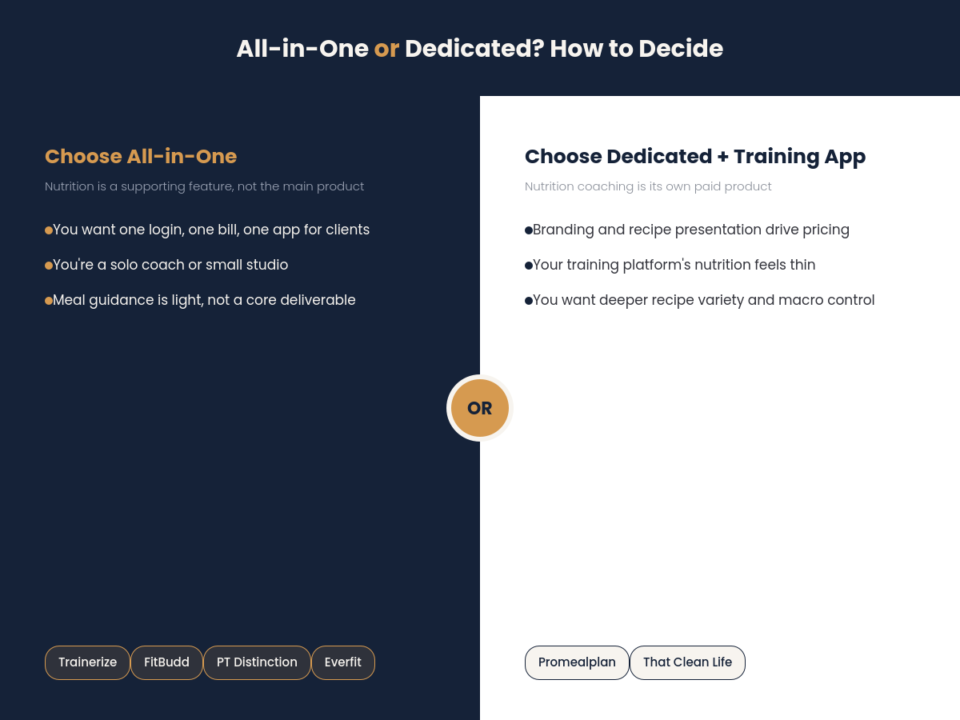
This is the real fork in the road, and it comes down to how nutrition fits into what you sell.
Choose an all-in-one platform (Trainerize, FitBudd, PT Distinction, Everfit) if:
- Nutrition is a supporting feature of your training program, not the main product
- You want one login, one bill, and one app for clients to check
- You’re a solo coach or small studio that doesn’t want to manage multiple subscriptions
Choose a dedicated nutrition tool (Promealplan, That Clean Life) paired with a training platform if:
- You sell nutrition coaching as its own product or package
- Branding and recipe presentation matter to your pricing and positioning
- Your training platform’s built-in nutrition features feel thin compared to what you actually deliver
Many established coaching businesses run exactly this hybrid setup: a training platform for programming, check-ins, and payments, and a dedicated nutrition tool layered on top purely for meal-plan generation and delivery. It’s a common enough pattern that most training platforms are built to be paired this way rather than to be the only tool a nutrition-focused coach ever uses.
What Fitness Coaches Can (and Can’t) Do With AI-Generated Nutrition Plans
This part gets skipped in most software round-ups, but it matters more than any feature comparison. Nutrition regulation varies by state and by country, and the rules genuinely affect what you can deliver, AI-assisted or not.
In the United States, states regulate the provision of nutrition information through licensure, statutory certification, or registration, and the details differ state by state. In states with a clearly defined scope of practice, what’s called medical nutrition therapy, meaning specific, individualized dietary prescriptions tied to a medical condition, is legally reserved for a registered dietitian, licensed nutritionist, or equivalent credential.
That doesn’t mean a certified personal trainer can’t talk about food at all. Generally, a trainer can:
- Share general nutrition education (macronutrients, calorie balance, healthy eating patterns)
- Point clients toward reputable sources like the USDA or the Academy of Nutrition and Dietetics
- Offer habit-based coaching around food choices and consistency
Where trainers typically need to be more careful, especially without an additional nutrition credential, is:
- Prescribing an individualized meal plan tied to a medical condition
- Giving medical nutrition therapy for conditions like diabetes, kidney disease, or eating disorders
- Making diagnostic claims about a client’s health status
An AI nutrition tool doesn’t change these boundaries. It’s a delivery mechanism, not a credential. If you’re using AI-generated meal plans with clients, it’s worth pairing your base CPT (NASM, ISSA, NSCA, or an equivalent) with a nutrition-specific credential, such as a Precision Nutrition certification or a similar fitness-nutrition course, and clear client agreements that state your plans are general guidance, not medical nutrition therapy, and that clients with a diagnosed condition should work with their physician or a registered dietitian. Several personal trainer insurance providers also offer a diet-and-nutrition coverage add-on specifically because base policies often don’t cover nutrition advice by default, so it’s worth checking your own policy.
None of this is legal advice, and the specifics vary by where you and your clients are located, so when in doubt, check your state’s dietetic licensing board or your country’s equivalent regulatory body before building nutrition coaching into your service menu.
How to Choose the Right AI Nutrition Planning Tool for Your Coaching Business
Run through these questions before you sign up for anything:
- How many clients are you coaching right now, and where do you expect to be in a year? Per-client pricing that looks cheap at 5 clients can get expensive fast at 50.
- Is nutrition a core paid service or a value-add? If clients are paying specifically for meal plans, prioritize a tool with strong branding and recipe depth. If it’s a bonus feature, a lighter built-in tool is probably enough.
- Do your clients have specific dietary needs? Allergies, medical conditions, or religious dietary practices call for a platform with granular filtering, not just calorie counting.
- Do you already use a training platform you like? If so, check whether it has a nutrition add-on worth using before adding a second subscription.
- How much do you personally want to customize meal plans by hand? Some coaches want a starting template they tweak; others want the AI to do nearly all of the initial work.
Most coaches land on one of two setups: an all-in-one platform for simplicity, or a training app plus a dedicated meal-planning tool for more control. Neither is objectively better. It depends on how you actually coach.
Common Mistakes Coaches Make With AI Nutrition Tools
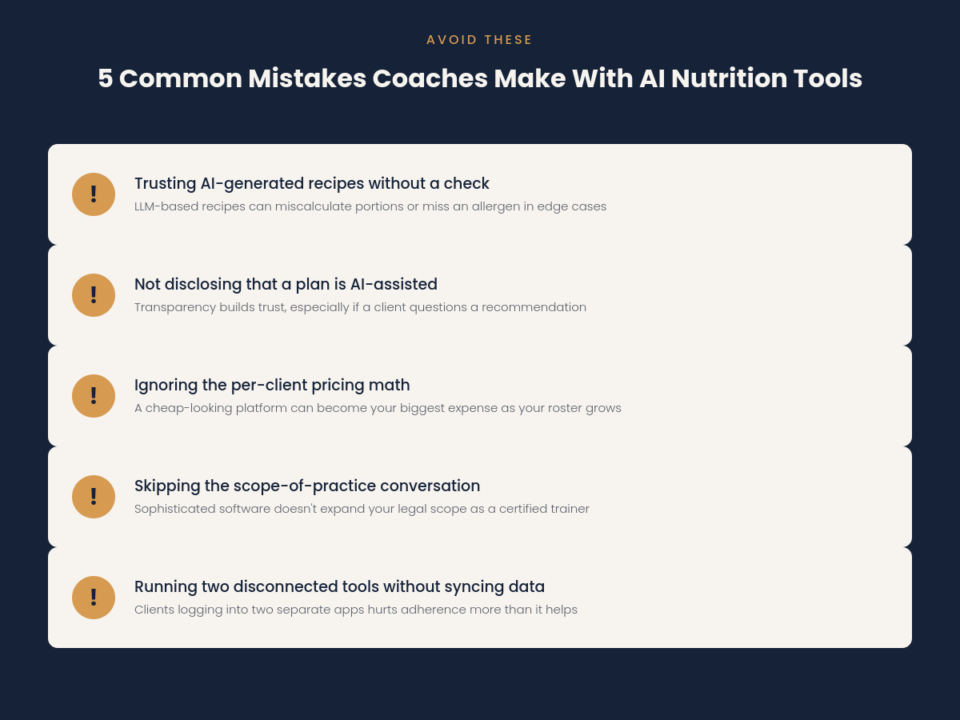
- Treating AI-generated recipes as verified without a check. Large language model-based recipe generation can miscalculate portions or miss an allergen in edge cases. If accurate macros are non-negotiable for a client, favor tools with dietitian-validated libraries, or double-check AI output yourself.
- Not disclosing that a plan is AI-assisted. Clients generally don’t mind, but transparency builds trust, and it matters if a client later has questions about where a recommendation came from.
- Ignoring the per-client pricing math. A platform that looks cheap at your current roster size can become your biggest software expense as you scale.
- Skipping the scope-of-practice conversation. Using a sophisticated tool doesn’t expand your legal scope of practice. Stay within what your certification and local regulations allow.
- Running two disconnected tools without syncing data. If your training platform and nutrition tool don’t talk to each other, clients end up logging into two apps and checking two dashboards, which hurts adherence more than it helps.
Frequently Asked Questions
Can AI nutrition planning tools replace a human coach?
No. AI nutrition tools handle the repetitive calculations (macros, calorie targets, meal structuring) well, but they can’t read a client’s context the way a coach can, like a stressful week that calls for a simpler plan, or a preference that a spreadsheet of macros won’t capture. Most coaches use these tools to speed up the mechanical parts of nutrition planning, not to replace the coaching relationship itself.
Are AI-generated meal plans accurate for macros?
It depends on the tool. Platforms that pull from a dietitian-validated recipe database (like Promealplan or That Clean Life) tend to have more reliable macro accuracy than tools where a language model generates a recipe from scratch on the fly, since freeform generation can misjudge ingredient quantities. For client work where precision matters, it’s worth checking whether a platform’s recipes are human-verified or purely AI-generated.
What’s the difference between a nutrition coaching platform and a calorie tracking app?
A coaching platform (like Promealplan, FitBudd, or Trainerize’s nutrition module) is built for a coach to create and deliver a plan to a client under their own brand. A calorie tracking app (like MyFitnessPal or the consumer side of Cronometer) is built for an individual to log their own food. Trackers are useful as a client-facing logging tool, but they don’t give a coach the ability to build and brand a meal plan the way dedicated coaching software does.
Do I need a nutrition license to use AI nutrition tools with clients?
You don’t need a license to use the software itself, but the advice you give while using it still falls under your local scope-of-practice rules. In many places, general nutrition education is fine for a certified trainer to provide, while individualized medical nutrition therapy is reserved for a registered dietitian or licensed nutritionist. Check your state or country’s regulations before building specific meal prescriptions into your service offering.
What’s the best free AI nutrition tool for coaches?
Most dedicated coaching platforms don’t offer a fully free tier once you need to manage real clients, though several (like Trainerize and Promealplan) offer a free plan capped at a small number of clients or meal plans, which is enough to test the platform before committing.
Can I white-label AI-generated meal plans under my own brand?
Yes, with the right tool. Platforms like Promealplan include white-label branding (your logo, colors, and business name) on every paid tier. Others, like Trainerize, gate white-label options behind higher-priced tiers or a separate branded-app fee. If branding matters to your business, confirm exactly which tier includes it before signing up.
Should I use one all-in-one app or separate tools for training and nutrition?
Either works. An all-in-one platform is simpler to manage and cheaper if nutrition is a secondary part of your offer. Pairing a training platform with a dedicated nutrition tool gives you more control over meal-plan quality and branding, which matters more if nutrition coaching is a primary paid service rather than an add-on.
Conclusion
There’s no single best AI Nutrition Planning Tools for Fitness Coaches. The right pick depends on how central nutrition is to your business, how many clients you’re managing, and whether branding and recipe depth matter as much to you as raw convenience.
If you’re training-first and want nutrition as a supporting feature, Trainerize, FitBudd, or PT Distinction will cover you without adding a second subscription. If nutrition coaching is your main product, pairing a training app with a dedicated generator like Promealplan or a recipe-rich platform like That Clean Life will get you closer to the polished, branded experience clients are paying for. And whatever you choose, remember that the software handles the calculations. The judgment calls, and staying inside your scope of practice, are still on you.
Start with your current roster size and your actual service offer, test one or two platforms with a free trial where available, and build from there instead of trying to find one tool that does everything perfectly on day one.
This article is part of our ongoing series on Best AI Tools for Personal Trainers & Fitness Coaches. For related reading, see our guides to Best AI Workout Plan Generator for Personal Trainers and AI check-in and client retention tools for personal trainers.