
Table of Contents
Quick Answer
The best AI tools for real estate lead generation in 2026 split into two different jobs, and most agents end up needing one from each category. Conversational AI tools — Perspective AI, Structurely, CINC’s Alex, and Roof AI — capture and qualify whoever lands on your website right now, replacing a static contact form with a real back-and-forth.
Predictive AI tools — SmartZip, Offrs, Fello, and Revaluate — mine public records or your own database to flag homeowners likely to sell before they’ve told anyone. Ylopo and CINC bundle both functions together with paid advertising built in, which suits teams with an ad budget.
Real Geeks and Structurely work well for solo agents on a tighter budget. None of these tools manufacture motivated buyers or sellers out of thin air — they either respond to existing interest faster than a human can, or surface people worth calling sooner than a human would notice.
What Makes a Lead Generation Tool “AI,” and How Is That Different From a Regular CRM?
A CRM stores contacts and reminds you to follow up. AI lead generation software does something a plain CRM can’t: it reads behavior and language, then acts on its own.
- A regular CRM logs that a lead visited three listings. An AI tool applies lead scoring to that same pattern, marks the lead as “hot,” and automatically texts them about a fourth matching property.
- A regular contact form collects a name, email, and phone number. A conversational AI tool holds an actual conversation — asking about timeline, financing, and motivation — the way a human intake call would.
- A regular database sits still until an agent searches it. A predictive AI tool scans that same database daily against public records and flags who’s newly likely to sell.
The distinction matters when you’re shopping: some products marketed as “AI-powered” are really just a CRM with a chatbot bolted on. Real estate lead generation AI worth paying for actually changes the outcome of the funnel, not just the label on the box.
Why Speed Matters More Than Volume in Real Estate Lead Generation
Most agents assume their lead problem is quantity. The data says otherwise — the real problem is almost always response time.
The 5-Minute Rule
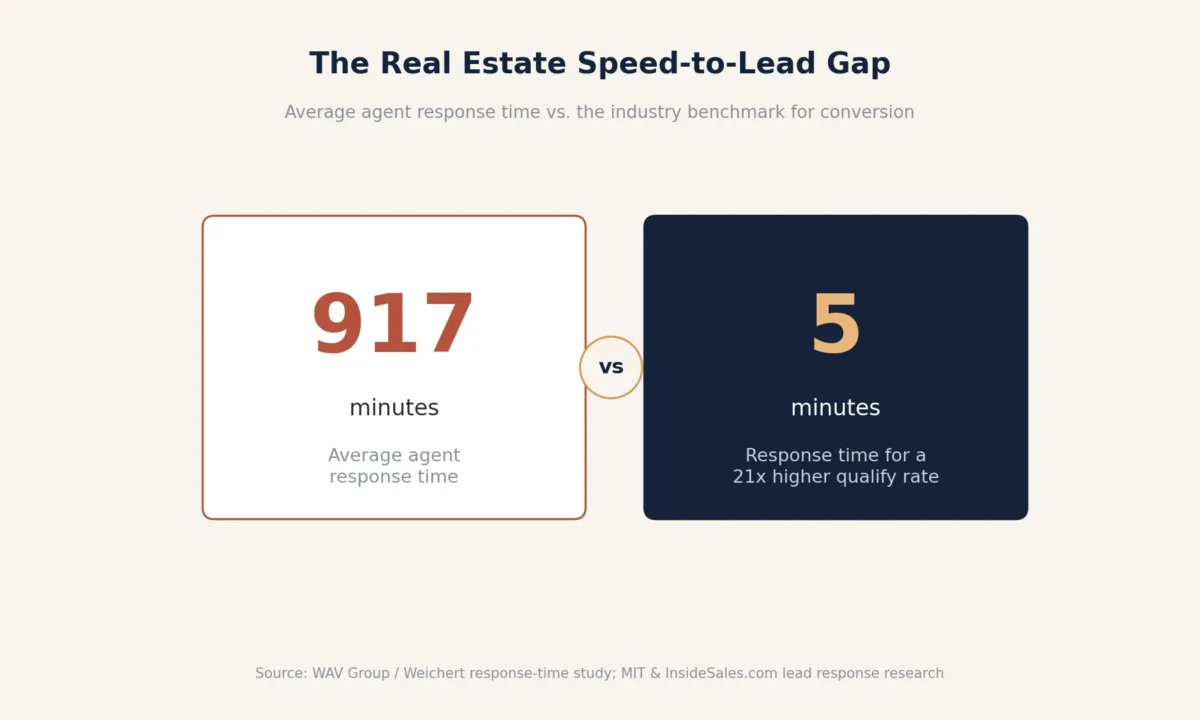
A widely cited study from MIT and InsideSales.com, which analyzed more than 1.25 million sales leads, found that agents who contact a new lead within 5 minutes are roughly 21 times more likely to qualify that lead than agents who wait 30 minutes. Real estate–specific research has repeatedly validated the same pattern.
- A 2014 study by WAV Group and Weichert, tracking 384 U.S. brokers, found the average response time to a buyer inquiry was 917 minutes — over 15 hours.
- The same study found 48% of buyer inquiries received no response at all.
- Separate industry research puts the figure even higher: roughly 78% of buyers end up working with whichever agent responds first.
- According to NAR and Zillow data, about 62% of real estate inquiries come in outside normal business hours — evenings, nights, and weekends.
Where Real Estate Leads Actually Get Lost
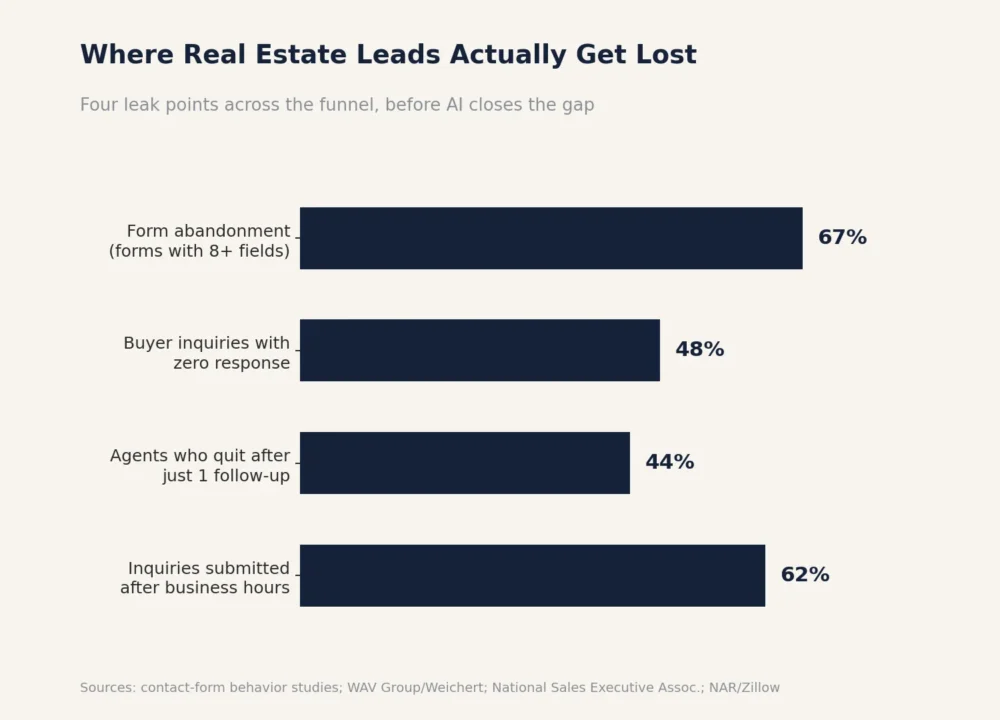
- Contact forms leak leads before they even reach the CRM. Studies on form behavior show abandonment rates climbing past 67% once a form has more than five fields — and most real estate intake forms run eight to twelve.
- Follow-up stops too early. Research from the National Sales Executive Association, echoed by Inman’s coverage of the industry, found that 80% of sales require five or more follow-up touches, yet 44% of agents give up after just one attempt.
- Persistence pays off disproportionately. Leads that receive six or more contact attempts convert at rates roughly 70% higher than leads that get fewer touches.
- Overall conversion stays low industry-wide. Internet lead conversion typically runs 0.4%–1.2%, though marketplace leads (Zillow, Realtor.com) convert higher — around 5% on average, and 7–9% for top-performing teams.
None of this means agents are bad at sales. It means the gap between “responded in 5 minutes” and “responded in 15 hours” is where most commission checks quietly disappear — and it’s exactly the gap AI lead generation tools are built to close.
The Two Types of AI Tools for Real Estate Lead Generation
Nearly every product in this space falls into one of two buckets. Knowing which one you actually need prevents buying the wrong tool.
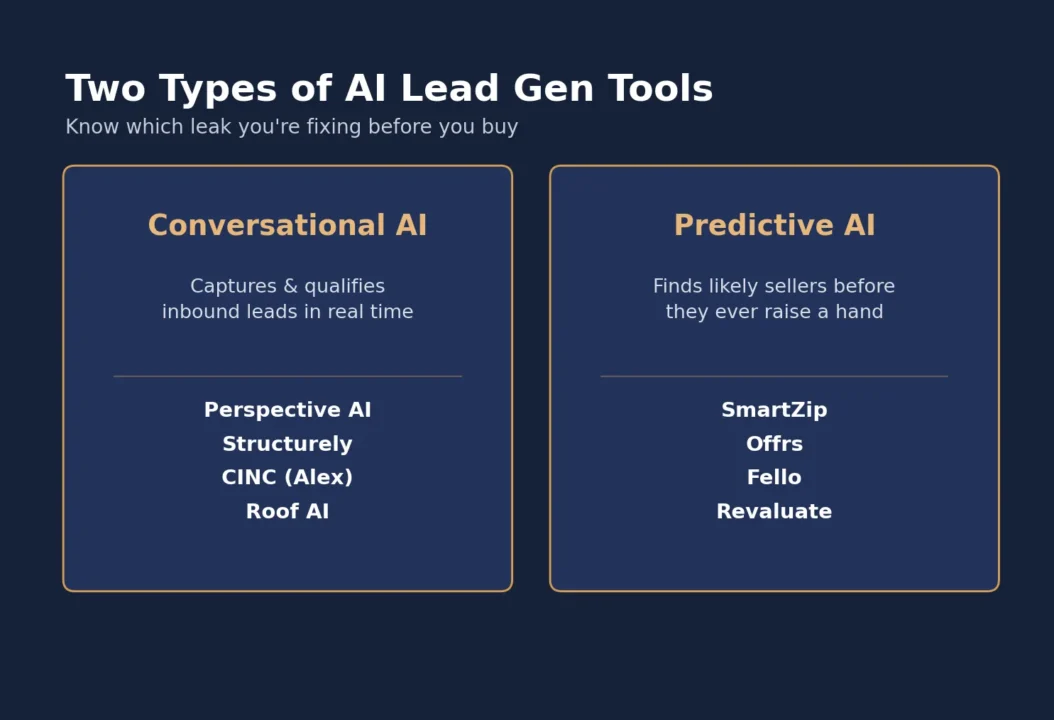
1. Conversational AI: Capturing and Qualifying Inbound Leads
These tools sit on your website, landing pages, or ad campaigns and engage whoever shows up, in real time, by chat, text, or voice.
- They ask qualifying questions — budget, timeline, financing, motivation — the way a human intake call would.
- They respond within seconds, at any hour, closing the 917-minute response gap discussed above.
- They hand off a structured, ready-to-call lead to the agent instead of a bare name and email address.
Use this category if you already generate meaningful traffic or ad clicks but your form conversion sits under 3%.
2. Predictive AI: Finding Sellers Before They List
These tools don’t wait for someone to fill out a form. They analyze public records, ownership data, and behavioral signals to flag people who are likely to sell soon — before a “For Sale” sign ever goes up.
- Signals typically include length of ownership, equity position, life events (divorce, inheritance, pre-foreclosure), and neighborhood turnover trends.
- Output is usually a scored list or an enriched CRM, not a live conversation.
- These tools still require the agent (or an ISA — inside sales agent) to do the actual outreach.
Use this category if your pipeline of new contacts is thin, or if you have a large, cold database of past clients and sphere contacts you’ve stopped working.
Best AI Tools for Real Estate Lead Generation in 2026
Ylopo — Best for AI-Powered Ad Management and Long-Term Nurture
Ylopo is one of the most established names in AI-powered lead generation for real estate teams. It runs paid Facebook and Google advertising and then hands leads to its AI assistant, nicknamed rAIya, which texts and calls prospects in a voice that’s difficult to distinguish from a human. What sets it apart is patience: most real estate leads don’t transact for 6–12 months, and rAIya keeps a natural-feeling conversation going across that entire window without an agent lifting a finger.
- Built-in AI video ad generation pulls listing photos directly from the MLS.
- Best suited to mid-size and large teams that already have (or plan to build) a paid ad budget.
- Typical pricing runs roughly $400–$600 a month before ad spend, with enterprise plans reaching $1,000+ a month.
CINC (Commissions Inc) — Best for High-Volume Team PPC
CINC combines managed Google and Facebook ad campaigns, IDX websites, a built-in CRM, and an AI texting assistant called Alex. It’s built for teams that want one connected system rather than stitching several tools together.
- Alex handles early-stage outreach and behavioral follow-up but is designed to hand off, not replace, human conversation once a buyer asks anything nuanced.
- CINC manages a large volume of ad spend across its client base, which shows in its targeting sophistication for niches like school districts or waterfront properties.
- Pricing typically starts around $600–$900 a month per agent and climbs toward $1,500–$2,000+ for team and enterprise tiers, plus ad spend on top.
Structurely (Sidekick) — Best for Instant Text-Based Qualification
Structurely is a conversational AI assistant that engages leads over SMS, asks qualifying questions, books appointments, and keeps working a lead for up to a year if needed.
- It plugs into most major real estate CRMs rather than replacing them.
- It’s a strong fit for agents who have leads coming in but no time — or no ISA — to work the top of the funnel.
- Pricing runs around $149 a month, making it one of the more affordable entries in this category.
Perspective AI — Best for Replacing a Weak Contact Form
Perspective AI takes a different approach: instead of bolting a chatbot onto your existing form, it replaces the form entirely with an open-ended AI conversation. Rather than asking a stranger to fill in eight fields before they get anything in return, it asks one open question and lets the prospect answer in their own words — then follows up conversationally to capture budget, timeline, and financing status as structured data.
- Best suited to agents whose site gets real traffic but whose form conversion is stuck in the low single digits.
- Designed to integrate cleanly with CRMs like Follow Up Boss rather than compete with them.
SmartZip and Offrs — Best for Predictive Seller Farming
Both platforms use predictive analytics to answer the same question: which homeowners in my area are quietly getting ready to sell?
- SmartZip analyzes more than 250 data points per property and has reported around 72% prediction accuracy for identifying likely sellers 6–12 months out. Pricing is typically custom-quoted, often in the $250–$500+ a month range.
- Offrs uses similar public-record and behavioral modeling, with pricing usually structured per property analyzed rather than a flat monthly fee — making it one of the cheapest ways to test predictive farming before committing to a bigger platform.
- Both work best layered with direct mail or door-knocking; neither one replaces the actual outreach.
Fello and Revaluate — Best for Mining a Cold Database
If your biggest asset is a CRM full of past clients you haven’t contacted in years, this is the category built for that problem.
- Fello scores existing CRM contacts on likelihood to sell and then runs automated, personalized text and email campaigns to the highest-scoring names. Pricing is around $165 a month as a CRM add-on.
- Revaluate does something similar — predicting which contacts in a database are most likely to move using third-party data and modeled signals — aimed at agents who don’t want to buy new leads at all, just work the ones they already have more intelligently.
Real Geeks — Best for Budget-Conscious Solo Agents
Real Geeks bundles an IDX website, CRM, and a more recently added AI chatbot into one accessible package, with Facebook ad management available as an add-on for agents who want to run their own paid campaigns.
- It’s less sophisticated on AI depth than Ylopo or CINC, but meaningfully cheaper.
- Typical pricing runs around $299–$599 a month depending on the plan.
- A practical starting point for new or solo agents who need a complete system rather than several disconnected tools.
Where Zillow Premier Agent Fits
Zillow Premier Agent isn’t really an AI lead generation tool — it’s a paid marketplace that connects agents to buyers already browsing Zillow’s listings. It’s worth mentioning here because most agents pair it with one of the AI tools above: the AI tool handles instant qualification and follow-up on the leads Zillow delivers, since those leads are typically shared with multiple agents and speed-to-lead determines who wins the conversation.
How Much Do AI Lead Generation Tools Cost for a Realtor?
Pricing depends heavily on whether the tool includes paid advertising or just software.
| Tool Type | Typical Monthly Cost | Includes Ad Spend? |
|---|---|---|
| Database mining (Fello, Revaluate) | $150–$250 | No |
| Predictive farming (SmartZip, Offrs) | $50–$500+ (varies by model) | No |
| Conversational qualification (Structurely) | $150–$300 | No |
| Contact-form replacement (Perspective AI) | Custom / usage-based | No |
| Budget all-in-one (Real Geeks) | $300–$600 | Add-on |
| Full-service platform (Ylopo, CINC) | $600–$2,000+ | Often yes, or billed separately |
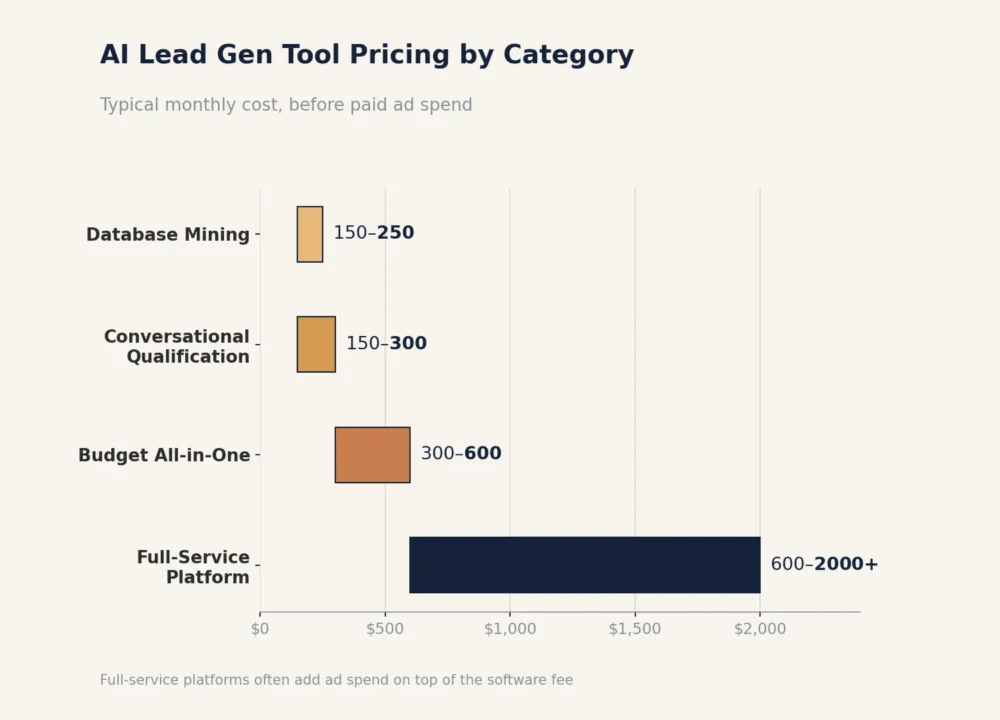
Vendors update pricing frequently and several require a sales call for an exact quote — always confirm current numbers directly before signing anything.
How to Choose the Right AI Lead Generation Tool for Your Business
- Diagnose the actual leak first. If you have traffic but a weak form, you need conversational AI. If you have a cold database but no new contacts, you need predictive AI. Buying the wrong type wastes months.
- Match the tool to your ad budget, not just your goals. Ylopo and CINC are built around paid advertising; if you don’t have a budget for ads, a database-mining or predictive-farming tool will deliver better ROI.
- Track cost per lead, not just the subscription price. A $600-a-month platform that converts well can cost less per closed deal than a $150-a-month tool that generates leads no one follows up on.
- Check what happens after AI qualifies a lead. Some tools hand off a clean, structured lead to a human. Others just generate a list; you still have to call yourself. Know which one you’re buying.
- Ask about exclusivity. Marketplace-style sources like Zillow Premier Agent often share leads with multiple agents; platforms like Market Leader advertise exclusive leads. This materially changes your realistic conversion rate.
- Test before committing annually. Most tools in this category offer a trial period or month-to-month option specifically so you can validate real conversion numbers before a longer contract.
Common Mistakes Agents Make With AI Lead Generation
- Treating AI as a replacement for follow-up discipline, instead of a tool that enforces it. AI can text a lead instantly; it still needs an agent to actually show up for the appointment it books.
- Buying a predictive tool expecting instant leads. Predictive AI surfaces likely sellers — it doesn’t replace the outreach, and results in rural or low-data markets are typically weaker than in dense urban areas.
- Running paid ads without an AI qualification layer behind them. Ad platforms like CINC and Ylopo generate volume; without instant follow-up, that volume just becomes 917-minute-response-time leads all over again.
- Ignoring after-hours coverage. With roughly 62% of inquiries arriving outside business hours, a tool that only “helps during the day” solves less than half the actual problem.
FAQs
What are the best AI Tools for Real Estate Lead Generation in 2026?
The strongest picks depend on the job: Ylopo and CINC for full-service platforms with paid advertising built in, Structurely and Perspective AI for conversational lead qualification, and SmartZip, Offrs, or Fello for predictive seller targeting.
How much do AI lead generation tools cost for real estate agents?
Standalone qualification tools like Structurely run around $150 a month. Full platforms that include paid advertising, like Ylopo and CINC, typically run $600–$2,000+ a month before ad spend. Predictive farming tools vary widely, from usage-based pricing under $50 a month to custom quotes in the $250–$500+ range.
Can AI actually generate real estate leads, or does it just manage the ones I already have?
Both, depending on the tool. Predictive AI platforms like SmartZip and Offrs surface new names you weren’t already tracking. Conversational AI tools like Structurely and Perspective AI don’t create new leads — they capture and qualify the ones already reaching your website faster than a human could.
What’s the difference between AI lead capture and AI lead qualification?
Lead capture tools bring new contacts into your pipeline through ads, websites, or predictive data. Lead qualification tools take contacts you already have and determine, through conversation or scoring, which ones are worth an agent’s time right now. Most agents eventually need one tool from each category.
Do AI lead generation tools work for solo agents, or only teams?
Both, but the right tool differs. Solo real estate agents typically get better ROI from lower-cost, single-purpose tools like Structurely, Fello, or Real Geeks. Full-service platforms like CINC and Ylopo are usually better value for teams with enough ad budget and lead volume to justify the higher monthly cost.
How fast should I respond to a new real estate lead?
Within 5 minutes if at all possible. Research analyzing over a million sales leads found agents responding within 5 minutes are roughly 21 times more likely to qualify a lead than those who wait 30 minutes — and the real estate industry average response time is still measured in hours, not minutes.
Is Zillow Premier Agent an AI lead generation tool?
Not really. It’s a paid marketplace that delivers buyer leads from Zillow’s traffic, typically shared with more than one agent. Most agents pair it with a dedicated AI tool to instantly qualify and respond to the leads Zillow sends, since speed determines who wins those shared leads.
Can I just use ChatGPT instead of a dedicated AI lead generation tool?
Not for the core job. ChatGPT and Claude are useful for writing follow-up scripts, nurture emails, and ad copy, but they can’t run ad campaigns, capture form submissions, or hold live qualification conversations with leads the way purpose-built tools do. Most agents use both — a dedicated lead gen tool for capture and qualification, and general AI for the writing around it.
Conclusion
AI tools for real estate lead generation don’t solve a lead volume problem — they solve a speed and consistency problem, which turns out to be the bigger one for most agents.
The data is consistent across every independent study on this: the agent who responds in minutes, not hours, wins the deal far more often than the agent with a bigger ad budget. Start by figuring out where your funnel actually leaks — a weak contact form, an underworked database, or thin lead volume altogether — and pick one tool that fixes that specific leak.
Add the second type only once the first one is working. Done right, AI lead generation for real estate won’t manufacture motivated clients out of nowhere, but it will make sure you’re the first agent in the conversation when a real one shows up.