
Table of Contents
Quick Answer
The best AI product description writer for Etsy Sellers depends on what you actually need. If you want free, flexible copy and don’t mind writing your own prompts, ChatGPT or Claude produce the most natural-sounding descriptions. If you want speed and built-in Etsy keyword data, Alura’s AI Writer or a purpose-built Etsy listing generator will draft a title, description, and all 13 tags in one pass.
If your bottleneck is keyword research rather than writing, pair any AI writer with eRank (best free tier) or Marmalead (best raw keyword accuracy). No single tool wins every category — the strongest workflow most sellers land on is a dedicated Etsy SEO tool for keyword data, plus a general AI writer for the actual sentences, followed by a human edit pass for voice and accuracy.
Why “Just Any AI Tool” Isn’t Enough for Etsy
Etsy is a search engine as much as it’s a marketplace. Every listing is competing against millions of others for the same handful of search terms, and your description plays a specific role in that competition: it doesn’t rank your listing directly, but it drives the click-through and conversion signals that do affect ranking.
It’s also gotten smarter about how it reads those search terms. Etsy’s search system increasingly relies on natural language processing to understand the meaning behind a query, not just match the literal words in it — which is part of why a description stuffed with repeated keyword phrases reads as low-quality to the algorithm and the buyer alike, instead of “more relevant.”
That’s the gap most sellers run into. A generic AI product description generator built for Amazon or Shopify writes in a corporate, benefit-stacked tone. Etsy buyers respond to something different — a description that sounds like it was written by the actual maker, answers their practical questions, and doesn’t read like an ad. An AI product description writer for Etsy Sellers needs to understand that distinction, whether that’s a purpose-built Etsy tool trained on real listing data or a general model you’ve prompted correctly.
There’s also a data problem. General AI assistants like ChatGPT and Claude are excellent writers, but they have no idea what buyers are actually typing into Etsy’s search bar this month. That’s where Etsy-specific SEO tools come in — they supply the keyword data that general AI tools can’t see on their own.
New to how Etsy search works? Our Etsy SEO guide covers the fundamentals — this article assumes that baseline and focuses specifically on the description.
The Best AI Product Description Writers for Etsy Sellers
1. General-Purpose AI Assistants — ChatGPT, Claude, and Gemini
The general AI chatbots most sellers already have an account for are usually the fastest route from a blank listing to a solid first draft. None of them know Etsy’s search volume or competition data, so keyword research still has to happen separately — but each writes well once you give it real product details instead of a vague prompt. Fed the right prompt, a general assistant already functions as a solid AI Etsy listing writer. Many sellers keep two of these open at once and compare drafts, since one model occasionally catches a detail or phrasing the other misses.
Pros
- Free tiers are genuinely usable for writing full listings
- Fast and flexible; handle bulk work well if you paste in a spreadsheet of product details
- No new subscription needed if you already use one of these day to day
Cons
- No access to Etsy search volume, competition, or trend data
- Default output can sound generic until you refine your prompt and add real product facts
- You have to bring your own keywords from a separate research tool
2. Etsy-Specific AI Listing Generators (Alura, Roketfy, and similar tools)
A newer category of tool skips the general-purpose AI writer entirely and builds the description generator directly into an Etsy SEO platform. You describe the product (or in some cases upload a photo), and the tool returns a title, full description, and a set of tags formatted specifically for Etsy’s structure. In effect, these platforms double as an Etsy AI copywriting tool with keyword data already built in.
Pros
- Trained on what performs on Etsy specifically, not general copywriting
- Often bundles a listing checker that scores your existing listings
- Saves the step of manually pairing keyword research with a writing tool
Cons
- Paid plans typically run $20–$50/month depending on the platform
- Copy can feel more formulaic than a well-prompted general AI assistant
- Some tools require a text description; only a few can read a product photo directly
3. Jasper — Best for Multi-Product Brand Consistency
Jasper is built for marketing teams, not solo Etsy sellers, but shops with a large, varied catalog sometimes use it to keep tone consistent across hundreds of listings. See Jasper’s pricing — it sits around $59/month billed annually for the Pro plan, with custom pricing for larger teams — noticeably more than a general AI assistant’s paid tier.
Pros
- Brand voice settings keep tone consistent across a big catalog
- Built-in plagiarism check add-on
- Useful if you’re also writing shop announcements, ads, and emails, not just listings
Cons
- Expensive relative to what a single-shop Etsy seller typically needs
- No permanent free plan, only a short trial
- Overkill for sellers with under 50 listings
4. Copy.ai — Best Budget Multi-Tone Generator
Copy.ai‘s product description tool offers one-click tone switching (playful, luxurious, minimalist) and a genuinely usable free tier, which makes it a reasonable middle ground between ChatGPT’s flexibility and Jasper’s price tag.
Pros
- Free plan available; paid tier is cheaper than Jasper
- Multiple tone presets in one click, useful for testing which voice converts
- Built-in translation, handy for sellers targeting international buyers
Cons
- Etsy-specific formatting (tags, character limits) isn’t built in
- Output quality is solid but generally a step behind ChatGPT/Claude for nuanced, story-driven copy
5. Etsy SEO & Research Tools — Not Writers, But the Data Behind a Good One
None of these write your description for you, and it’s worth being upfront about that. What they supply is the one thing general AI tools can’t: real Etsy search, competition, and sales data. Feed their output into any writer above and you get the best of both — accurate data plus natural writing.
- eRank: The most generous free tier in this category — 200 keyword lookups a day plus basic listing audits. Paid plans start around $5.99–$9.99/month.
- Marmalead: No free plan, but its keyword data is pulled closer to Etsy’s own search behavior. Runs about $19/month.
- EverBee: Built for product research rather than keywords — shows estimated sales and revenue across existing Etsy listings, useful for validating an idea before you invest in materials. Free tier available; paid plans from around $7.99/month.
- Sale Samurai: Strongest at bulk tag analysis across large catalogs, which makes it a common pick for print-on-demand shops managing hundreds of listings at once.
- EtsyHunt: A newer tool with an unusually generous free tier covering keyword search, product research, and competitor lookup — a reasonable second opinion alongside eRank.
Want the full head-to-head? See our eRank vs Marmalead vs Alura comparison.
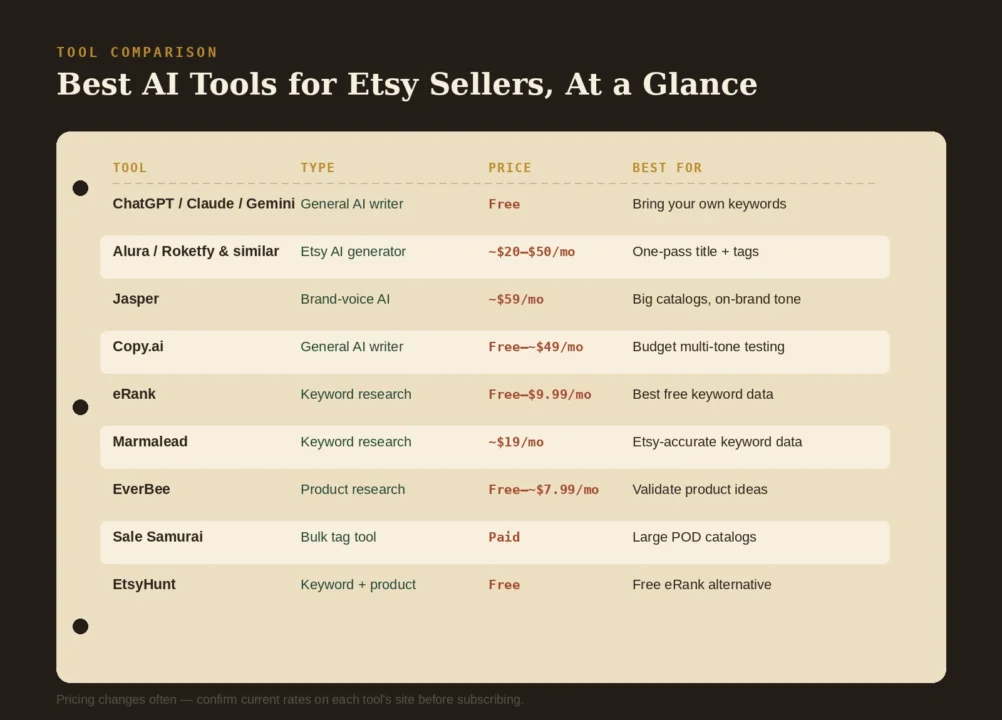
At a Glance: Which Tool Fits Which Seller
| Tool | Type | Starting Price | Best For |
|---|---|---|---|
| ChatGPT / Claude / Gemini | General AI writer | Free | Flexible, natural-sounding copy; bring your own keywords |
| Alura / Roketfy (and similar) | Etsy-specific AI generator | ~$20–$50/mo | One-pass title + description + tags |
| Jasper | General AI writer (brand voice) | ~$59/mo | Large catalogs needing consistent tone |
| Copy.ai | General AI writer | Free–~$49/mo | Budget-friendly multi-tone testing |
| eRank | Keyword research | Free–$9.99/mo | Best free keyword data |
| Marmalead | Keyword research | ~$19/mo | Most Etsy-accurate keyword data |
| EverBee | Product research | Free–~$7.99/mo | Validating product ideas before listing |
| Sale Samurai | Bulk tag analysis | Paid | Large POD catalogs |
| EtsyHunt | Keyword + product research | Free | Generous free alternative to eRank |
Pricing changes often — confirm current rates on each tool’s site before subscribing.
Free vs. Paid: Which Should You Actually Use?
For most new or small Etsy shops, the free combination of eRank’s free tier + ChatGPT (or Claude) covers everything you need: real keyword data plus solid writing, at zero cost. It just takes a bit more manual work — copying keywords over yourself and writing your own prompts.
Paid, Etsy-specific listing generators earn their monthly fee once you’re managing a large catalog (print-on-demand shops with 100+ SKUs, for example — see our best tools for print-on-demand sellers roundup), where the time saved on bulk-writing pays for the subscription many times over. If you’re listing fewer than 20–30 products, it’s hard to justify the cost over a free workflow. Either way, it’s worth running the numbers with an Etsy fees calculator before you add a tool subscription on top of what Etsy already takes.
Who Actually Needs an AI Product Description Writer for Etsy?
Not every seller needs the same setup. Here’s how the right choice usually breaks down by shop type:
- New or small shops (under 20 listings): A free AI product description writer for Etsy Sellers — ChatGPT or Claude, paired with eRank’s free keyword tier — is genuinely enough. Paying for a dedicated tool this early rarely pays for itself yet.
- Print-on-demand or high-volume sellers (100+ SKUs): This is where a purpose-built AI product description writer for Etsy Sellers earns its subscription. Rewriting hundreds of listings by hand isn’t realistic, and the hours saved by an Etsy-specific generator add up fast.
- Vintage and one-of-a-kind sellers: Every item is different, so an AI product description writer for Etsy Sellers should be treated as a first draft, not a finished listing. Plan on more manual editing here than in any other category, since no tool knows the specific history or condition of a one-off piece.
How to Write an Etsy Product Description With AI (Step-by-Step)
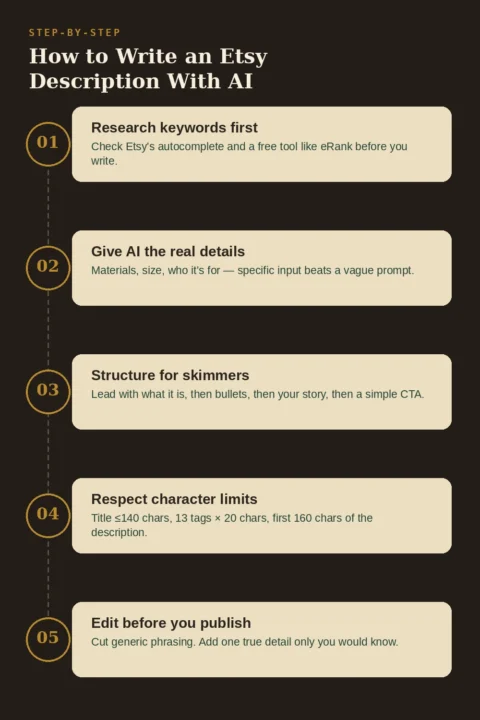
Step 1: Do keyword research before you open the AI tool
Type your product into Etsy’s own search bar and note the autocomplete suggestions — those are real buyer searches. Cross-check with eRank or Marmalead’s free tier for search volume. Bring 3–5 solid keyword phrases into your prompt; don’t let the AI guess at what buyers are searching for.
Step 2: Give the AI real details, not a vague prompt
“Write a description for my earrings” produces generic copy every time. Instead, hand the AI everything a buyer would ask about: materials, dimensions, how it’s made, processing time, and who it’s for. Specific input is the single biggest factor in output quality — vague instructions produce vague copy, no matter which AI tool you’re using.
Step 3: Structure the description for how buyers actually read it
Etsy shoppers, especially on mobile, skim. A structure that consistently converts:
- First 1–2 sentences: what it is, made of, and the key benefit — many buyers read only this far
- Bullet points: dimensions, materials, personalization options, processing time
- Short paragraph: the story or craftsmanship detail that makes it yours, not generic
- Closing line: a simple call to action, like inviting questions before they order
Step 4: Respect Etsy’s character limits
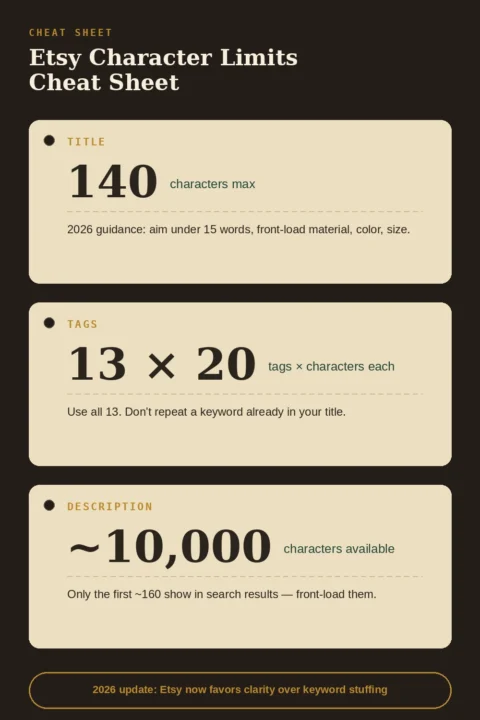
- Title: Our full Etsy title character limit guide covers this in depth, but the short version is 140 characters max, though Etsy’s own newer guidance (more on this below) favors clear, short titles under 15 words over stuffing every character
- Tags: 13 tags, 20 characters each — use all 13, and don’t repeat a keyword you already used in the title
- Description: roughly 10,000 characters available, but only the first ~160 characters show up in search previews and Google, so front-load the important information there
Step 5: Edit — don’t publish the raw AI output
Read it as a buyer would. Cut any claim the AI added that isn’t true of your actual product. Swap in a phrase you’d actually say out loud. This step is what separates a listing that feels handmade from one that reads like it came out of a template — and it’s also the step most sellers skip.
What Changed in Etsy’s Own Title Guidance (2026 Update)
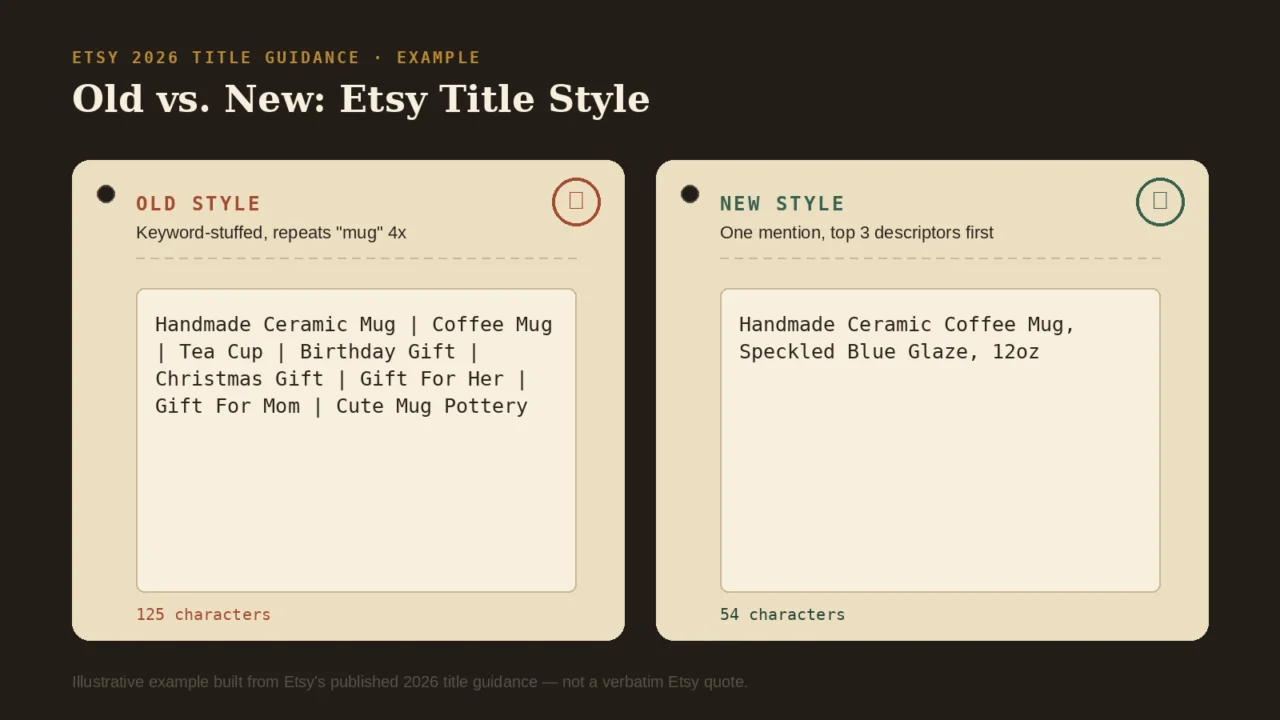
This is worth knowing before you write another listing: Etsy itself has moved away from the old “stuff every keyword into the title” advice that dominated Etsy SEO content for years. According to Etsy’s own title guidance, the platform’s search system now weighs title, tags, attributes, description, first photo, and reviews together — so the title no longer has to carry the entire SEO burden by itself. For the full picture of ranking factors beyond titles, see how the Etsy algorithm ranks listings in 2026.
Etsy’s current guidance for titles:
- Clearly state the item once — “mug,” “dress” — don’t repeat it
- Lead with the top three descriptors that matter most: color, material, size
- Aim for under 15 words when including special traits
- Only include occasion or gift-recipient words (“birthday,” “wedding”) if they’re essential to what the item is
- Drop subjective words like “beautiful” or “perfect” from the title — save them for the description
- Remove pricing or shipping language entirely; Etsy handles that with badges automatically
In practice, this shifts more of the SEO and persuasion work onto your description — which is exactly why having a strong AI product description writer for your Etsy shop matters more now than it did a couple of years ago.
Etsy’s AI Disclosure Rules: Do You Need to Disclose an AI-Written Description?
Etsy’s Creativity Standards require sellers to disclose in the listing when an item is created using AI — the clearest examples are AI-generated art, AI-designed patterns, or AI-produced digital products. Etsy is explicit that human creative input, disclosure, and authenticity are what keep AI-assisted items eligible on the platform.
Where it gets less clear-cut is using AI purely to help write the description of a product you made yourself by hand. That’s a different situation from AI generating the product itself, and Etsy’s public guidance is focused on the item, not the marketing copy describing it. That said, a few practical points worth keeping in mind:
- If AI generated any part of the actual product (art, design, digital file), disclosure is required — don’t skip this
- Etsy has stepped up enforcement on AI-generated items sold as handmade or original, with real consequences for non-compliance
- Even where disclosure isn’t strictly required for description-writing alone, avoid letting AI copy make claims about your process that aren’t true — that’s a policy and trust problem regardless of the disclosure question
- Policy in this area is actively evolving, so it’s worth checking Etsy’s current Seller Handbook before you rely on any third-party summary, including this one
Common Mistakes Sellers Make With AI-Written Etsy Descriptions
Even a good AI Etsy description generator can go wrong in predictable ways. Here’s what trips up most sellers:
- Copy-pasting the first draft. Raw AI output almost always needs a pass to remove generic phrasing and add details only you would know.
- Skipping keyword research first. An AI tool can’t read Etsy’s search data — if you don’t feed it real keywords, it will guess, and the guess is usually wrong.
- Letting every listing sound identical. If your whole shop reads like it came from the same template, buyers notice, and so does Etsy’s quality scoring over time.
- Overstuffing keywords into the description. Etsy’s algorithm — and buyers — read unnaturally repeated phrases as low quality, not high relevance.
- Ignoring the questions buyers actually ask. Dimensions, materials, processing time, and personalization options prevent pre-purchase questions and returns far more than persuasive adjectives do.
FAQs
Is ChatGPT good enough, or do I need a paid Etsy-specific tool?
For most small shops, ChatGPT or Claude paired with a free keyword tool like eRank covers everything you need. Paid, Etsy-specific generators become worth it once you’re managing a large catalog and the time saved outweighs the subscription cost.
Will Etsy penalize me for using AI to write my descriptions?
Etsy’s disclosure rules are aimed at AI-generated products, not AI-assisted writing of a description for something you made yourself. Just make sure the description stays accurate to your actual product and process.
How long should an Etsy product description be?
There’s no strict minimum, but front-load the first 160 characters with the most important information, since that’s what shows in search previews. Beyond that, aim for enough detail to answer a buyer’s practical questions without turning into an essay.
Can AI-written descriptions hurt my Etsy SEO?
The description itself doesn’t directly rank your listing in Etsy search, but it strongly influences whether shoppers click through and buy — which does feed back into your ranking. Generic, keyword-stuffed AI copy hurts conversion; well-edited, specific AI-assisted copy doesn’t.
What’s the single best free combination for Etsy sellers?
eRank’s free tier for keyword data, paired with ChatGPT or Claude for the actual writing. It costs nothing and covers both halves of the problem — knowing what to say and knowing what buyers are searching for.
Do I still need to write all 13 tags manually?
No — most AI tools, especially Etsy-specific listing generators, will suggest a full set of 13 tags alongside the description. Just make sure they cover different search variations rather than repeating words already in your title. For a deeper walkthrough, see how to choose Etsy tags that actually convert.
Is an Etsy-specific AI writer different from a generic AI product description generator?
Yes, meaningfully. A generic AI product description generator built for Amazon or Shopify doesn’t know Etsy’s tag system, character limits, or the handmade and vintage tone Etsy buyers expect. An Etsy-specific AI listing generator — or a general assistant fed the right prompt — closes that gap.
Conclusion
There’s no single “best” AI product description writer for Etsy sellers — there’s a best fit for your shop size and budget. New or small shops do fine with a free AI writer like ChatGPT or Claude paired with eRank’s free keyword tier. Larger catalogs, especially in print-on-demand, benefit from a dedicated Etsy listing generator that bundles keyword data and writing into one step. Whichever route you choose, the tool is only doing half the job — the edit pass where you add real product details and cut the generic phrasing is what actually makes a listing convert.
If you’re looking for a full package of AI tools for Etsy sellers, then you can follow our complete Best AI tools for Etsy sellers pillar guide.