
Table of Contents
Quick Answer
eRank is the best all-around AI keyword research tools for Etsy sellers in 2026 — its free plan is strong enough to actually run a shop on before you ever pay for anything. But “best” splits by what you need: Marmalead wins for AI-guided listing coaching and trend forecasting, Alura and EverBee win if you want product research bundled with keyword data, EtsyHunt and Sale Samurai win on price, and pairing any of these with ChatGPT or Claude is the fastest way to turn keyword data into an actual listing.
There’s no single “best” tool for every shop. The right one depends on whether you’re starting from zero, fixing existing listings, or trying to find your next product idea. Below, I’ll walk through how Etsy search actually works, what makes a keyword tool worth paying for, and an honest, side-by-side look at the tools sellers actually use in 2026.
What an AI Keyword Research Tool for Etsy Sellers Actually Does
An Etsy keyword research tool pulls data on what shoppers type into Etsy’s search bar, then tells you how often those phrases get searched and how many listings you’d be competing against. The “AI” part usually means one of a few things: the tool understands buyer intent beyond exact-match phrases, it forecasts which keywords are about to trend, or it can auto-generate a title and tag set instead of just handing you a spreadsheet of numbers.
That last part matters more than most sellers realize. Raw keyword data is only half the job. Knowing that “minimalist gold necklace” gets decent traffic doesn’t help much if you don’t know where to place it, how to pair it with your other 12 tags, or whether your title is even readable on a phone screen.
Why Google Keyword Tools Don’t Work for Etsy
If you’ve ever pasted a product idea into Google Keyword Planner and used those numbers for an Etsy listing, you’ve probably noticed the results don’t line up with your actual traffic. That’s because Etsy is its own search environment, closer to Amazon than to Google.
A phrase can get thousands of monthly searches on Google and almost none on Etsy — or the reverse. Someone searching Google for “how to store jewelry” is researching. Someone searching Etsy for “jewelry organizer for travel” is ready to buy. The intent, the phrasing, and the volume are all different, which is exactly why Etsy-specific tools exist in the first place.
How AI Changes the Keyword Research Game
Older keyword tools just showed you a number next to a phrase. Modern tools apply natural language processing (NLP) to understand what a phrase means, not just match it letter for letter. In practice, that shows up as:
- Semantic matching — understanding that “boho wall decor,” “bohemian wall hanging,” and “macrame wall art” are all chasing a similar buyer, even without identical wording
- Intent detection — separating browsers from buyers based on how specific and purchase-ready a phrase sounds
- Trend forecasting — flagging a keyword’s upward momentum weeks before it peaks, using historical seasonal patterns
- Automated listing generation — writing a full title, description, and 13-tag set from a single keyword, then letting you edit rather than start from a blank page
- Listing audits — scanning your existing shop and flagging weak titles, empty tags, or thin descriptions automatically
None of this replaces your judgment about your own product and audience. It just cuts down the hours you’d otherwise spend guessing.
How Etsy’s Search Algorithm Actually Ranks Your Listings in 2026
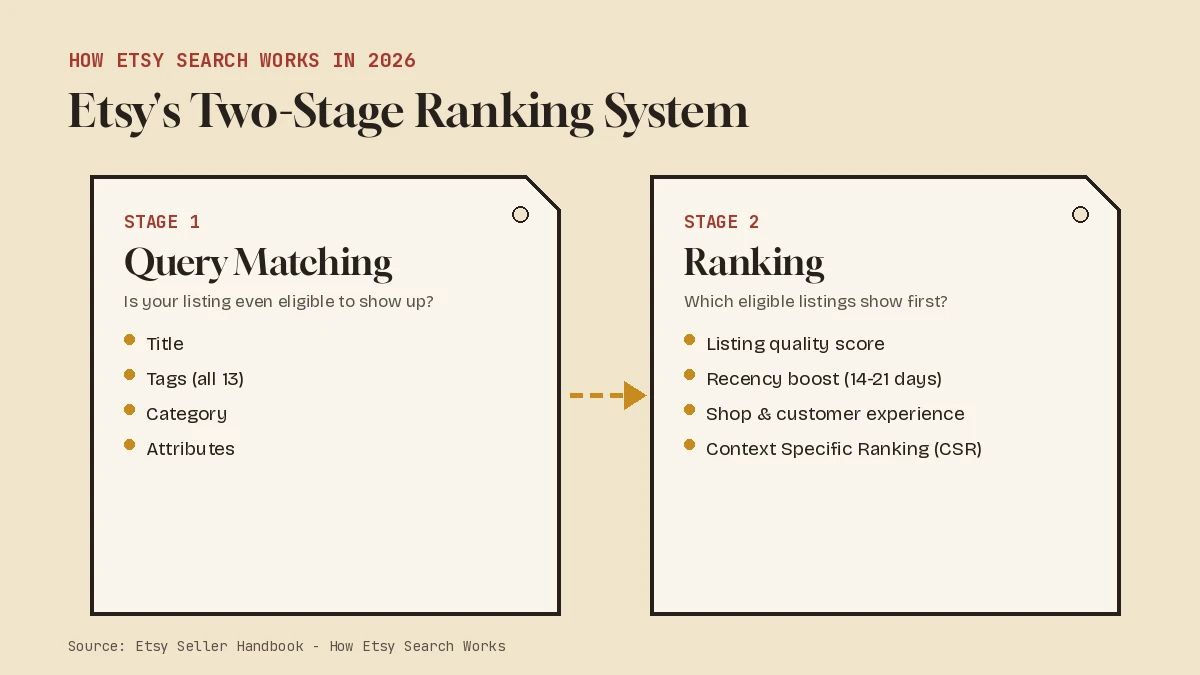
Etsy doesn’t publish its exact ranking formula, but its own Seller Handbook lays out the general framework, and it hasn’t changed in any dramatic way going into 2026 — it’s just gotten more sensitive to buyer behavior. Search happens in two stages: matching, then ranking.
Stage 1: Query Matching (Relevance)
Before ranking even starts, Etsy checks whether your title, tags, category, and attributes actually match what someone typed. If your listing doesn’t contain the words a buyer used, it’s not eligible to show up at all, no matter how good your photos are.
Etsy has also gotten better at semantic, natural-language matching. A listing described as “simple, delicate jewelry” can now surface for a search like “minimalist necklace” without that exact phrase appearing anywhere. A few years ago, close-to-exact keyword matches were almost mandatory; that’s loosened as Etsy’s own natural language processing has improved.
This is where keyword research does its heaviest lifting. You need the words buyers actually type, not the words you’d use to describe your own product.
Stage 2: Ranking (Listing Quality and Shop Trust)
Once a batch of listings qualifies, Etsy ranks them using a mix of signals, roughly in this order of weight:
- Listing quality — click-through rate, add-to-cart rate, and purchase rate relative to how many times your listing was shown
- Recency — new and recently renewed listings get a short-term visibility boost, though this window has narrowed compared to a few years ago
- Shop quality — your reviews, response time, shipping reliability, and overall customer experience
- Context-Specific Ranking (CSR) — Etsy’s personalization layer, which shows different shoppers different results based on their individual browsing and purchase history
A useful thing to know: Etsy has confirmed that neither an Etsy Plus subscription nor running Etsy Ads directly influences where your listings rank in organic search. Star Seller status also doesn’t directly boost rank — but the behaviors that earn it (fast responses, on-time shipping, strong reviews) do feed into your shop quality score, so the two are connected even if one doesn’t cause the other.
What This Means for Keyword Research
Getting the right keywords into your title and tags gets you into the race. It doesn’t win the race for you. A perfectly optimized title on a listing with blurry photos and a vague description will still lose to a decent listing that converts well. Keyword tools help with the first half. Your photos, pricing, and description do the rest.
What to Look for in an Etsy AI Keyword Tool
Before comparing specific tools, it helps to know what actually separates a useful one from a flashy dashboard full of numbers. Look for:
- Etsy-specific data, not repurposed Google or Amazon search volume
- Competition context, not just raw search volume — a keyword with 2,000 searches and 200,000 competing listings is often worse than one with 400 searches and 3,000 listings
- Long-tail suggestions, since buyer-intent phrases like “personalized leather journal for dad” usually convert better than broad terms like “leather journal”
- Actionable guidance, not just a grade — a tool that tells you why a tag is weak is more useful than one that just gives it a “D”
- A usable free tier or trial, so you can test the data quality before committing money
- Listing or shop audits, so you can fix what’s already published, not just plan new listings
Keyword Research Looks Different Depending on What You Sell
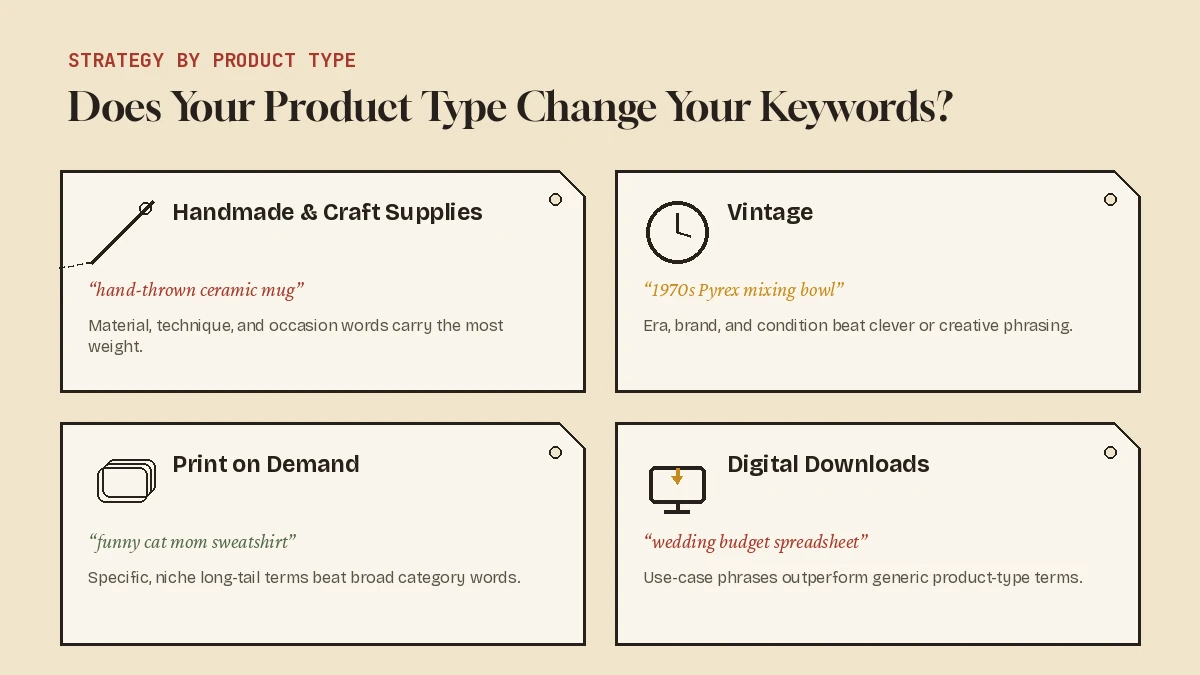
Etsy isn’t one uniform marketplace. A handmade jeweler, a vintage reseller, and a print-on-demand shop are all competing for attention in different ways, and that changes what “good keywords” actually means for each:
- Handmade and craft supplies — buyers search using material, technique, and occasion words (“hand-thrown ceramic mug,” “wool felting kit”), so attribute fields carry nearly as much weight as your tags.
- Vintage — searches lean on era, brand, and condition (“1970s Pyrex bowl,” “MCM teak side table”), so accuracy in your title matters more than creative phrasing.
- Print-on-demand (POD) — competition on generic terms is brutal, so specific, long-tail keywords tied to a niche, fandom, or occasion outperform broad category words.
- Digital downloads — buyers often search by use case rather than product type (“wedding budget spreadsheet template” instead of just “spreadsheet”), so intent-based long-tail phrases matter more than raw volume.
The Best AI Keyword Research Tools for Etsy Sellers in 2026
Here’s how the most established tools stack up. Pricing on Etsy tools changes fairly often, so treat the numbers below as a general guide and confirm current pricing on each provider’s site before subscribing.
1. eRank — Best Free Option and Everyday Workhorse
eRank is used by over a million sellers and is usually the first tool people try, mainly because its free plan is genuinely usable rather than a teaser. It pulls trend and competition data across Etsy, Google, Amazon, and eBay, and its Listing Audit (Health Check) scans your shop for missing tags, thin descriptions, and other basic issues that quietly suppress visibility.
Pricing: Free plan (limited daily searches), Basic around $5.99/month, Pro around $9.99/month, Expert around $29.99/month.
Pros:
- Free tier is strong enough for a new shop to actually use
- Listing audits catch fixable mistakes fast
- Trend Buzz shows rising keywords across multiple marketplaces
- Large, active seller community for support and tutorials
Cons:
- Free plan search limits get restrictive quickly once you’re actively optimizing
- Doesn’t show exact search volume, only relative indicators (high/medium/low)
- Its A–F listing grades are sometimes inconsistent with real-world performance, so treat them as a starting point rather than gospel
2. Marmalead — Best for AI Listing Coaching
Marmalead was one of the first tools built specifically for Etsy SEO, and its Marma AI feature is closer to a coach than a spreadsheet. It audits your listings against what Etsy’s own Seller Handbook recommends, explains what’s weak, and walks you through the fix rather than leaving you to interpret a score on your own.
Pricing: Around $19/month, single plan, no permanent free tier (trial available).
Pros:
- Marma AI gives specific, plain-language fixes instead of just numbers
- Strong engagement scoring and seasonal trend forecasting
- Storm brainstorming mode generates keyword variations from real Etsy search data
- Good fit for sellers who want guidance, not just raw data
Cons:
- No lasting free plan, so you can’t test long-term without paying
- Pricier than eRank for similar core functionality
- Some sellers report it takes a bit of a learning curve to use the full toolset well
3. Alura — Best All-in-One Platform
Alura combines keyword discovery, product research, listing optimization, and marketing tools like an AI review analyzer that scans competitor feedback for unmet needs. It’s built for sellers who’d rather work in one dashboard than juggle three tabs.
Pricing: Free tier with limited daily searches, Growth plan around $19.99/month ($9.99/month billed annually), Professional around $49.99/month ($29.99/month billed annually).
Pros:
- Broad feature set: keywords, product research, competitor analysis, email marketing
- Listing Helper pulls keyword suggestions in as you write
- AI review analyzer surfaces market gaps competitors are missing
- Solid free tier for testing before you commit
Cons:
- Can feel like a lot of tool for someone who just wants keyword numbers
- Top-tier plan pricing is steep for a solo, part-time seller
- Best value only shows up if you actually use the extra features, not just the keyword tool
4. EverBee — Best for Product Research Alongside Keywords
EverBee started as a product and sales-estimation tool before adding keyword and listing features, and that history still shows in its strengths. If you’re not just optimizing existing products but deciding what to make next, EverBee’s estimated sales and revenue data across a huge catalog of listings is genuinely useful.
Pricing: Free tier available, paid plans generally starting under $10/month with fuller keyword and AI tools unlocked around $29.99/month.
Pros:
- Strong for validating a product idea before you invest in materials
- Chrome extension surfaces trending products while you browse Etsy
- Generous free plan for the search volume it allows
- Good complement to a pure keyword tool like eRank
Cons:
- Keyword research is a secondary feature, not the core strength
- Full functionality is locked behind the higher-priced Growth tier
- Less depth on long-term trend history than dedicated SEO tools
5. EtsyHunt (eHunt) — Best Budget Option with a Big Product Database
EtsyHunt leans into competitor and trend analysis, backed by one of the largest searchable Etsy product databases among these tools. It’s aimed at sellers who want affordable access to product and keyword data without a steep monthly bill.
Pricing: Free plan (around 10 searches/day), Basic around $3.99/month, Pro around $19.99/month ($16/month billed annually), Team around $59.99/month.
Pros:
- Very affordable entry point, especially on the Basic plan
- Huge product database for spotting best-sellers and gaps in a niche
- Chrome extension for on-the-fly research while browsing Etsy
- Includes a basic built-in AI assistant (EtsyGPT) for quick listing help
Cons:
- Dashboards can feel information-heavy and take time to interpret
- No dedicated listing optimization suite the way some competitors have
- Free plan’s 10-search daily cap is tight for active research sessions
6. Sale Samurai — Best for Long-Tail Keyword Discovery
Sale Samurai’s strongest case is surfacing specific, multi-word phrases — the kind of long-tail search terms that carry real purchase intent, like “personalized silver initial necklace for mom” instead of just “silver necklace.” Its Chrome extension lets you research directly on Etsy’s own search pages.
Pricing: No permanent free plan, but a 3-day free trial. Single plan around $9.99/month or $99/year.
Pros:
- Good at surfacing specific long-tail phrases other tools miss
- Chrome extension works directly on Etsy without switching tabs
- Includes a Listing Creator that mirrors Etsy’s own upload flow
- Simple, flat pricing with no confusing tiers
Cons:
- No free tier, only a short trial, so it’s harder to test long-term for free
- Trend history is shallower than Marmalead’s for long-range seasonal planning
- Keyword data is modeled/estimated rather than pulled live from Etsy, same caveat that applies to most tools in this space
7. ChatGPT and Claude — Best for Turning Keywords Into Listing Copy
General AI assistants aren’t Etsy-specific keyword tools, and they don’t have access to real Etsy search volume. What they’re genuinely good at is taking the keyword list a dedicated tool gives you and turning it into a natural-sounding title, tag set, and description in a fraction of the time it’d take to write from scratch.
Pros:
- Fast at drafting multiple title and description variations to test
- Useful for rewriting a stiff, keyword-stuffed listing into something a human actually wants to read
- Can help brainstorm related search phrases and buyer-language angles a spreadsheet might miss
Cons:
- No real Etsy search volume or competition data on their own
- Can produce generic-sounding copy without a detailed, specific prompt
- Works best paired with a dedicated Etsy keyword tool, not as a replacement for one
Other Etsy Keyword Tools Worth a Quick Look
A few newer or more specialized tools come up in seller forums too: Koalanda (leans on data-accuracy claims for sales and keyword scoring), Product Flint (budget research plus AI listing generation), and credit-based platforms like Insight Agent that bundle Etsy keyword data with Amazon and print-on-demand research. None have the multi-year track record of the tools above, so treat them as worth a free trial rather than a default first choice.
Quick Comparison Table
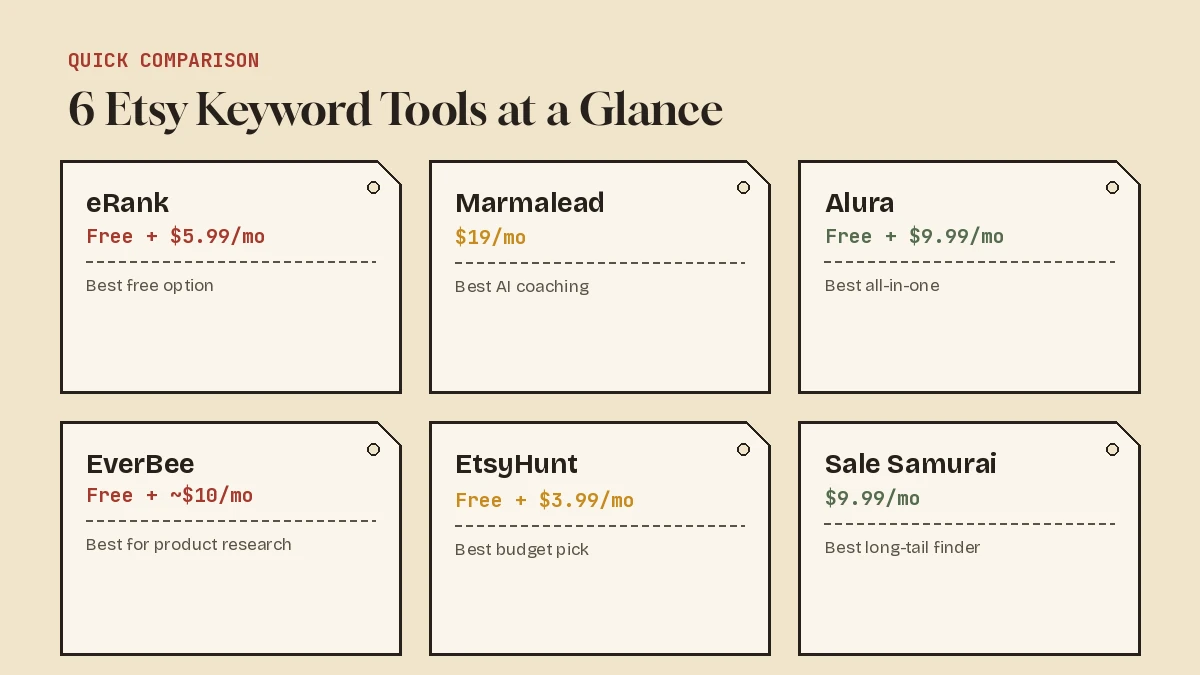
Here are Quick Comparison of AI keyword research tools for Etsy sellers :
| Tool | Free Plan? | Starting Paid Price | Best For |
|---|---|---|---|
| eRank | Yes (limited) | ~$5.99/mo | Free, everyday keyword lookups + listing audits |
| Marmalead | Trial only | ~$19/mo | AI listing coaching and trend forecasting |
| Alura | Yes (limited) | ~$9.99/mo (annual) | All-in-one keyword + product + marketing tools |
| EverBee | Yes (limited) | Under $10/mo | Product research paired with keywords |
| EtsyHunt | Yes (limited) | ~$3.99/mo | Budget-friendly with a large product database |
| Sale Samurai | 3-day trial | ~$9.99/mo | Long-tail keyword discovery |
| ChatGPT / Claude | Yes (free tier) | Varies | Writing titles, tags, and descriptions from keyword data |
How to Do Etsy Keyword Research With an AI Tool, Step by Step
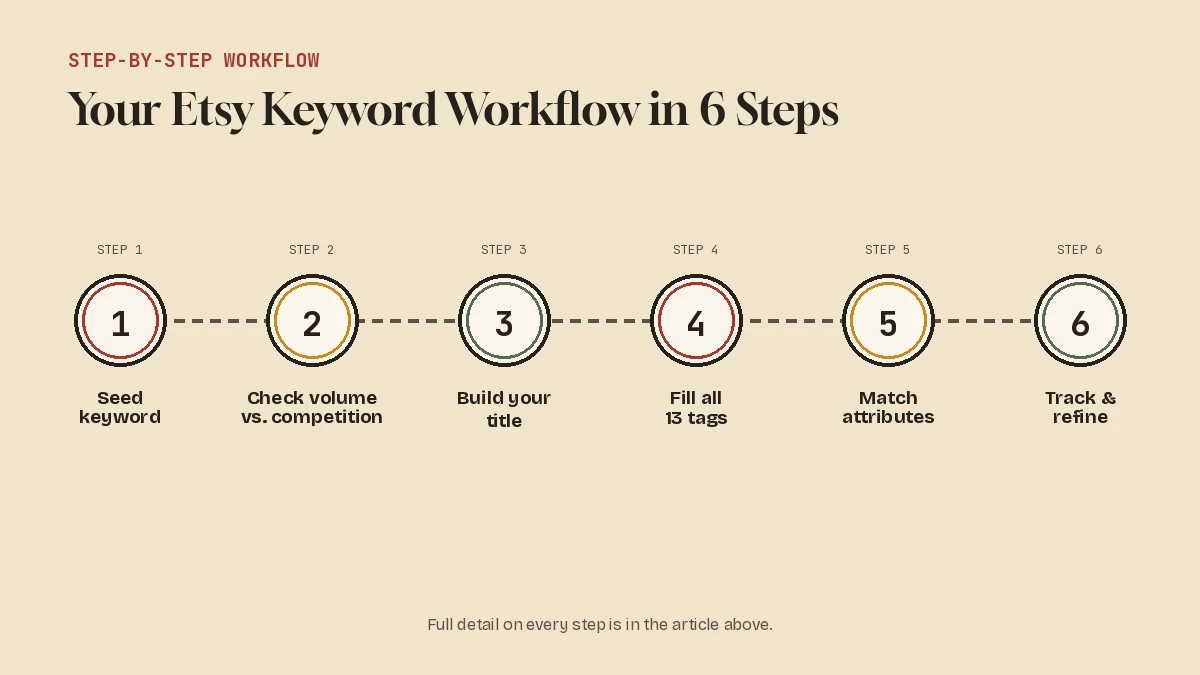
Here’s a practical workflow that works regardless of which tool you pick.
- Start with a seed keyword. Type your product into Etsy’s own search bar first. The autocomplete suggestions are real phrases other buyers have typed recently, and they’re free.
- Run that seed phrase through your keyword tool. Look at relative search volume and, more importantly, how many listings you’d be competing against.
- Favor medium-volume, lower-competition phrases, especially early on. A specific long-tail phrase with modest search volume you can actually rank for beats a broad, high-volume term you’ll never crack the first page for.
- Build your title around the strongest phrase first. Etsy gives you up to 140 characters; put your primary buyer phrase in the first 40, since that’s what shows in search results and on mobile.
- Fill all 13 tags with distinct phrases, not repeats of your title. Each tag is a separate shot at matching a different way someone might search.
- Match your categories and attributes (color, material, occasion, size) as specifically as Etsy allows. These act as additional, filterable search signals in the sidebar.
- Write your description for buyers, not the algorithm. Descriptions don’t directly drive ranking the way titles and tags do, but they drive conversion, and conversion rate is one of the biggest ranking levers you have.
- Track performance and adjust. Most tools let you monitor which keywords are actually sending traffic. Give changes at least a couple of weeks before deciding whether they worked.
Common Etsy Keyword Research Mistakes to Avoid
- Copying Google search volume onto Etsy listings. The two platforms have different buyer behavior; what’s popular on one isn’t automatically popular on the other.
- Stuffing the same keyword into every tag. Etsy’s algorithm can detect repetition, and it wastes tag slots that could be matching different searches.
- Chasing only high-volume keywords. These usually come with the most competition, which makes them the hardest to actually rank for as a smaller or newer shop.
- Renewing listings for a “freshness boost” as your main SEO strategy. This tactic has weakened significantly, since Etsy now weighs conversion and review quality far more heavily than recency alone.
- Ignoring seasonal timing. Keywords for holiday or seasonal products need to go live weeks before the actual demand spike, not during it.
- Never revisiting old listings. Buyer language and search trends shift; a title that worked two years ago may be missing phrases buyers use today.
FAQs
Is eRank or Marmalead better for Etsy keyword research?
eRank is the stronger choice for AI keyword research tools for Etsy sellers, if you want a usable free plan and straightforward keyword and audit data. Marmalead tends to edge ahead for sellers who want AI-guided coaching that explains what to fix and why, not just a data dashboard. Many established sellers use one for daily research and try the other during a free trial before deciding.
Can I do Etsy keyword research for free?
Yes. eRank, Alura, EverBee, and EtsyHunt all offer usable free tiers, and Etsy’s own search bar autocomplete is a free, direct source of real buyer search phrases. A free tool is enough for a new shop; you’ll likely want a paid plan once you’re managing dozens of active listings.
Can ChatGPT or Claude replace an Etsy keyword tool?
Not entirely. General AI assistants don’t have access to real Etsy search volume or competition data, so they can’t tell you if a phrase is actually being searched. They’re excellent for turning a keyword list from a dedicated tool into a well-written title, tag set, and description.
How many tags should I actually use on an Etsy listing?
All 13. Every empty tag slot is a missed opportunity to match a different way a buyer might phrase their search, and it costs you nothing to fill them.
Do Etsy tags and titles still matter in 2026, or is it all about engagement now?
Both matter, just for different reasons. Tags, titles, and attributes control whether your listing is even eligible to appear for a search (query matching). Engagement signals — clicks, favorites, and purchases — determine how it ranks once it’s eligible. You need the first to get a shot at the second.
How long does it take to see results after updating my keywords?
Most sellers notice traffic shifts within one to two weeks, though Etsy’s algorithm needs a reasonable sample of impressions and clicks before it fully re-evaluates a listing. Give changes at least two to three weeks, and avoid rewriting everything at once so you can tell what actually worked.
Is search volume data from these tools 100% accurate?
No, and it’s worth knowing that upfront. Nearly every third-party Etsy keyword tool uses modeled or estimated search volume rather than Etsy’s own internal numbers, since Etsy doesn’t share that data publicly. Treat the figures as a relative comparison between keywords, not an exact traffic count.
Conclusion
There isn’t one tool that wins every category, and that’s fine. If you’re just starting out, eRank’s free plan and Alura’s free tier give you enough real data to write solid first listings without spending anything. As your shop grows and you want a tool that explains its recommendations rather than just grading you, Marmalead’s AI coaching earns its higher price tag. Pair whichever keyword tool you land on with ChatGPT or Claude for the actual writing, and you’ll cut hours off your listing process without losing the buyer-focused, natural language that gets people to click.
The keyword research itself is only step one. Etsy still ranks listings on how well they convert once they’re found, so treat your keyword tool as the thing that gets you in front of buyers — your photos, pricing, and description are what turn that visibility into a sale.
If you’re looking for a full package of AI tools for Etsy sellers, then you can follow our complete Best AI tools for Etsy sellers pillar guide.