
Table of Contents
Quick answer
Agentic AI in real estate is software that plans and completes multi-step tasks on its own — qualifying a lead, scheduling a showing, dispatching a maintenance vendor, or pre-underwriting a commercial deal — without a person prompting every step. Unlike generative AI, which only responds when asked, agentic AI carries context from one action to the next and calls the tools it needs (a CRM, a calendar, a document parser) to actually finish the job. McKinsey estimates it could generate $430–550 billion in annual productivity value across real estate, construction, and development.
Adoption is moving fast in 2026, but the deployments that hold up long-term are the ones built on clean data, clear human sign-off rules, and Fair Housing safeguards — not the ones that skip straight to automation.
What Is Agentic AI in Real Estate?
Agentic AI in real estate is a system that works toward a goal instead of just answering a question. Give it an objective — capture a lead, close a maintenance ticket, screen a deal — and it breaks that goal into steps, decides what to do at each step, and keeps going until the job is done.
A few real examples of what that looks like in practice:
- A voice agent answers an inbound call from a Zillow lead, asks the standard qualifying questions, checks the agent’s live calendar, and books a showing — all inside one phone call.
- A sensor flags a leak in an apartment building at 6 a.m. An agent identifies the unit, dispatches a vendor, grants temporary smart-lock access, and drafts a resident notice before a property manager has even opened the ticket.
- A commercial real estate agent ingests an offering memorandum, a rent roll, and trailing financials, then produces a pre-underwriting summary with flagged risks in under two hours — a process that used to take a week.
Each of these shares the same shape: one goal, several connected steps, and very little human prompting along the way.
Agentic AI vs. Generative AI vs. Traditional Automation
People use these three terms almost interchangeably, but they’re not the same thing.
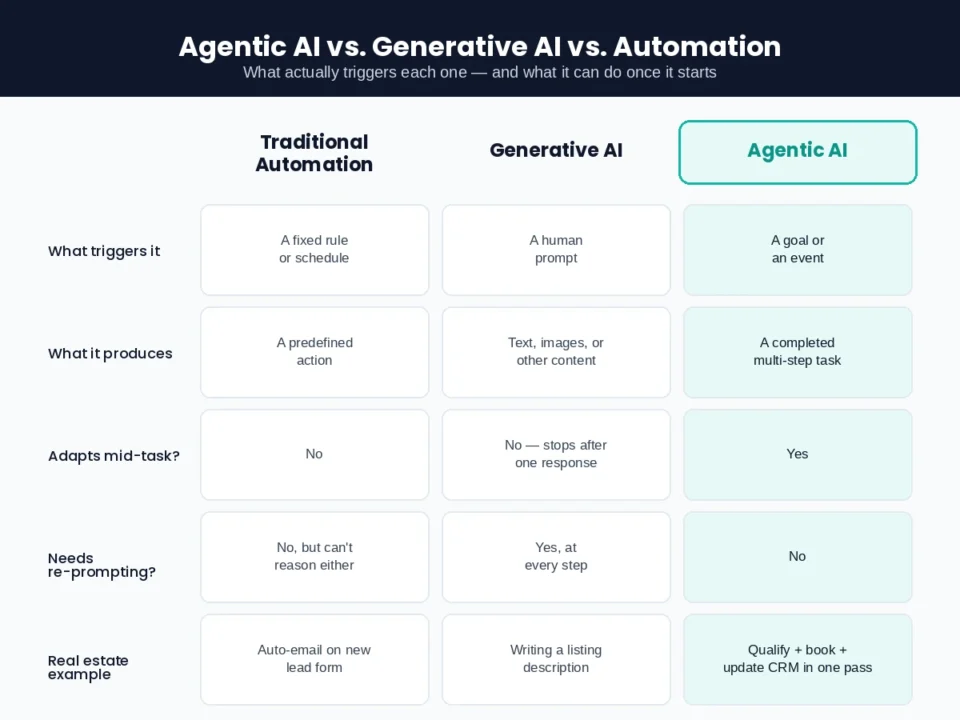
| Traditional Automation | Generative AI | Agentic AI | |
|---|---|---|---|
| What triggers it | A fixed rule or schedule | A human prompt | A goal or an event |
| What it produces | A predefined action | Text, images, or other content | A completed multi-step task |
| Can it adapt mid-task | No | No, it stops after one response | Yes, it adjusts as it goes |
| Needs re-prompting | No, but also can’t reason | Yes, at every step | No |
| Real estate example | Auto-email when a new lead form is submitted | Writing a listing description | Qualifying a lead, booking the showing, and updating the CRM in one pass |
A script that emails your team every time a new listing hits a spreadsheet is automation — genuinely useful, but it can’t reason or adjust. A tool like ChatGPT drafting your listing copy is generative AI — it creates something in response to a prompt, then stops and waits for the next one. Agentic AI sits a level above both. It plans, calls the tools it needs, and keeps working without waiting for a person to tell it what to do next.
The Building Blocks: Large Language Models, Memory, and Tool Calling
Agentic AI real estate systems are built from a few components working together, not one single piece of software:
- A large language model (LLM) handles the reasoning — reading a lead’s message or a lease clause and deciding what it means and what to do about it.
- Memory lets the agent remember what happened earlier in the conversation, or earlier in a client relationship, instead of starting from zero every time.
- Tool calling and API integration is what lets the agent actually do something: check a calendar, write to a CRM, pull live MLS data, or trigger a smart lock.
- Workflow logic and guardrails define what the agent is allowed to decide on its own and what needs a human’s sign-off.
Take any one of these away and you’re back to a chatbot that talks but can’t act, or a script that acts but can’t reason.
How Agentic AI Actually Works: The Perceive-Reason-Act Loop
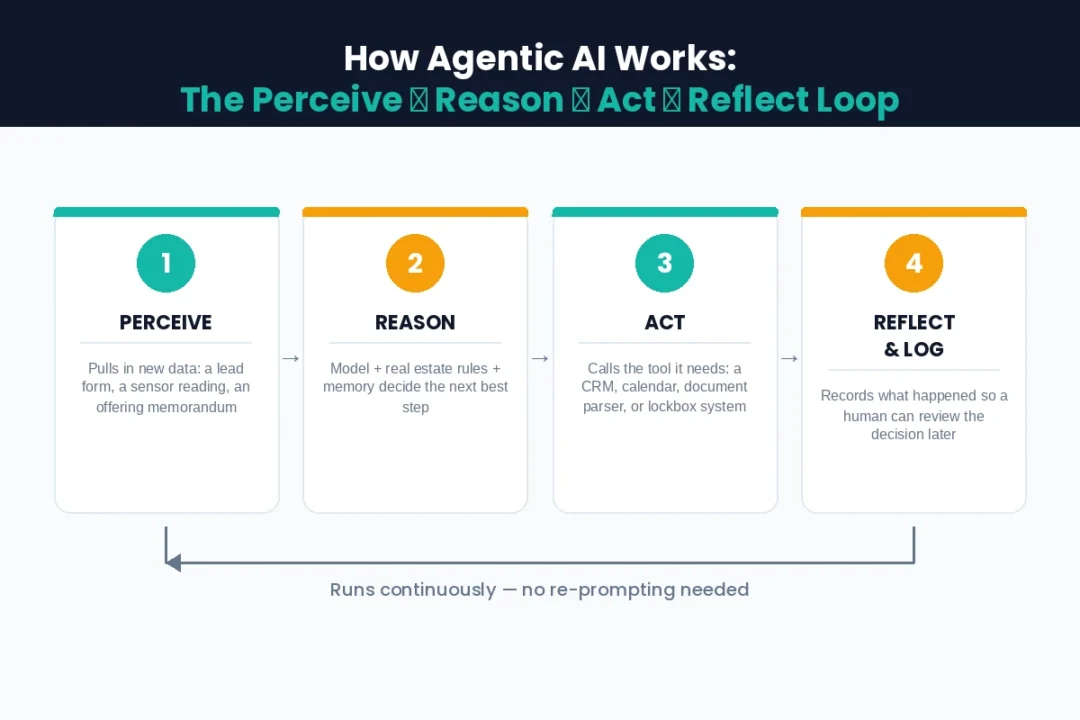
Most agentic systems run on a repeating loop:
- Perceive — the agent pulls in what it needs: a new lead’s form submission, a maintenance sensor reading, an offering memorandum.
- Reason — the underlying model, combined with real-estate-specific rules and memory of past interactions, figures out the next step.
- Act — the agent calls whatever tool the step requires: a CRM API, a calendar, a document parser, a lockbox system.
- Reflect and log — after acting, the agent records what happened, so the next step has full context and a human can review the decision later.
That log is what separates a real agentic deployment from a chatbot bolted onto a website. It isn’t just replying — it’s touching your calendar, your CRM, and your data, and leaving a trail behind it.
Why 2026 Is the Turning Point for Agentic AI Adoption
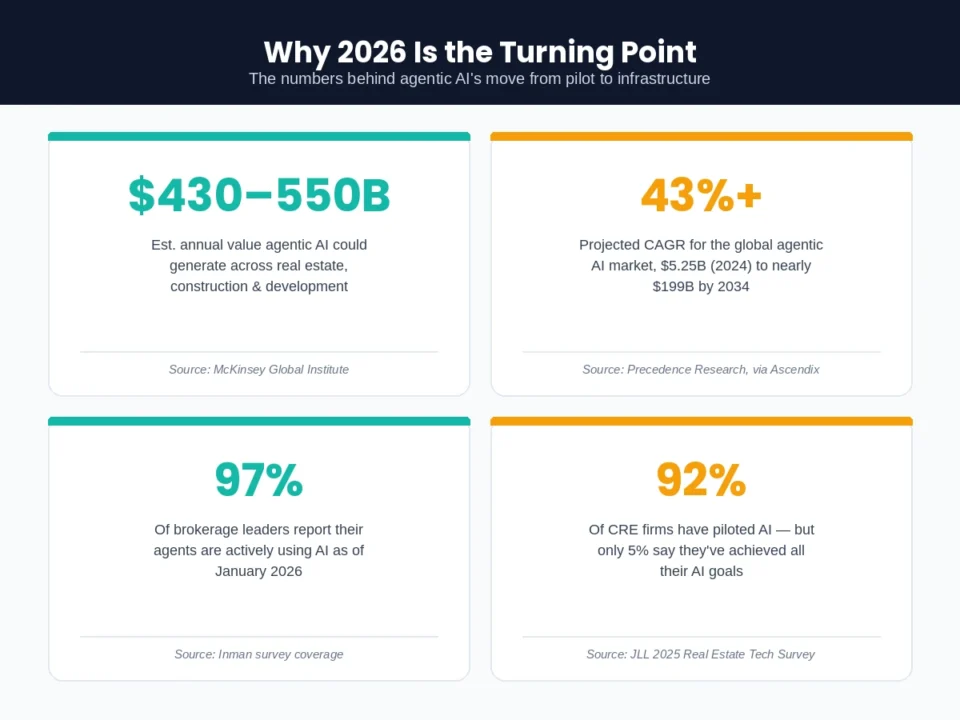
Agentic AI in real estate has moved past the experimental stage faster than most other proptech categories. A few numbers explain why:
- McKinsey Global Institute estimates automation, including AI applied to knowledge work, could generate roughly $430 billion to $550 billion in annual value globally across real estate, construction, and development.
- The global agentic AI market itself was valued at roughly $5.25 billion in 2024 and is projected to reach nearly $199 billion by 2034, a compound annual growth rate above 43%, according to Precedence Research data cited by Ascendix.
- Gartner expects 40% of enterprise applications to embed task-specific AI agents by the end of 2026, up from under 5% in 2025 — though the same research warns more than 40% of agentic AI projects could fail by 2027 without proper governance, per Forbes.
- A January 2026 survey covered by Inman found 97% of brokerage leaders report their agents are actively using AI, with the industry describing it as infrastructure now, not an experiment.
- Global PropTech investment reached $16.7 billion in 2025, a 67.9% year-over-year jump that surpassed pre-pandemic funding levels, according to CRETI’s 2025 year-end analysis, with capital increasingly favoring AI-enabled platforms with strong data foundations.
- On the commercial side, JLL’s 2025 Global Real Estate Technology Survey found 92% of CRE firms have piloted AI, but only 5% say they’ve achieved all their AI goals.
That last stat is the important one. Money is flowing into agentic AI faster than operational readiness is catching up. The organizations pulling ahead are the ones redesigning entire workflows around agents — not the ones adding a chatbot to an existing process and calling it done.
Where Agentic AI Is Already at Work in Real Estate
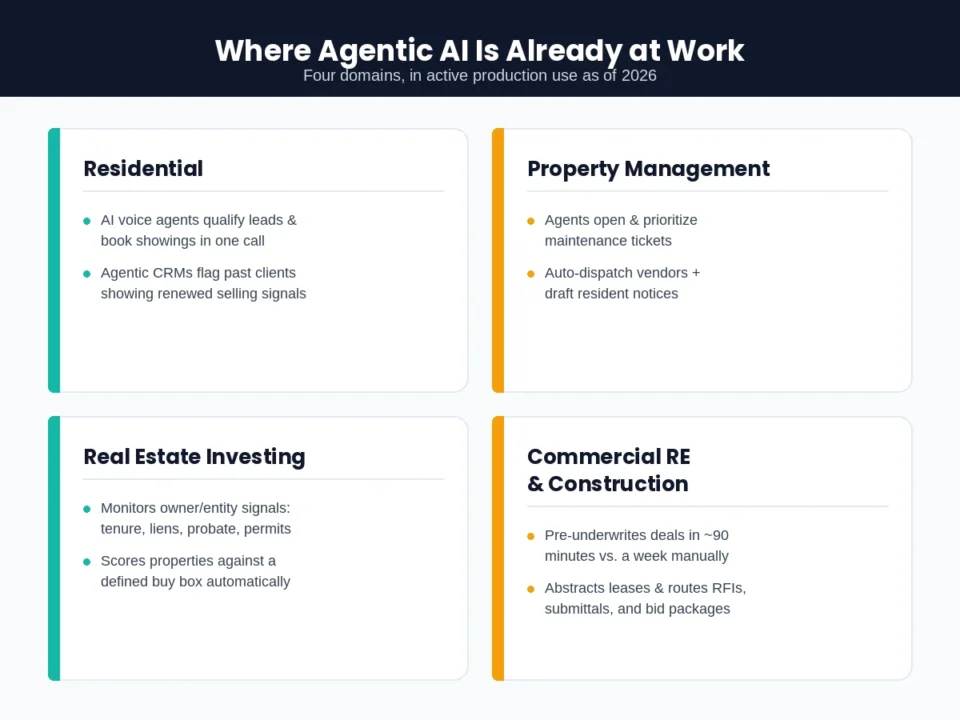
Residential: AI Voice Agents for Lead Qualification and Showings
Speed decides a lot of residential deals before an agent ever picks up the phone. Industry research has found the average agent takes over 900 minutes to respond to a new lead — by which point a buyer has often already spoken with two or three competitors. Separately, agents who respond within 5 minutes are roughly 21 times more likely to qualify a lead than those who wait 30 minutes.
AI voice agents close that gap. They call a new lead within seconds of a form submission, ask the standard qualifying questions — budget, financing status, timeline, neighborhood preferences — and book a showing directly on a live calendar, all inside one call. They also handle:
- After-hours and weekend inbound calls that would otherwise go to voicemail
- Automated reminder calls before scheduled showings, to cut down on no-shows
- Multilingual conversations, so a bilingual lead gets the same qualification experience as an English speaker
- Long-term nurture check-ins at 30-, 60-, and 90-day intervals for leads who aren’t ready yet
Every call gets logged automatically — recording, summary, disposition, and next action — so a human agent has full context before their next touchpoint.
The results show up in the numbers. McKinsey has worked with home builders who improved lead response times by more than 90% using always-on agentic follow-up, and with rental organizations that improved renewal rates by 3 to 7 percent after putting agentic workflows into their leasing process.
Residential: Agentic CRMs and Sphere Nurturing
A newer category of tool coordinates several specialized agents at once instead of handling one task at a time. Some platforms now run a lead-prioritization agent, a sales agent that engages and qualifies leads, and a separate agent that flags which past clients are showing renewed selling signals — all running simultaneously, without a person prompting each one individually.
This matters because most AI-powered CRM tools have historically been built to convert cold leads from a portal, not to protect an agent’s existing sphere. Since most transactions come from repeat and referral business, an agentic system that proactively notices “this past client just started browsing again” closes a gap that reactive tools miss entirely.
Property Management: Maintenance and Operations
Property management is one of the clearest, lowest-risk proof points for agentic AI, because the tasks are high-volume, rules-based, and easy to measure. In pilot deployments examined by McKinsey, agents that autonomously open maintenance tickets, sort them by priority, dispatch staff, and send status updates cut workflow times by more than 30%. Higher-stakes decisions — anything involving significant cost or a contract — still route to a human for approval.
Real Estate Investing: Agentic Deal-Sourcing Pipelines
For individual and small-fund investors, the most useful form of agentic AI isn’t a chatbot — it’s a sourcing pipeline that runs continuously in the background. A typical setup:
- Monitors public signals that suggest an owner may be close to selling: long ownership tenure, loan maturities, stalled permits, tax delinquency, or probate filings
- Resolves the entity behind a property, since a growing share of investment property sits inside an LLC. The share of U.S. single-family rentals held through LLCs, LPs, and LLPs reached 20.6% in 2024, up from 15.2% three years earlier, according to the Harvard Joint Center for Housing Studies
- Enriches the resolved owner with a current phone number, email, and confidence score
- Scores each flagged property against a defined buy box — asset type, size, location, price band, condition
- Automates the first outreach and hands warm replies to a CRM
Done manually, each of these steps means checking recorder sites, permit portals, and tax rolls one property at a time. An agentic pipeline watches all of them continuously across an entire market.
Commercial Real Estate: Underwriting and Deal Screening
This is where agentic AI’s time savings show up most dramatically. Underwriting a mixed-use deal used to take a commercial analyst more than a week. Agentic systems now run a full analysis in about 90 minutes, with a human analyst spending another 20 minutes reviewing the output — the difference between bidding on three deals a quarter and fifteen.
A typical agentic underwriting workflow:
- Screens hundreds of listings daily against defined investment criteria — asset class, geography, price range, occupancy
- Extracts data from T-12 income statements, rent rolls, and offering memoranda
- Calculates net operating income (NOI), models the debt service coverage ratio (DSCR) at a target leverage level, and estimates a 5-year IRR range across base, upside, and downside scenarios
- Flags risks automatically — near-term lease expirations representing a large share of NOI, below-market rents that suggest an inflated pro forma, or environmental disclosures needing further review
Teams screening 10–20 deals a week report AI pre-underwriting alone can reclaim 30 to 80 analyst hours weekly.
Commercial Real Estate: Lease Abstraction and Due Diligence
An estimated 80% of enterprise real estate data still lives outside databases — in PDFs, scans, and email threads. Purpose-built agentic systems can read complex retail leases and produce a structured comparison of uses, rents, escalations, and renewal options in under seven minutes, while flagging unusual clauses.
At the portfolio level, this adds up. Goldman Sachs has estimated AI tools could reduce CRE due diligence costs by 20–35% for large institutional portfolios, and CBRE reporting has found development teams using AI for underwriting complete preliminary analysis three times faster than teams without it.
Construction and Capital Expenditures: Keeping Complex Projects on Track
Construction is the real estate domain agentic AI has reached last, but it’s catching up fast. Before a project ever breaks ground, teams generate a steady stream of requests for information (RFIs), submittals, permits, and bid packages — exactly the kind of high-volume, document-heavy coordination agentic systems handle well.
In active deployments, agents are being used to:
- Draft and route RFIs, submittals, and meeting minutes automatically
- Interpret building codes and specifications to flag compliance gaps early
- Coordinate permitting workflows and bid package assembly
- Compare building information models (BIM) against actual site conditions
- Monitor for schedule-risk signals and flag change orders that exceed a defined review threshold
The payoff isn’t just speed. A complete, automatically maintained paper trail makes cost overruns and change-order disputes easier to catch before they compound into real delays.
Popular Agentic AI Platforms in Real Estate
No single platform covers every use case well. Here’s how a few widely used tools compare.
Lofty AOS
- Best for: Residential teams wanting a full agentic operating system rather than a single-task tool
- Pros: Coordinates several specialized agents at once — lead prioritization, sales, social, and homeowner re-engagement; strong at surfacing sphere and past-client opportunities
- Cons: Meaningful setup investment upfront; agents still need review during onboarding to match a brokerage’s tone and compliance requirements
BoldTrail (Inside Real Estate)
- Best for: Teams converting cold portal leads at scale
- Pros: Behavioral lead nurturing that automatically segments and prioritizes contacts based on browsing activity; mature integrations, widely deployed
- Cons: Built for stranger-to-lead conversion, not for proactively surfacing sphere or referral opportunities
AI voice agent platforms (Retell AI, Bland AI, and similar tools)
- Best for: Brokerages that need fast, always-on call qualification and showing scheduling
- Pros: Sub-60-second response to new leads; live calendar integration for real-time booking; multilingual support
- Cons: Handles structured, predictable conversations well, but hits a ceiling on emotionally complex conversations or open-ended negotiation, where a human agent is still needed
Dealpath AI Studio and similar CRE underwriting copilots
- Best for: Acquisitions teams that want document-to-model automation
- Pros: Abstracts offering memorandum data in under a minute; auditable data lineage that cites extracted numbers back to the source page
- Cons: Best treated as a first-pass model — it still needs analyst review before reaching an investment committee
ProptechOS-style building operations platforms
- Best for: Portfolio owners automating facilities, BIM, and tenant-platform data across many buildings
- Pros: Turns dashboards and alerts into actual execution instead of just recommendations; works across multiple connected systems at once
- Cons: Requires a reasonably unified data layer to be effective — fragmented building data limits what it can do out of the box
Benefits of Agentic AI in Real Estate
- Faster response times. Leads get contacted in seconds instead of hours, and CRE deals get pre-underwritten in minutes instead of days.
- Round-the-clock coverage. Voice agents and maintenance agents don’t stop working at 6 p.m. or on weekends.
- Fewer manual errors. Document extraction and data entry, historically among the most error-prone parts of real estate work, get standardized.
- More time for the parts that need a human. Agents and analysts spend more time on negotiation, advisory work, and relationship management.
- A clear audit trail. Well-built agentic systems log every action, which supports both quality control and regulatory compliance.
- Scale without proportional headcount. One agentic workflow can absorb lead or deal volume that would otherwise require hiring more staff.
Risks, Limitations, and Compliance: What to Watch Before You Deploy
Fair Housing Act and HUD Guidance
This is the single biggest compliance exposure in real estate AI. HUD has confirmed the Fair Housing Act applies to AI-generated advertising, tenant screening, and content — and that liability sits with the housing provider or agent, not the AI vendor. Language that seems harmless, like describing a neighborhood as “great for young professionals” or “close to churches,” can function as steering or a proxy for a protected class, even without any discriminatory intent. Disparate impact alone, not intent, is enough to trigger a violation.
Safeguards that show up consistently across brokerage AI programs:
- Run every AI-generated public-facing message through a Fair Housing language check before it publishes
- Avoid protected-class references and known proxy phrases — “family-friendly,” “safe neighborhood,” or references to schools and religious institutions used in a steering context
- Keep ad targeting and personalization logic limited to Fair Housing-safe segments: geography, price band, property type, and intent stage
- Audit ad segment composition on a regular cadence, since HUD’s disparate-impact standard applies regardless of intent
State rules are moving faster than federal guidance in some cases. California’s AB 723, effective January 2026, makes undisclosed AI-altered listing photos a misdemeanor. Colorado’s original AI Act (SB24-205) would have required formal impact assessments for AI used in “consequential decisions,” including housing — but it was repealed and replaced by SB26-189 in May 2026, which drops the impact-assessment requirement in favor of disclosure and transparency rules and now takes effect January 1, 2027.
Data Quality: Garbage In, Garbage Out
Researchers at McKinsey describe clean property, lease, and vendor data as the “factual layer” agents treat as ground truth. In practice, real estate data is scattered across spreadsheets, undigitized PDFs, and property management systems that don’t talk to each other. When that underlying data is wrong, an agentic system doesn’t make a small error — it executes the wrong action with full confidence, at machine speed. A legal briefing on agentic AI governance from early 2026 specifically flagged “executing erroneous actions” and “making decisions without necessary domain knowledge” as top risks.
Governance, Human Oversight, and the Trust Gap
Only about 1% of companies describe themselves as fully mature in AI deployment, even though 92% plan to increase AI spending over the next three years, according to McKinsey’s Superagency research. That gap between spending and readiness is the real story in agentic AI adoption right now.
Teams getting this right tend to follow the same pattern:
- Define clear boundaries between what the agent can decide on its own and what needs human sign-off, especially anything involving money or a contract
- Log every action so there’s a complete audit trail
- Set up anomaly alerts and a fast way to roll back a bad decision
- Tie success metrics to real outcomes — cash flow, tenant satisfaction, closed deals — instead of adoption metrics like login counts
How to Start Using Agentic AI in Your Real Estate Business
- Pick one high-volume, low-stakes workflow first. Lead response and maintenance ticketing are common starting points because they have clear metrics and limited downside if something goes wrong early on.
- Clean up your underlying data before you automate. Standardize property, lease, and contact data so the agent isn’t reasoning from broken inputs.
- Define what the agent can and can’t do. Put anything involving money, contracts, or public-facing Fair Housing-sensitive language behind a human approval step.
- Connect it to your live systems. An agent is only as useful as its access to your current MLS feed, calendar, and CRM — not a static export from last month.
- Review early and often. Teams that succeed typically check a sample of agent interactions weekly during the first month, then taper off as accuracy stabilizes.
- Expand one workflow at a time. Once one domain is stable and measurable, move to the next instead of attempting an all-at-once rollout.
Agentic AI vs. Human Real Estate Agents: What Actually Changes
Agentic AI doesn’t remove the need for a licensed agent — it shifts where an agent’s time goes. Routine coordination, first-touch qualification, and document review increasingly get handled by agents; negotiation, fiduciary duty, complex client relationships, and final decisions stay with humans. Some industry estimates suggest a large share of tasks currently performed by junior staff could eventually be automated, which reshapes team structure far more than it eliminates the profession.
The Future of Agentic AI in Real Estate
A few directions are already visible heading into 2027 and 2028:
- Voice and action merge. Voice agents will increasingly send a floor plan by text or pull up a virtual tour mid-call, instead of just talking.
- Agent-to-agent coordination. Brokerage AI systems are expected to start scheduling referrals and confirming appointments with each other directly, without a human placing the connecting call.
- Life beyond closing. Traditional residential revenue ends at closing; agentic systems are starting to enable ongoing client engagement that opens recurring revenue channels instead of one-time transactions.
- Institutional-grade CRE deployment. Broad institutional adoption of agentic AI across full commercial deal lifecycles — from screening through closing and portfolio surveillance — is expected within roughly 12 to 24 months of the pilots running today.
- AI-native search as a discovery channel. More buyers and sellers are starting their “which agent should I trust” research inside AI answer engines rather than traditional search, which is starting to shape how brokerages structure their public content.
Frequently Asked Questions
What is agentic AI in real estate, in simple terms?
It’s AI that completes a multi-step real estate task on its own — like qualifying a lead and booking a showing in one continuous action — rather than just answering a single prompt and stopping.
How is agentic AI different from a chatbot?
A chatbot answers whatever you ask and stops there. Agentic AI plans a sequence of steps toward a goal, calls the tools it needs — a calendar, a CRM, a document parser — and carries context from one step to the next without being re-prompted.
Is agentic AI legal to use for real estate marketing?
Using AI itself isn’t the legal issue — what it produces is. HUD has confirmed the Fair Housing Act applies to AI-generated advertising and content, and liability sits with the agent or brokerage, not the AI vendor. Every AI-generated public-facing message should be reviewed for Fair Housing language before it publishes.
Will agentic AI replace real estate agents?
Not in the near term. It’s automating repetitive, rules-based coordination — qualification, scheduling, document review — while negotiation, fiduciary responsibility, and client relationships remain human-led. Some industry estimates suggest a large share of junior staff tasks could eventually be automated, which reshapes team structure more than it removes the profession.
What real estate tasks can agentic AI handle today?
Lead qualification and showing scheduling, after-hours call response, maintenance ticket routing and vendor dispatch, off-market deal sourcing, CRE pre-underwriting, and lease abstraction are all in active, production use as of 2026.
Is agentic AI only useful for large brokerages or institutional investors?
No. Voice agent platforms and agentic CRMs are priced and built for solo agents and small teams, not just enterprise portfolios. The entry cost is generally low; the real friction is workflow setup and review discipline in the first few weeks.
What’s the biggest risk of deploying agentic AI too fast?
Bad underlying data. If property, lease, or contact data is inaccurate, an agent won’t make a small mistake — it will execute a confident, wrong action at machine speed. Clean data and a defined human sign-off step for high-stakes decisions are the two most consistent safeguards across successful deployments.
Conclusion
Agentic AI in real estate isn’t a future concept — it’s running lead qualification calls, opening maintenance tickets, sourcing off-market deals, and pre-underwriting commercial acquisitions right now, in 2026. It genuinely compresses work that used to take days into minutes. But the firms getting real value from it aren’t chasing the flashiest tool on the market.
They’re redesigning one specific workflow at a time, cleaning up their underlying data, and keeping a human accountable for anything that carries legal or financial weight. Start with one high-volume, low-stakes process, measure it honestly, and expand from there.
If you’re building out your full AI marketing stack, this page pairs naturally with our complete Best AI Tools for Real Estate Agents 2026 pillar guide.