
Table of Contents
Quick Answer
If you’re thinking about Can AI Replace a Real Estate Agent? then the Short answer is : No, AI can’t replace a real estate agent, and nothing on the market in 2026 comes close to doing the whole job. What AI has done is take over the mechanical half of real estate work: pulling comparable sales, drafting listing copy, qualifying leads at 2 a.m., and building a first-pass valuation in seconds instead of hours. According to the National Association of Realtors, 88% of buyers and 91% of sellers still worked with a licensed agent in 2025, both near all-time highs.
What AI can’t do is negotiate a counteroffer, carry legal and fiduciary liability for the transaction, sense when a seller’s real bottom line has shifted, or hold a real estate license at all. No U.S. state allows that. The agents actually at risk aren’t the ones using AI. They’re the ones who were never offering much beyond paperwork in the first place.
What “Replacing a Real Estate Agent” Would Actually Require
Most “AI vs. real estate agent” arguments only look at one slice of the job, usually pricing or marketing, and then declare the whole profession obsolete. That’s not really a fair test. A real estate transaction bundles together a lot of separate skills, and an AI tool would need to cover all of them to actually replace an agent, not just one or two.
Here’s what’s actually packed into the job:
- Pricing the home correctly using a comparative market analysis (CMA), not just an algorithm’s best guess
- Marketing and exposure: MLS syndication, photography, listing copy, social promotion
- Screening buyers and scheduling showings safely
- Fielding offers and negotiating price, repairs, and contingencies
- Managing a legally binding contract through inspection, appraisal, and financing deadlines
- Coordinating inspectors, appraisers, lenders, title companies, and escrow through closing
- Carrying a fiduciary and legal duty to the client, backed by a license and insurance
- Providing judgment and a steady presence through what’s usually the largest financial decision of a person’s life
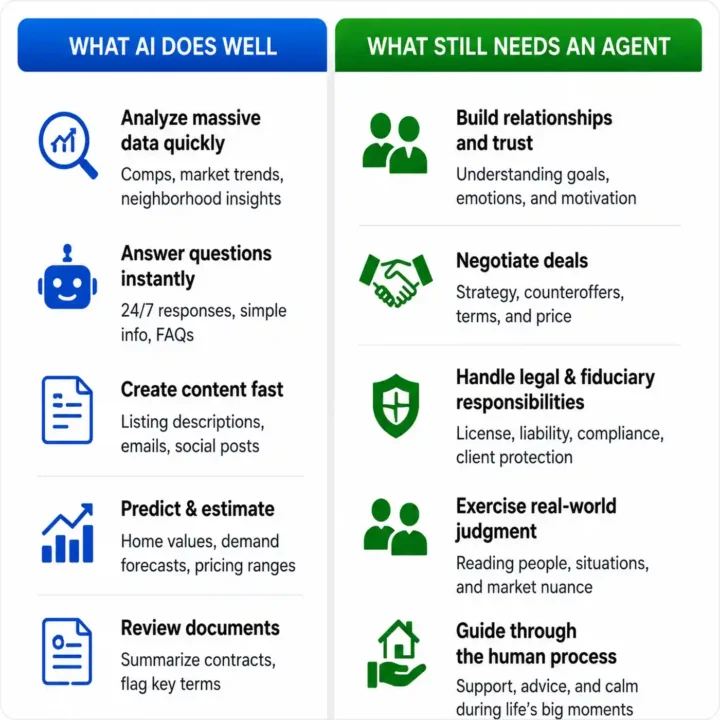
AI is genuinely good at parts of this list. It isn’t close to good at the rest. The rest is also the part that was never really about data entry to begin with.
Where AI Already Does Real Work in Real Estate
Real estate has quietly become one of the more AI-saturated industries in the U.S. economy. An RPR survey of 225 real estate professionals, published in early 2026, found that 82% of agents already use AI in their business, and 92% are either using it now or planning to. A separate January 2026 survey of brokerage leaders by Delta Media put agent-level AI usage even higher, at 97%. Broader industry tracking shows that number climbing fast — brokerage-level adoption sat at around 80% as recently as 2024.
That adoption is concentrated in a handful of areas where generative AI genuinely earns its keep.
Property Valuations and Pricing Data
Automated valuation models (AVMs) like Zillow’s Zestimate use machine learning and public records to estimate a home’s value for more than 100 million properties. Zillow’s own published accuracy data puts the median error at roughly 2% for homes currently on the market, and roughly 7% for homes that aren’t listed.
That gap matters. The on-market number looks better mainly because the model has a live listing price to anchor to. If you’re checking your home’s value while it’s off-market, which is most of the time, you’re looking at the least reliable version of that number. Zillow itself is upfront that a Zestimate is a starting point, not an appraisal and not a CMA.
Lead Generation and Instant Response
AI chatbots and virtual assistants are now the second most common AI tool category among agents, per the RPR data, used by 47% of respondents. Their real advantage is speed. A buyer who fills out an online form at midnight typically hears back from two or three agents at once, and whoever responds first usually keeps that lead. A chatbot never sleeps, never gets stuck in an inspection, and never lets a lead go cold overnight.
Marketing Copy and Listing Content
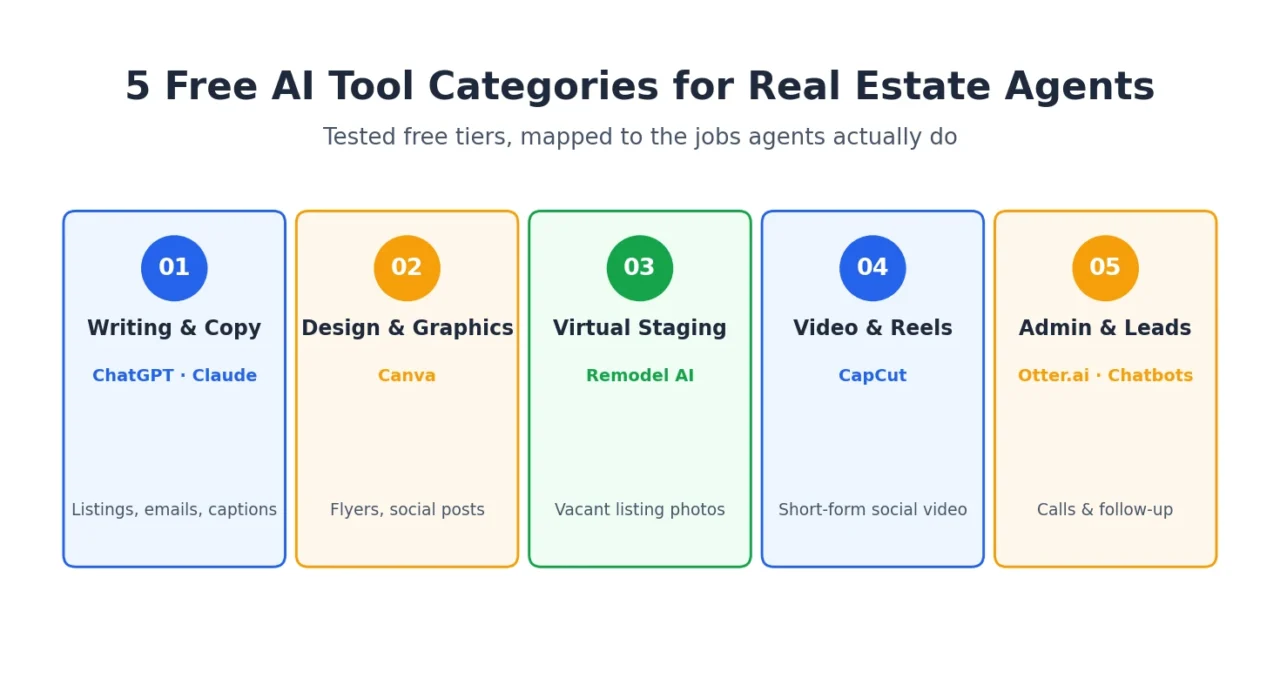
Writing tools are the single most-used category of AI in real estate, with 77.93% of agents using them, according to the RPR survey. The biggest impact shows up in listing descriptions (68.47% of agents), social media content (59.46%), and email or newsletter copy (53.15%).
This is also where things go wrong fastest if nobody checks the output. AI-written listings have already been caught inventing details outright, including a documented case of an Australian real estate agency using ChatGPT to write a listing that claimed proximity to schools that don’t actually exist. Fast copy still needs a human fact-check against the MLS data before it goes live.
Market Analysis and Predictive Insights
Beyond single-property pricing, AI models can process years of sales data, permit records, and demographic shifts to flag trends a person would take days to spot manually, like which ZIP codes are heating up before comps fully reflect it. This is genuinely useful for investment analysis and pricing strategy, as a research input rather than a final answer.
Document Review and Contract Summarization
AI tools can scan a 40-page purchase agreement, flag unusual clauses, and hand an agent a quick read of what actually matters instead of a slow manual pass through every page. The same speed shows up in building a first-pass CMA: pulling every comparable sale in a radius and formatting several pricing scenarios in minutes rather than the hour or so it used to take. It’s a genuine time-saver for the paperwork side of a transaction.
Virtual Staging and Visualization
AI staging tools can now generate a fully furnished version of an empty room in real time, sometimes while an agent is standing in the property with a seller. Virtual tours and 3D walkthroughs, powered by similar underlying tech, help buyers filter listings faster before ever booking an in-person showing.
What AI Still Can’t Do (and Why It Matters)
This is the half of the job that shows up in almost every industry conversation about AI and real estate agents, and for good reason. None of it is about to change soon.
Negotiate Under Real Pressure
An AI model can pull every comparable sale in a five-mile radius and recommend a price in under a minute. What it can’t do is read the room. Real negotiation in real estate rarely happens on paper. It happens in the tone of an agent’s voice when presenting an offer, in the three-second pause after a counteroffer lands, in knowing whether a seller who swore they wouldn’t budge is actually done or just posturing. That’s pattern recognition built from years of reading people, not data.
Carry Fiduciary and Legal Responsibility
Every U.S. state requires a licensed natural person, or a licensed corporation acting through licensed individuals, to represent someone in a real estate transaction for compensation. California’s Department of Real Estate reaffirmed this directly in a 2026 licensee advisory: using AI doesn’t change the fact that only DRE-licensed persons or corporations may perform licensed real estate activities, and brokers still owe clients a fiduciary duty regardless of what tools they use.
Practicing real estate without a license is a crime in every state, and a felony in several. Arizona, for example, classifies it as a Class 6 felony carrying up to two years in prison and a $150,000 fine for a first offense. AI has no legal personhood. It can’t hold a license, carry errors-and-omissions insurance, or be held liable in court. Someone with skin in the game still has to sign off on the advice.
Read Hyper-Local Nuance
Linda O’Koniewski, broker-owner of Leading Edge Real Estate in Boston, described this exact problem in a 2026 HousingWire interview: sellers getting AI-generated repair lists back with items like gutter extensions and GFCI outlet upgrades that don’t reflect what’s actually customary or reasonably priced in that specific market. AI is good at reading a document. It’s much weaker at knowing what a contractor in that ZIP code actually charges, or why a renovation two doors down skews the comps.
Provide Real Emotional Steadiness
Buying or selling a home is regularly one of the biggest financial and emotional decisions a person makes. A good agent notices when a buyer’s hesitation is about the house or about something else entirely, and knows when to just listen instead of talk. No chatbot replicates that, and consumer research backs up how much this still matters: a 2026 Cotality survey found trust in AI to help find a home actually fell to just 16%, a 14-point year-over-year drop, even as AI usage kept climbing.
Physically Show Up
AI cannot walk a buyer through a property, notice a water stain behind a curtain, catch a strange smell in the basement, or gauge someone’s real-time reaction to a room. Photos and 3D tours help with filtering, but the final walk-through is still a human job.
The Real Math: What’s Actually Being Automated
A useful way to think about this, instead of a blanket yes-or-no, comes from a June 2026 report by consultants Amit Kulkarni and Russ Cofano of Alloy Advisors called “The Home Sale Transaction, Reconsidered.” It splits a typical listing into two buckets.
Commoditized tasks — MLS data entry, listing descriptions, transaction coordination — used to carry a combined value of roughly $1,500 to $3,500 per listing. With modern AI tools, the report found the marginal cost of doing this work has dropped close to zero, aside from around $10 to $30 per deal in workflow software.
Human-value tasks — skilled negotiation execution, emotional coaching, on-site judgment, hyperlocal knowledge, and licensed fiduciary accountability — were valued at roughly $2,000 to $6,500 per transaction, regardless of home price. That last part is the key detail: a 3% commission on a $400,000 home works out to $12,000, and on a $1.5 million home it’s $45,000, even though the actual negotiation and judgment involved doesn’t scale up alongside it.
That’s the actual shift happening in the industry right now. The cheap, mechanical part of the job got cheaper. The hard part didn’t, and it’s not clear AI is anywhere close to touching it.
AI vs. Human Real Estate Agent: Quick Comparison
| What’s Needed | AI Tools | Human Agent |
|---|---|---|
| First-pass home valuation | Fast, consistent, free | Slower, but adjusts for what AI can’t see |
| Listing descriptions & social posts | Strong first draft | Needs a human edit for voice and accuracy |
| Responding to leads at 2 a.m. | Instant | Not realistic |
| Reading a seller’s real bottom line | Can’t do it | This is the job |
| Legal and fiduciary responsibility | None — can’t hold a license | Required by law in all 50 states |
| Negotiating repairs after inspection | Suggests numbers | Negotiates outcomes |
| Emotional steadiness during closing | None | Central part of the role |
| Physically walking a property | Can’t | Can |
Pros and Cons of AI-Driven Alternatives to a Real Estate Agent
People rarely ask “can AI replace a real estate agent” in the abstract. Usually they’re comparing a specific AI-powered option against hiring an agent. Here’s how the main ones actually stack up.
Automated Valuation Models (AVMs) — e.g., Zillow’s Zestimate
Pros
- Free and instant, covering well over 100 million U.S. homes
- A reasonable ballpark for tracking your equity over time
- Improves in accuracy once a home is actively listed and the model has fresh data
Cons
- Median error jumps from about 2% on-market to about 7% off-market — a meaningful dollar swing on a typical home
- Can’t see condition, recent renovations, or unique features unless someone manually updates the record
- Lenders don’t accept it in place of a licensed appraisal, and it’s not a substitute for a CMA
iBuyers (Opendoor, Offerpad)
Pros
- Speed and certainty: closings in as little as 8 to 14 days
- No showings, staging, or open houses required
- A real option when moving fast matters more than maximizing price
Cons
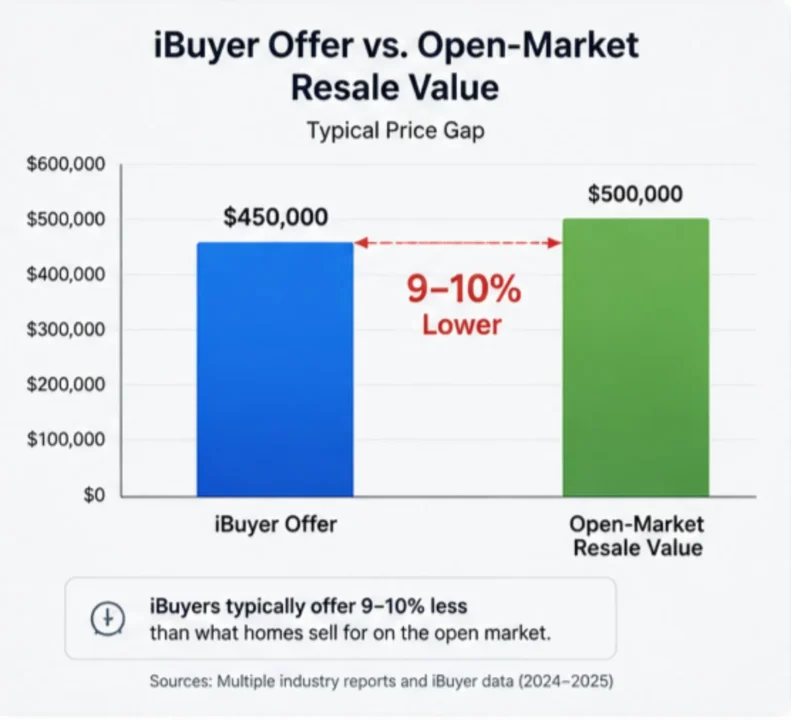
- One widely cited analysis of over 530 homes by real estate analyst Mike DelPrete found Opendoor’s purchase prices ran about 9% below eventual open-market resale value, and Offerpad’s about 10% below
- Service fees typically run 5% to 8%, on top of largely non-negotiable repair deductions after inspection
- Several states, including Texas under a 2026 law, still require a licensed agent’s written agreement before an iBuyer can show or make an offer on a home — and that agent represents the company’s interests, not yours
AI Chatbots and Virtual Assistants
Pros
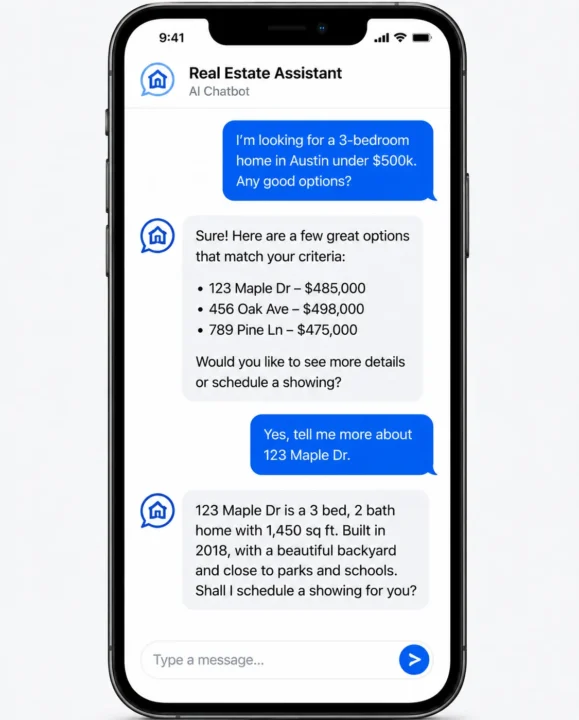
- Instant, 24/7 response that never lets an inbound lead go cold
- Handles routine questions, scheduling, and initial qualification well
- Frees up an agent’s time for higher-value conversations
Cons
- Can misstate property facts if outputs aren’t reviewed before publishing
- Feels impersonal or even deceptive if a consumer isn’t told they’re talking to a bot
- Needs a human handoff for anything emotionally loaded or legally sensitive
AI-Powered CRMs and Lead Generation Platforms
Pros
- Automatic behavioral tracking and follow-up based on what a lead actually does online
- Lead scoring helps agents prioritize who to call first
- Saves real hours per week on manual data entry and reminders
Cons
- Often built to convert cold, unknown leads and weaker at nurturing an agent’s existing sphere of past clients and referrals
- Still requires a human to actually close the relationship, not just the workflow
- For a full breakdown of specific platforms, see our guide to AI CRM tools for realtors
Who’s Actually at Risk From AI in Real Estate?
Production in this industry has always been lopsided. Industry observers like Allan Dalton, former CEO of Realtor.com, have long pointed out that roughly 20% of agents produce around 80% of total transactions in a typical market. AI doesn’t create that gap. It widens it.
Agents most exposed to AI-driven disruption tend to share a few traits:
- Part-time or low-volume agents offering little beyond opening doors and filing paperwork
- Agents who compete purely on being “nice” or “available,” without a real negotiation or pricing strategy
- Anyone whose entire value proposition was information access, in a world where a buyer can now ask an AI model the same questions for free
Agents least exposed tend to operate as advisors and negotiators first, using AI to buy back hours rather than to replace judgment. The National Association of Realtors’ 2025 Profile of Home Buyers and Sellers found that 76% of first-time buyers specifically credited their agent with helping them understand the process, and more than half of all buyers said their agent pointed out property issues or flaws they’d have otherwise missed. That’s not a service AI currently offers.
How Smart Agents Are Actually Using AI
Brokers who are ahead of this shift aren’t treating AI as competition. A few practical patterns are showing up across the industry:
- Using AI for a first-draft listing description or CMA, then applying local judgment before it reaches a client
- Letting a chatbot handle after-hours questions, then personally following up the next morning
- Being upfront with clients about where AI is being used, instead of pretending every reply is typed by a human
- Actively showing clients where AI gets local details wrong — pulling up an AI-generated price estimate in a listing appointment and walking through why the real number differs
That last point reflects a broader shift some brokerage leaders describe: agents moving from being the source of information to being the interpreter of it. Buyers and sellers increasingly show up to a first meeting having already asked an AI model a dozen questions. The value now sits in helping them figure out what that information actually means for their specific situation.
The Legal Reality: Why AI Can’t Hold a Real Estate License
This is the part of the “can AI replace a real estate agent” debate that tends to get skipped, and it’s arguably the most concrete answer available.
Every U.S. state requires a real estate license to represent a buyer or seller in exchange for compensation. That license can only be held by a natural person, or by a licensed corporation acting through its licensed individuals. AI is neither. It cannot sit for a licensing exam, carry errors-and-omissions insurance, be disciplined by a state real estate commission, or be sued for breach of fiduciary duty.
California’s Department of Real Estate addressed this directly in a 2026 advisory to licensees: AI use doesn’t change three fundamentals of real estate law. Only DRE-licensed persons or corporations may perform licensed activities, brokers must supervise the work happening under their license, and brokers and their agents still owe clients a fiduciary duty. The same basic structure holds across other states, even where the specific regulator hasn’t issued formal guidance yet.
There’s also a fair housing angle worth knowing about. AI models used for advertising, lead prioritization, or pricing can produce discriminatory outcomes even without anyone intending it, and using AI doesn’t shield a licensee from liability under the Fair Housing Act or state-level equivalents. That legal exposure sits with the human license holder, not the software vendor.
None of this is a permanent, unchangeable law of physics. Legal frameworks can shift over time, the way liability rules have started adapting around autonomous vehicles. But as of 2026, the license, the insurance, and the legal accountability all still have to trace back to a human being.
Frequently Asked Questions
Will AI completely take over real estate jobs?
Not in the foreseeable future. AI is automating the mechanical, repeatable parts of the job, like pricing research, first-draft marketing, and lead qualification, but licensing law, fiduciary duty, and real negotiation still require a human. It will keep shrinking demand for agents who offer little beyond paperwork, without eliminating the profession.
Can AI negotiate a home sale better than a real estate agent?
AI can model offer scenarios and suggest numbers based on comparable sales, but negotiation is a real-time, high-stakes reading of tone, timing, and motivation. No AI tool currently available handles that reliably, especially once a deal gets contentious.
Is Zillow’s Zestimate accurate enough to price my home instead of getting a CMA?
Not on its own. Zillow’s published data shows a median error around 2% for on-market homes and about 7% for off-market homes, which can mean tens of thousands of dollars on a typical property. Zillow itself describes it as a starting point, not an appraisal or a replacement for a local agent’s comparative market analysis.
Do I still need a real estate agent if I already use AI tools to research homes?

Most people still do, and the data backs that up. NAR’s 2025 Profile of Home Buyers and Sellers found 88% of buyers and 91% of sellers used a licensed agent, both near record highs, even as consumer AI use for research has grown quickly.
Is it legal to use an AI chatbot instead of a licensed agent for my transaction?
No. Every U.S. state requires a licensed person to represent a buyer or seller in a real estate transaction for compensation. An AI chatbot can answer general questions or gather information, but it can’t legally serve as your agent, hold a license, or carry fiduciary responsibility for the deal.
Which real estate agents are most likely to be replaced by AI?
Part-time and low-volume agents who mainly provide paperwork and access to listings, without real pricing strategy or negotiation skill, are most exposed. Full-service, relationship-driven agents who use AI to handle routine tasks are generally seeing the opposite effect: more time for the work that actually differentiates them.
Will AI lower real estate agent commissions?
It’s already applying pressure in that direction. As routine tasks like listing entry and marketing become nearly free to produce with AI, and as commission structures have become more negotiable since the 2024 NAR settlement, the pricing conversation is shifting toward what specific, high-value work an agent actually does for their fee.
What’s the best way for agents to use AI instead of competing with it?
Use AI to handle the repeatable, low-judgment tasks (first drafts, after-hours responses, CMA prep) and reserve your time for negotiation, local expertise, and client relationships. Being transparent with clients about where AI is used tends to build trust rather than erode it.
The Bottom Line
AI is not going to replace real estate agents in 2026, and the honest reason isn’t sentimental, it’s structural. Every state still requires a licensed human to carry legal and fiduciary responsibility for a transaction, and no AI system can negotiate under pressure, read a room, or physically walk a property. What AI has genuinely done is make the mechanical parts of the job faster and, in many cases, nearly free.
That’s not bad news for agents. It’s a filter. The agents who only ever offered paperwork and access are the ones losing ground, because a buyer can now get that from a free chatbot. The agents who offer judgment, negotiation, and a steady hand through the biggest financial decision most people ever make are seeing AI free up more time to do exactly that.
If you’re trying to figure out which AI tools are actually worth adopting this year rather than just hype, our full guide to the best AI tools for real estate agents in 2026 breaks them down by category, so you’re not guessing.