
Table of Contents
Quick answer
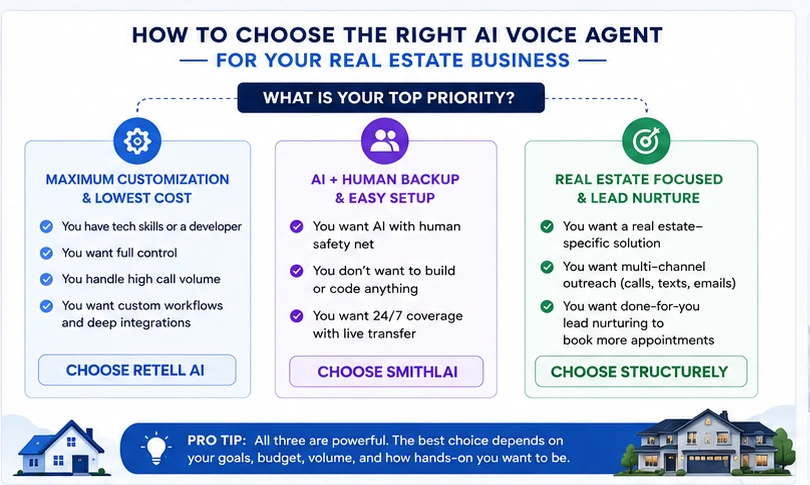
The best AI voice agents for real estate depends on what you’re trying to fix. Retell AI is the strongest pick if you (or a developer on your team) want to build a custom voice bot at the lowest per-minute cost, with real-time calendar and CRM actions during the call. Smith.ai is the better choice if you want AI answering with a real human backup for the calls a bot shouldn’t handle alone — no coding required. Structurely is purpose-built for real estate: it’s an AI inside sales agent that texts, emails, and calls leads for 12+ months until they’re ready to talk to you.
Solo agents chasing fast setup usually start with Smith.ai or Structurely; tech-comfortable teams and larger brokerages tend to land on Retell AI for the control and cost efficiency at scale.
What Is an AI Voice Agent for Real Estate?
An AI voice agent for real estate is software that answers or makes phone calls on an agent’s behalf, using a synthetic voice that can hold a real back-and-forth conversation instead of reading a script. It’s a real estate-specific application of the broader conversational AI category.
Three technologies work together behind the scenes: speech-to-text turns the caller’s words into text, natural language processing (NLP) and a large language model figure out intent and generate a reply, and text-to-speech turns that reply back into a natural-sounding voice — ideally in under a second, so the caller doesn’t notice a delay.
When people say AI voice assistant, AI phone agent, or AI receptionist, they’re usually describing this same stack; the label just depends on who’s selling it.
For real estate specifically, that means the agent can:
- Answer an inbound buyer or seller lead the moment they call from a Zillow listing or a “Contact Agent” web form
- Handle lead qualification — budget, financing status, timeline, must-have areas — through natural conversation instead of a rigid phone tree
- Check a calendar and book a showing or consultation in real time
- Place outbound calls to FSBO (For Sale By Owner) or expired listings
- Log the conversation and update a CRM automatically
How It’s Different From a Chatbot or Virtual Assistant
A chatbot handles typed text on a website. A virtual assistant, in the older sense, usually means a human contractor doing admin work. An AI voice agent sits in between: it’s automated like a chatbot, but it operates over a live phone call, which is still where most real estate leads convert.
Some platforms blend all three. Structurely, for example, runs the same AI persona across text, email, and voice, so a lead who starts on SMS and later picks up the phone gets a consistent experience.2
Why Real Estate Needs Voice AI Specifically
AI Voice agent is one of the entire real estate ai tool combo. Speed-to-lead is the entire argument for this category. Industry research on lead response time consistently shows agents take, on average, well over 15 minutes — sometimes hours — to call back a new online lead that came in through an MLS-fed portal like Zillow or a brokerage’s IDX site. By then, that buyer has usually already spoken with two or three other agents who answered first.
The National Association of Realtors’ own technology survey work shows a strong majority of agents already use at least one AI tool in their business — voice answering is simply the layer spreading fastest, because it sits directly at the moment a lead is won or lost.
An AI voice agent picks up in under a second, every time, including nights, weekends, and open-house rushes. It doesn’t replace an agent’s judgment or negotiation skill — it replaces the gap between “lead comes in” and “someone finally calls them back.”
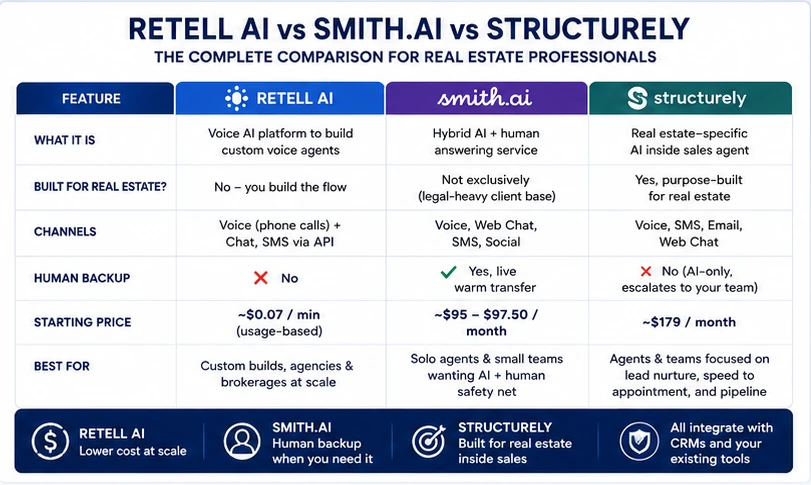
Retell AI vs Smith.ai vs Structurely: At-a-Glance Comparison
| Retell AI | Smith.ai | Structurely | |
|---|---|---|---|
| What it is | Voice AI infrastructure/platform | Hybrid AI + human answering service | Real estate-specific AI inside sales agent (ISA) |
| Built for real estate? | No — you build the flow | Not exclusively (legal-heavy client base) | Yes, purpose-built |
| Channels | Voice (+ chat, SMS via API) | Voice, web chat, SMS, social | Voice, SMS, email, web chat |
| Human backup | No | Yes, live warm transfer | No (AI-only, escalates to your team) |
| Setup effort | Moderate to high (dev/no-code builder) | Low (guided onboarding) | Low to moderate |
| Starting price | ~$0.07/min usage-based (no monthly minimum) | ~$95–97.50/month | ~$179/month |
| CRM integrations | Via API/webhook, Follow Up Boss and others | 7,000+ via native + Zapier | 60+, including Follow Up Boss, HubSpot, Salesforce |
| Best for | Custom builds, brokerages at scale | Solo agents/teams wanting AI + human safety net | Long-term lead nurture and qualification |
These prices aren’t directly comparable at a glance: Retell AI bills per minute of actual call time with no monthly floor, while Smith.ai and Structurely charge flat monthly subscriptions with call or lead caps. A low-volume Retell AI setup can cost less than $50/month; a high-volume one can exceed either competitor’s top tier. Pricing above reflects publicly listed rates as of mid-2026 and can change — always confirm current numbers directly with each vendor before budgeting.
Retell AI Review: Best for Teams That Want to Build a Custom Voice Stack
Retell AI isn’t a finished real estate product. It’s voice AI infrastructure — the engine, not the car. You or a developer connects it to a phone number, a CRM, and a calendar, then builds the qualification script yourself, either with Retell’s visual flow builder or through direct API calls.
What Retell AI Does Well
- Low latency. Retell advertises response times under a second, which is what makes a call feel like a conversation instead of a bot reading lines with a delay.
- Real-time function calling. The agent can check calendar availability and book a showing during the call, rather than emailing a confirmation afterward through Zapier-style middleware.
- Telephony flexibility. It connects to Twilio or other carriers, and supports voice engines like ElevenLabs, Cartesia, and OpenAI, so you’re not locked into one vendor.
- Cross-channel consistency. The same agent personality can run across voice, chat, and SMS.
- Security posture. Retell is SOC 2 certified and HIPAA-ready, which matters for larger brokerages with compliance requirements.
Retell AI Pricing
Retell’s advertised rate starts around $0.07 per minute of voice infrastructure, with no mandatory subscription. New accounts get $10 in free credit and 20 free concurrent calls.
The catch: that headline number covers one layer only. A working agent actually bills across four components — voice infrastructure, text-to-speech, the language model, and telephony — which typically lands most real-world setups closer to $0.13–$0.31 per minute once everything is combined. For a solo agent running roughly 1,000 minutes a month, that’s somewhere between $130 and $310, before any developer time spent building the flow.
Extra concurrent call capacity beyond the free 20 runs about $8 per slot per month, and Enterprise plans (50+ concurrency, custom compliance terms) are quote-based.
Pros & Cons
Pros:
- True usage-based billing — pay only for connected call time, no platform fee
- Fastest, most natural-feeling conversation flow of the three thanks to low latency
- Can take real actions mid-call (booking, CRM updates) instead of after the fact
- Scales from one solo agent to a large brokerage on the same platform
Cons:
- No real estate template out of the box — expect several hours of setup before it’s production-ready
- Costs are genuinely hard to forecast since the final rate depends on your LLM and voice choices
- No built-in human fallback if the AI hits a conversation it can’t handle
- Best results require some technical comfort or a developer
User ratings: Reviewers on Product Hunt rate Retell AI around 4.4/5, praising the natural-sounding, real-time conversation quality. Trustpilot scores run lower, around 3.4/5, with recurring complaints about customer support responsiveness at self-serve tiers.
Best Fit
Retell AI fits agents and brokerages that already have (or are willing to hire) some technical support, care most about cost efficiency at volume, and want full control over the qualification script rather than a pre-built one.
Smith.ai Review: Best Hybrid AI + Human Answering Service
Smith.ai built its reputation answering phones for law firms, but its AI Receptionist product is also positioned for real estate agents, contractors, and other appointment-driven businesses. The core idea: AI answers first, and if the call gets complicated, it hands off — live — to a real, North America-based receptionist.
What Smith.ai Does Well
- AI with a human safety net. Complex, emotional, or unusual calls escalate to a live agent instead of leaving the caller stuck with a bot.
- Fast to launch. No developer needed — you’re generally live within days through guided setup.
- Built-in spam filtering. Smith.ai blocks calls from a database of 20 million-plus known spam and robocall numbers before they ever reach your receptionist.
- Multichannel from one dashboard. Voice, web chat, SMS, and social messages route through a single system.
- Real estate-relevant routing. Individual agent routing numbers are supported, which matters for agents working inside a larger team or firm.
- Call recording and transcripts. Every call is recorded and transcribed automatically, with a searchable dashboard — useful for reviewing how leads were qualified without listening to the whole call.
User ratings: Smith.ai’s AI Receptionist holds roughly a 4.7/5 on G2 and around 4.3–4.4/5 on Trustpilot, though the reviewer base skews heavily toward legal and professional services rather than real estate specifically.
Smith.ai Pricing
Smith.ai runs two separate product lines:
- AI Receptionist (AI-first, human backup): starts around $95–97.50/month for a Starter tier (roughly 60 calls included), with Basic around $270/month and Pro around $800/month. Calls within your tier run about $1.60–$1.90 each, with $2.40 overage per call beyond that. A warm transfer to a live agent adds roughly $3 per escalated call.
- Virtual Receptionist (human-led, AI-assisted): starts around $292.50/month for 30 calls, scaling toward $1,275/month for higher call volumes.
Both are month-to-month with no long-term contract, and Smith.ai backs new accounts with a 30-day money-back guarantee.
Pros & Cons
Pros:
- No coding or flow-building required to get started
- Live human fallback reduces the risk of losing a lead to a frustrating bot loop
- No long-term contract; cancel with 30 days’ notice
- Strong spam and robocall filtering out of the box
Cons:
- Not built specifically for real estate — most of its deepest integrations and reviewer base skew legal
- Per-call and overage pricing can climb quickly for agents fielding hundreds of monthly leads
- Warm-transfer fees add up if the AI escalates often
- Less customizable conversation logic than a developer-built voice stack
Best Fit
Smith.ai suits solo agents or small teams who want AI call answering live in days, value having a real person as backup, and don’t have (or want to hire) developer resources.
Structurely Review: Best Purpose-Built AI Inside Sales Agent for Real Estate
Structurely is the only one of the three built from day one for real estate and mortgage. Its AI persona, marketed under the name Aisa Holmes, works as an AI ISA (inside sales agent): it texts, emails, chats, and calls leads, and keeps working them for months — not days — until they’re ready to talk to a live agent.
What Structurely Does Well
- Persistent, long-term nurture. Structurely follows up with leads for 12+ months, which catches buyers and sellers who weren’t ready when they first inquired.
- Human-like conversational pacing. The AI uses natural pauses and casual phrasing designed to feel less like a script and more like texting a person.
- Real estate-specific qualification logic. Out of the box, it asks about budget, timeline, financing, and area preference — the same questions a trained ISA would ask.
- Deep CRM coverage. More than 60 integrations, including major real estate and general CRMs like Follow Up Boss, HubSpot, and Salesforce.
- Live transfer. The moment a lead is sales-ready, the call routes straight to an agent’s phone.
Reported outcomes vary by team, but publicly shared case studies include one RE/MAX team’s appointment conversion rate rising from 5% to 15%, and another client reporting a 233% lift in conversions after adoption — useful directional evidence, though individual results depend heavily on lead quality and volume.
Structurely Pricing
Structurely’s published tiers:
- Starter: around $179/month — 1 seat, 50 leads/month
- Growth: around $299/month — 10 seats, 125 leads/month
- Build: around $499/month — 30 seats, 225 leads/month
- An alternate $3-per-lead pricing model is also available for teams with variable volume
Pros & Cons
Pros:
- Purpose-built for real estate, so there’s minimal setup before it understands the domain
- Nurtures cold and long-cycle leads automatically instead of letting them go stale in a CRM
- Handles the full channel mix — text, email, chat, and voice — under one consistent persona
- Extensive real estate CRM integration list
Cons:
- Higher entry price than raw infrastructure platforms like Retell AI
- Lead caps on lower tiers (50/month on Starter) can be limiting for busier teams
- Some reviewers note occasional mismatches between the AI’s replies and where the conversation actually is
- Voice calling is a newer addition compared to Structurely’s original text/chat strength
User ratings: Structurely’s Capterra reviews skew positive, with agents most often praising natural-sounding scripts and fast lead engagement; the most common complaint is an excess of email notifications once a conversation is underway.
Best Fit
Structurely fits agents, teams, and brokerages carrying a real backlog of buyer and seller leads who need consistent, long-term follow-up without hiring a full-time ISA.
How to Pick the Right AI Voice Agent for Your Business
If You’re a Solo Agent or Small Team
Start with Smith.ai or Structurely. Both are live within days, need no developer, and are priced for a single agent’s call volume. Choose Smith.ai if human backup on tricky calls matters most to you; choose Structurely if long-term lead nurture and multi-month follow-up is your bigger pain point.
If You’re a Brokerage or Team Lead
Structurely’s per-seat and per-lead pricing scales more predictably across a team, and its CRM sync keeps every agent’s leads visible in one place. Smith.ai also supports individual agent routing, which works well if agents want their own numbers under one account.
If You Have Developer Resources
Retell AI gives you the lowest theoretical per-minute cost and the most control — you decide exactly how the qualification flow works, which CRM it writes to, and which voice it uses. That flexibility comes with setup time and less predictable monthly billing, so it fits teams big enough to justify a build, or agencies building voice AI as a service for multiple clients.
Is an AI Voice Agent for Real Estate Legal? (TCPA & Compliance Basics)
Yes, but only with proper consent — this is not optional. In February 2024, the FCC issued a declaratory ruling confirming that AI-generated voices count as “artificial or prerecorded voice” under the Telephone Consumer Protection Act (TCPA), regardless of how human they sound. That means the same consent rules that apply to traditional robocalls apply to your AI voice agent.
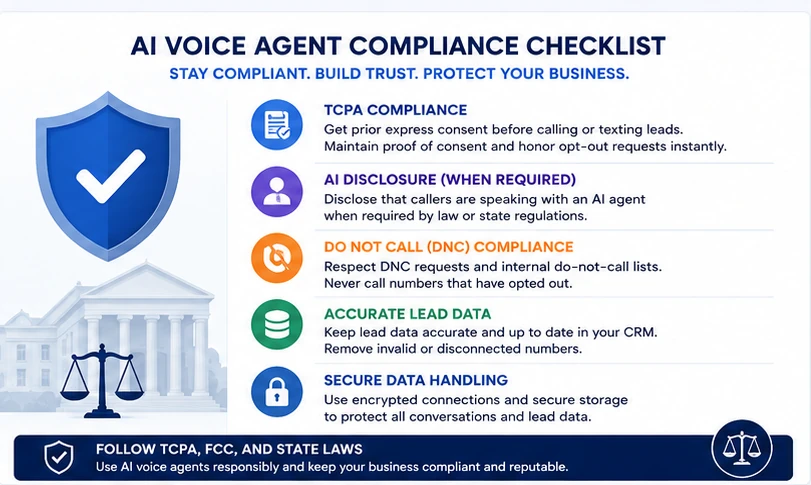
In practice, before deploying any outbound AI calling for real estate leads:
- Get prior consent. Marketing calls generally require prior express written consent in most states; informational calls need at least prior express consent.
- Disclose that it’s AI. Best practice — and increasingly a regulatory expectation — is identifying the call as AI-generated at the start of the conversation.
- Scrub against the Do Not Call (DNC) registry before dialing any number.
- Build in an opt-out. Callers need a fast, clear way to ask not to be called again.
- Keep records. Statutory damages run $500–$1,500 per violating call with no aggregate cap, and class-action exposure has grown sharply industry-wide, so documentation matters.
- Watch your qualification questions. Under the Fair Housing Act, avoid scripting anything that probes protected-class information, even indirectly — a bot asking “who else will be living there” carries the same steering risk as a human agent asking it.
- Protect your caller ID reputation. Carriers increasingly flag high-volume outbound numbers as spam risk without proper STIR/SHAKEN call authentication in place, which can quietly tank your answer rate before compliance even becomes the issue.
This applies to inbound answering less than it does to outbound cold calling FSBO and expired listings, which is exactly the use case where agents most often reach for a voice AI tool. If outbound calling is part of your plan, ask your vendor directly, in writing, how they handle consent tracking, DNC scrubbing, and AI disclosure — this varies by vendor and shifts as regulations evolve, so don’t assume any platform has it solved by default just because it’s popular for outbound use.
Frequently Asked Questions
What is the best AI voice agent for real estate agents in 2026?
There’s no single “best” — it depends on your setup. Structurely is the strongest fit if you want a real estate-specific AI ISA that nurtures leads long-term. Smith.ai fits agents who want AI answering with a human safety net and no setup work. Retell AI fits teams with developer resources who want the lowest cost and the most control.
Can an AI voice agent replace a real estate ISA?
It can handle the repetitive parts of the job — instant answering, initial qualification, and scheduling — but it doesn’t replace the judgment, objection handling nuance, and relationship-building a trained human ISA brings to a serious buyer or seller. Most agents use AI voice tools to handle volume and speed, then hand qualified leads to a human.
How much does an AI voice agent cost for a solo real estate agent?
Expect roughly $95–$180 per month at the low end (Smith.ai’s AI Receptionist Starter or Structurely’s Starter plan) up to a few hundred dollars a month depending on call or lead volume. A custom Retell AI build can run cheaper per minute but usually costs more upfront in setup time.
Do callers know they’re talking to an AI?
Under current FCC guidance, best practice is disclosing it at the start of the call. Platforms vary in how natural their AI sounds — Retell AI and Structurely are frequently cited for lower detectability due to natural pacing and low latency, but some callers will still notice, especially on longer or emotionally charged calls.
Will an AI voice agent integrate with my real estate CRM?
Most will, though the depth varies. Structurely lists 60+ integrations including Follow Up Boss, HubSpot, and Salesforce. Smith.ai connects to 7,000+ apps via Zapier plus native integrations. Retell AI connects via API and webhook, so it can reach almost any CRM with a developer setting up the connection.
Is it legal to use AI to cold call FSBO and expired listings?
Yes, if you have proper consent and follow TCPA rules, including DNC scrubbing and AI disclosure. Outbound cold calling carries more compliance risk than inbound answering, so review your consent process before scaling outbound AI calling volume.
Can I use more than one of these tools together?
Some teams do — for example, Structurely for long-term text/voice nurture on new leads, with Smith.ai or a live team handling escalations. Just make sure lead ownership and CRM logging don’t conflict between systems.
Conclusion
All three tools solve the same underlying problem — leads go cold because no one answers fast enough — but they solve it in different ways.
Retell AI gives you the raw infrastructure to build exactly the voice agent you want, at the lowest theoretical cost, if you have the technical resources to set it up. Smith.ai gives you a fast, no-code AI answering solution with a real human standing by for the calls that need one.
Structurely gives you a purpose-built AI ISA that doesn’t just answer calls — it keeps working your leads for months after the first conversation ends.
The right choice comes down to what you’re actually short on: time to build something, budget for human backup, or a system to stop leads from going cold after the first missed call. Match the tool to that gap, and speed-to-lead stops being the reason deals slip away.