
Table of Contents
Quick Answer
AI & Fair Housing Compliance means making sure any artificial intelligence tool you use in real estate — chatbots, tenant screening software, ad targeting, listing description generators, AVMs — follows the same Fair Housing Act rules a human agent would.
The law doesn’t care whether a person or an algorithm made the discriminatory decision. If your AI screens out voucher holders, targets ads away from certain zip codes, or writes “perfect for young families” into a listing, you (the agent, landlord, or broker) are legally responsible, not the software vendor. HUD confirmed this directly in 2024, and real cases — including a $2.275 million settlement involving an AI tenant-screening tool — show regulators and private plaintiffs are actively enforcing it. Using AI safely comes down to three habits: keep a human reviewing every output, document your process, and never let AI describe who should live somewhere instead of what the property offers.
What AI & Fair Housing Compliance Actually Means
The Fair Housing Act (FHA), part of the Civil Rights Act of 1968, bans discrimination in housing sales, rentals, and advertising based on seven protected classes:
- Race
- Color
- National origin
- Religion
- Sex (including gender identity and sexual orientation)
- Familial status (having children under 18, or being pregnant)
- Disability
Many states and cities add more — source of income (housing vouchers), age, marital status, sexual orientation as a standalone category, and military status are common additions. Colorado, California, New York, and Illinois all enforce broader protections than the federal floor.
Here’s the part that trips people up: the FHA doesn’t require intent. A practice can be perfectly “neutral” on paper and still violate the law if it produces a lopsided outcome for a protected group. That’s called disparate impact, or the “discriminatory effects” standard, and it’s exactly the theory that makes AI so risky — because an algorithm trained on biased historical data can reproduce old patterns of exclusion without anyone typing a single discriminatory line of code.
You Can’t Outsource Liability to a Vendor
This is the single most important idea in this entire guide, so it’s worth saying plainly: when your AI tool makes a housing decision, the law treats it as if you made that decision yourself.
HUD’s own guidance puts it this way — housing providers remain responsible for Fair Housing Act compliance even when screening, advertising, or leasing tasks are handed off to a third-party AI vendor. Blaming the software doesn’t work as a legal defense, and nothing about the shifting rules in 2026 changes that.
Where AI Actually Creates Fair Housing Risk
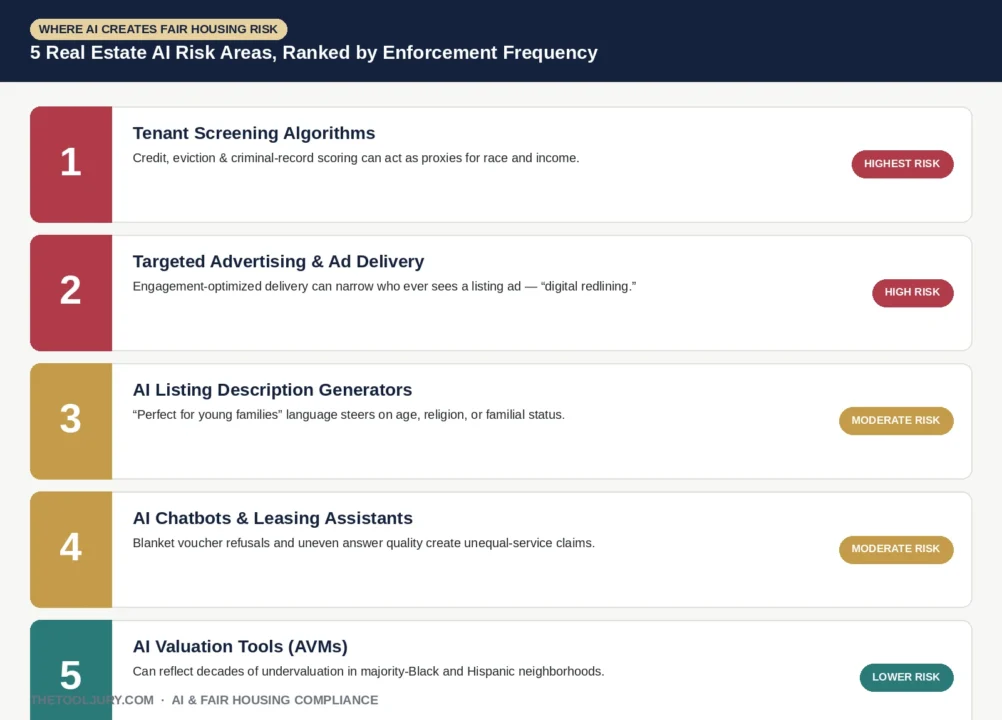
Not every AI use case carries the same level of risk. Here’s a breakdown of where real estate professionals run into trouble, ranked roughly by how often enforcement actually shows up.
1. Tenant Screening Algorithms
This is the most heavily litigated category. AI-based screening tools score applicants using credit history, criminal records, eviction filings, and income data — and each of those inputs can act as a proxy variable for a protected class. Credit scores, for instance, correlate with historical access to credit, which correlates with race. An eviction filing that was later dismissed in the tenant’s favor can still show up and tank a score. And because the scoring logic is often a black box — proprietary, and sometimes opaque even to the housing provider using it — a denied applicant may never learn which factor actually sank their application.
HUD’s guidance recommends housing providers and screening companies:
- Screen only for information relevant to whether someone will actually pay rent and follow lease terms
- Verify that records are accurate (public eviction and criminal databases are notoriously error-prone)
- Stick to the provider’s stated screening policy instead of letting the algorithm apply its own hidden criteria
- Give applicants a way to see and dispute the specific records used to deny them
2. Targeted Advertising and Ad Delivery Algorithms
Online platforms use AI to decide who sees your listing ads — often the very same AI tools for real estate lead generation agents rely on to fill their pipeline. Left unchecked, ad delivery algorithms optimize for engagement and can end up showing housing ads to a demographically narrow audience — even if you never selected discriminatory targeting yourself. This is sometimes called digital redlining or technological redlining, and it draws directly on the same legal theory as the historical redlining maps that once excluded entire neighborhoods from lending and housing access.
HUD’s 2024 advertising guidance specifically flagged this risk, noting that audience-optimization algorithms can create discriminatory ad delivery patterns even when the advertiser’s stated targeting criteria look completely neutral.
3. AI Listing Description Generators
This one hides in plain sight because the output sounds friendly. Ask a general-purpose AI tool to “make this listing pop,” and it will often reach for phrases like:
- “Perfect for young professionals” (age)
- “Walking distance to churches” or “safe Christian neighborhood” (religion)
- “Ideal for families” or “great for kids” (familial status)
- “Quiet, established neighborhood” (can carry racial or national-origin implications depending on context)
None of these are illegal because a machine wrote them — they’re illegal because of what they signal about who belongs there, which is textbook steering under 42 U.S.C. § 3604(c). The fix isn’t to avoid AI listing description tools; it’s to keep every draft focused on the property and the neighborhood’s objective features — square footage, amenities, walkability, school ratings as data — never on the type of person who’d supposedly fit in.
4. AI Chatbots and Virtual Leasing Assistants
AI chatbots are now often the first point of contact for a prospective renter, and that creates a new category of risk: unequal service, not just unequal outcomes. Real examples that have already triggered lawsuits and regulatory attention include:
- A leasing chatbot issuing a blanket “we don’t accept vouchers” response, disproportionately screening out applicants who rely on Section 8 assistance
- Faster, fuller answers for routine pricing questions but delayed responses to accessibility-related requests
- Shorter or lower-quality answers in non-English conversations
- Neighborhood descriptions that shift in tone depending on the name or language pattern of the person asking
Private fair housing organizations — the National Fair Housing Alliance (NFHA) and local groups like Open Communities among them — now handle the bulk of this enforcement; they processed roughly 74% of housing discrimination complaints in 2024, compared to under 5% investigated directly by HUD. These groups have flagged something specific to chatbots: every conversation is logged and repeatable. A tester — someone with legal standing to bring a complaint even if they never intended to rent the unit — can run the same question through your chatbot dozens of times from a laptop and build a documented pattern of unequal treatment in an afternoon.
5. AI Valuation Tools (AVMs)
Automated valuation models are legal as informal opinions of value, but they are not appraisals and can’t replace one. AVMs trained on historical sales data can reflect decades of undervaluation in majority-Black and Hispanic neighborhoods, a well-documented pattern in appraisal-bias research. Always label AI-generated valuations clearly and route anything tied to a lending decision through a licensed appraiser following USPAP standards.
The Legal Backdrop: HUD, Disparate Impact, and the 2026 Shift
The regulatory picture around AI and fair housing has moved a lot in the past two years, and it keeps moving. Here’s where things actually stand.
HUD’s 2024 AI Guidance
On May 2, 2024, HUD released two guidance documents — one on AI in tenant screening, one on AI in housing advertising — confirming that the Fair Housing Act applies fully to algorithm-driven decisions. The guidance came out of a 2023 executive order directing federal agencies to address discrimination risks from automated systems, and it followed a joint statement from HUD, the DOJ, the CFPB, the FTC, and the EEOC pledging coordinated enforcement against AI-driven bias.
Since then, the guidance documents have reportedly been withdrawn or archived under the current administration. That matters for how agencies enforce the rules, but it does not change the underlying statute. The Fair Housing Act itself was passed by Congress, not written by HUD, and private individuals can still sue over algorithmic discrimination regardless of which guidance documents are currently posted on HUD’s website.
Disparate Impact: Still the Law, Even as the Rule Changes
In 2015, the Supreme Court ruled in Texas Department of Housing and Community Affairs v. Inclusive Communities Project that disparate impact claims are valid under the Fair Housing Act — meaning a neutral-looking policy can still be illegal if its effects fall unevenly on a protected class.
In January 2026, HUD proposed removing its own regulatory framework for evaluating disparate impact claims (the rule found at 24 C.F.R. § 100.500), arguing that courts, not agencies, should define the standard going forward. As of mid-2026, this remains a proposed rule, not a final one — but even if it’s finalized, it wouldn’t erase the Supreme Court’s holding that disparate impact claims exist under the FHA. It would just remove the standardized federal test for evaluating them, pushing more of that work onto individual courts. Several states, including Colorado, California, and Illinois, also enforce disparate impact protections independently of whatever HUD’s regulations say.
Separately, the CFPB finalized a rule on April 22, 2026 under Regulation B (ECOA), removing disparate-impact liability for mortgage lending and underwriting decisions; the rule took effect July 21, 2026. That change is real, but it’s easy to over-read: it applies to loan underwriting, not to the listing, advertising, tenant screening, and leasing work that most agents, brokers, and property managers do every day. The Fair Housing Act’s coverage of those activities is unaffected.
The practical takeaway: treat fair housing compliance as ongoing professional liability management — tied to your license, your errors-and-omissions coverage, and your reputation — rather than something that rises or falls with the regulatory headlines of a given month.
Real Enforcement Cases You Should Know
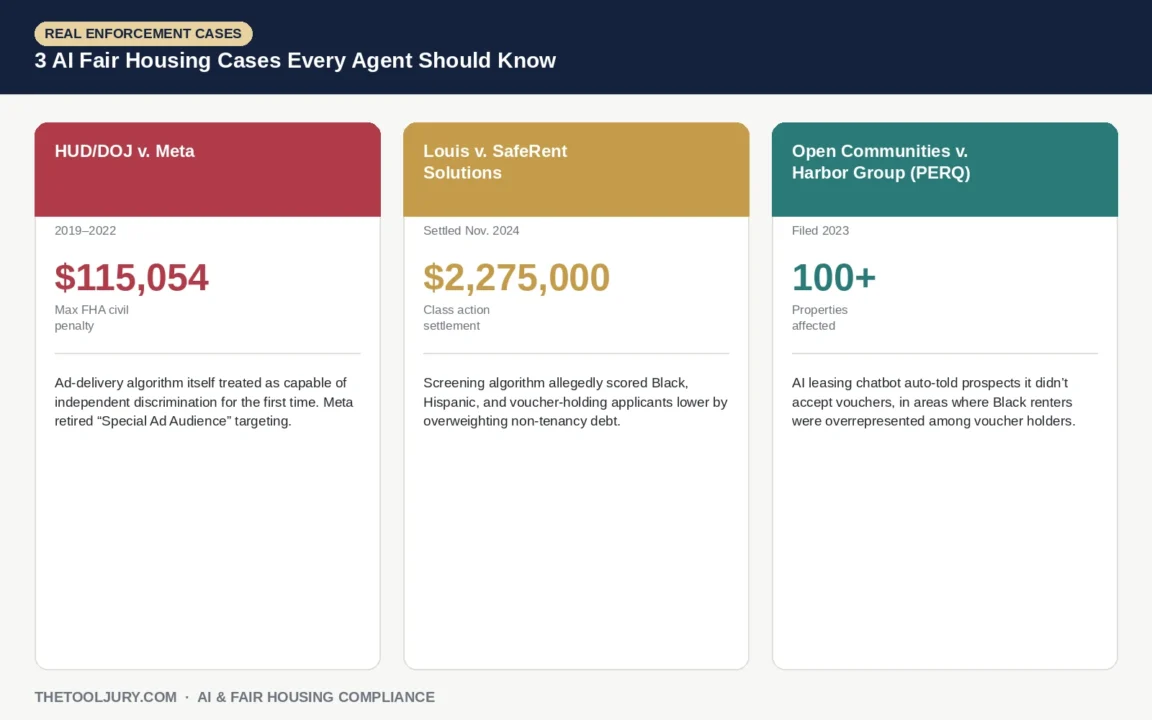
HUD/DOJ v. Meta (Facebook), 2019–2022 — HUD charged Facebook with Fair Housing Act violations in March 2019, building on a related suit the National Fair Housing Alliance (NFHA) had already filed. The DOJ’s June 2022 settlement required Meta to retire its “Special Ad Audience” (formerly “Lookalike Audience”) targeting tool, pay the maximum FHA civil penalty of $115,054, and build a new “Variance Reduction System” to close the gap between an ad’s intended audience and the group of users its algorithm actually showed the ad to. It remains the first case to treat an ad-delivery algorithm itself — not just an advertiser’s targeting choices — as capable of independent discrimination.
Louis v. SafeRent Solutions, settled November 2024 — A class action alleged that SafeRent’s tenant-screening algorithm disproportionately scored Black, Hispanic, and voucher-holding applicants lower, partly by overweighting non-tenancy debt while ignoring guaranteed rental-assistance income. SafeRent paid $2.275 million to settle, and the DOJ had already filed a statement of interest confirming the Fair Housing Act applies squarely to algorithmic screening tools.
Open Communities v. Harbor Group Management (PERQ), filed 2023 — A fair housing nonprofit’s six-month investigation found a national property manager’s AI leasing chatbot automatically told prospects it didn’t accept housing vouchers, across more than 100 properties, in areas where Black renters were overrepresented among voucher holders by two to ten times. The lawsuit named both the property manager and its AI vendor.
The pattern across all three cases is the same: an algorithm did exactly what it was built or trained to do, and the housing provider — not the software company — ended up as the primary defendant.
State Law Is Outpacing Federal Law
If federal enforcement priorities shift, state law fills the gap fast. A few examples worth tracking:
Colorado’s AI Act (SB24-205)
Colorado’s Consumer Protections for Artificial Intelligence Act, effective June 30, 2026, is the first U.S. law to impose comprehensive AI governance duties on private businesses. It classifies any AI system that makes or substantially influences a “consequential decision” — including housing — as high-risk, and requires:
- An annual impact assessment analyzing algorithmic discrimination risk (Colorado’s defined statutory term), reviewed again after any major system update
- A documented risk management program (aligned with a recognized framework like NIST’s AI RMF)
- Consumer notice before an AI system is used in a housing decision
- A right for consumers to correct inaccurate data and, where feasible, appeal an adverse decision through human review
- Public disclosure of what high-risk systems a business uses and how it manages discrimination risk
Small deployers (under 50 employees, using off-the-shelf models without custom training on their own data) get a narrower set of obligations. The Colorado Attorney General enforces the law; violations are treated as unfair trade practices, with penalties up to $20,000 per violation.
Other States Moving Fast
- California — AB 723 (effective January 2026) makes undisclosed AI-altered listing photos a misdemeanor, and requires access to original unedited images.
- New York and Illinois — Both enforce fair housing statutes independently of federal rulemaking, including disparate impact theories that don’t depend on HUD’s regulatory framework.
- More states are expected to follow with AI-specific housing disclosure and impact-assessment requirements over the next two years.
If you operate across state lines, build your compliance program around the strictest applicable state rule rather than the federal floor — it’s easier to scale down than to retrofit later.
A Practical Compliance Framework
You don’t need to abandon AI to stay compliant. You need a habit, not a headache. Here’s a framework that works whether you’re a solo agent using a listing description generator or a property manager running a leasing chatbot across a large portfolio.
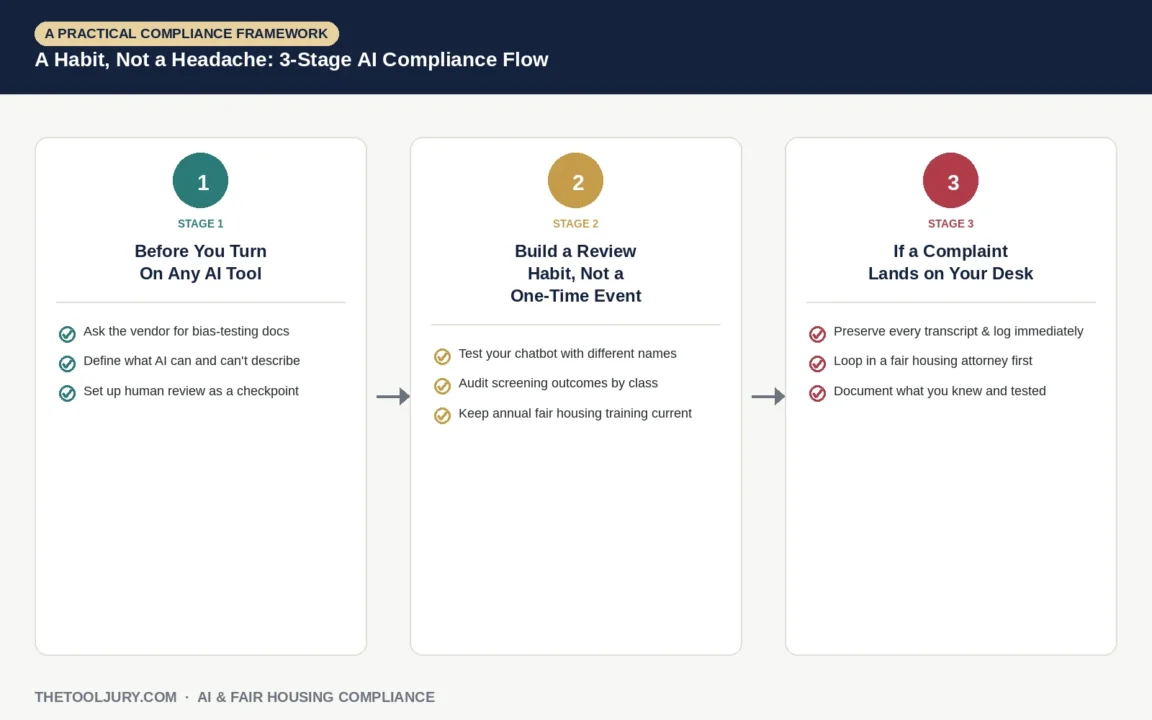
Before You Turn On Any AI Tool
- Ask the vendor for documentation. How was the tool tested for disparate impact? What data trained it? Is there a model card or bias-testing report you can keep on file?
- Define what the AI is and isn’t allowed to do. Describing the property: yes. Describing or inferring anything about who should live there: no.
- Set up human review as a checkpoint, not an afterthought. Every AI-generated ad, listing description, chatbot script, or screening recommendation gets a human set of eyes before it goes live.
Build a Review Habit, Not a One-Time Event
- Run your own chatbot through test conversations using different names, neighborhoods, and languages, and compare the responses.
- Periodically audit tenant-screening outcomes by protected class where you’re legally permitted to collect that data, looking for lopsided denial rates.
- Keep training current — annual fair housing training that specifically covers AI tools, with signed records, is inexpensive insurance against a claim.
- Revisit vendor contracts yearly; a tool that was compliant last year may have been updated in ways that change its risk profile.
If a Complaint Lands on Your Desk
- Preserve every transcript, log, and generated draft related to the complaint immediately — don’t let automated systems overwrite or delete records.
- Loop in a fair housing attorney before responding substantively.
- Document what you did know, what you didn’t, and what steps you’d already taken to test the tool — this evidence of “reasonable care” matters under both federal case law and newer state statutes like Colorado’s.
Pros and Cons of AI Tools in Fair-Housing-Sensitive Workflows
| AI Tool Type | Pros | Cons / Fair Housing Risk |
|---|---|---|
| Tenant screening AI | Faster turnaround, consistent criteria applied to every applicant, reduces person-to-person subjectivity | Can encode disparate impact through credit/eviction proxies; opaque scoring makes denials hard to explain or dispute |
| AI listing description writers | Saves hours on repetitive copywriting, keeps tone consistent across a brokerage | Prone to steering language (“perfect for families,” “young professionals”) pulled from training data; can hallucinate features that don’t exist |
| AI chatbots / leasing assistants | 24/7 availability, consistent scripted answers, full conversation logs for quality control | Can create two-tiered service (faster answers for some inquiries, delays for accessibility or language-related ones); logs are also easy evidence for testers |
| AI ad targeting | More efficient ad spend, better lead-to-lease conversion | Delivery algorithms can narrow the audience by protected-class proxies even without discriminatory targeting settings |
| AI valuation models (AVMs) | Instant, low-cost estimates useful for early conversations | Can reflect historical undervaluation patterns; must never substitute for a licensed appraisal in lending contexts |
Frequently Asked Questions
Does the Fair Housing Act apply to AI-generated content, like listing descriptions?
Yes. HUD’s 2024 guidance confirmed that AI-generated advertising, marketing copy, and listing descriptions are held to the same Fair Housing Act standard as anything written by a person. There’s no automation exemption.
Who is liable if an AI chatbot gives a discriminatory answer – me or the vendor?
You are. The housing provider or licensed agent is treated as responsible for decisions and statements made by an AI tool deployed on their behalf, even if a third-party vendor built and hosts it.
Is “I didn’t know the AI was doing that” a valid defense?
No. Fair housing law focuses on outcomes, not intent. Not knowing what your algorithm was doing can actually work against you, since it suggests a lack of the “reasonable care” that regulators and courts look for.
What counts as disparate impact in an AI context?
It’s when a facially neutral AI process — a screening score, an ad-delivery pattern, a chatbot script — produces a significantly worse outcome for a protected class, even without anyone intending discrimination. Courts still recognize this theory under the Fair Housing Act regardless of HUD’s current regulatory framework.
Are AI-generated listing photos or virtual staging a fair housing issue?
Not usually on their own, but they raise a separate compliance issue: several states now require clear disclosure of AI-altered images and access to the original photos, and undisclosed edits can violate advertising-truthfulness rules like NAR’s Code of Ethics.
Should small landlords or solo agents worry about this, or is it only a big-portfolio problem?
Everyone using AI in housing decisions is covered by the Fair Housing Act, regardless of portfolio size. State laws like Colorado’s do carve out lighter requirements for smaller deployers, but the underlying federal liability doesn’t scale down with company size.
Where can I report suspected AI-driven housing discrimination?
Complaints can be filed with HUD’s Office of Fair Housing and Equal Opportunity, or with a local fair housing nonprofit, many of which now specifically monitor AI-driven leasing and screening tools.
The Bottom Line
AI isn’t banned in real estate, and it doesn’t need to be feared — but it can’t be treated as a shortcut around fair housing law either. Every algorithm you deploy, from a listing description generator to a leasing chatbot to a tenant-screening score, is legally an extension of you. When it makes a biased call, the complaint lands on the license holder, not the software.
The good news is that compliance here isn’t complicated, even if the regulatory landscape keeps shifting under it. Keep AI focused on describing properties, not people. Put a human in the review loop before anything publishes or gets sent. Document what you tested and when. And keep an eye on your state — because right now, state law is moving faster than anything coming out of Washington.
If you’re building out your full AI marketing stack, this page pairs naturally with our complete Best AI Tools for Real Estate Agents 2026 pillar guide.
[Note : This article is for general informational purposes and isn’t legal advice. Fair housing law varies by state and changes frequently — talk to a fair housing attorney about your specific tools, markets, and workflows.]