
Table of Contents
Quick Answer
The best AI tools for real estate market analysis and property valuation depend on who’s using them. For a free baseline number, Zillow’s Zestimate and the Redfin Estimate are the fastest starting points, though both carry a median error of roughly 7% on off-market homes. For agents and appraisers who need defensible, data-backed numbers, HouseCanary (with its CanaryAI assistant) and Cotality (formerly CoreLogic) offer institutional-grade automated valuation models (AVMs) and comparable sales data. Investors evaluating deals tend to prefer all-in-one platforms like Homesage.ai, PropStream, Mashvisor, or DealCheck, which combine valuation with cap rate, cash flow, and ROI analysis.
Commercial real estate professionals rely on Reonomy, Cherre, or CoStar for ownership intelligence and market data. No AI tool replaces a licensed appraisal — treat every output as a well-informed starting point, not a final number.
What Is an AI Real Estate Market Analysis & Property Valuation Tool?
An AI real estate market analysis and property valuation tool is software that uses machine learning to estimate a property’s worth and read market conditions, without a human physically walking through the home or building. Instead of one appraiser’s opinion, these tools pull from millions of data points — recent sales, tax records, MLS (Multiple Listing Service) feeds, zoning maps, and sometimes aerial or satellite imagery — and run them through statistical models to produce a number in seconds.
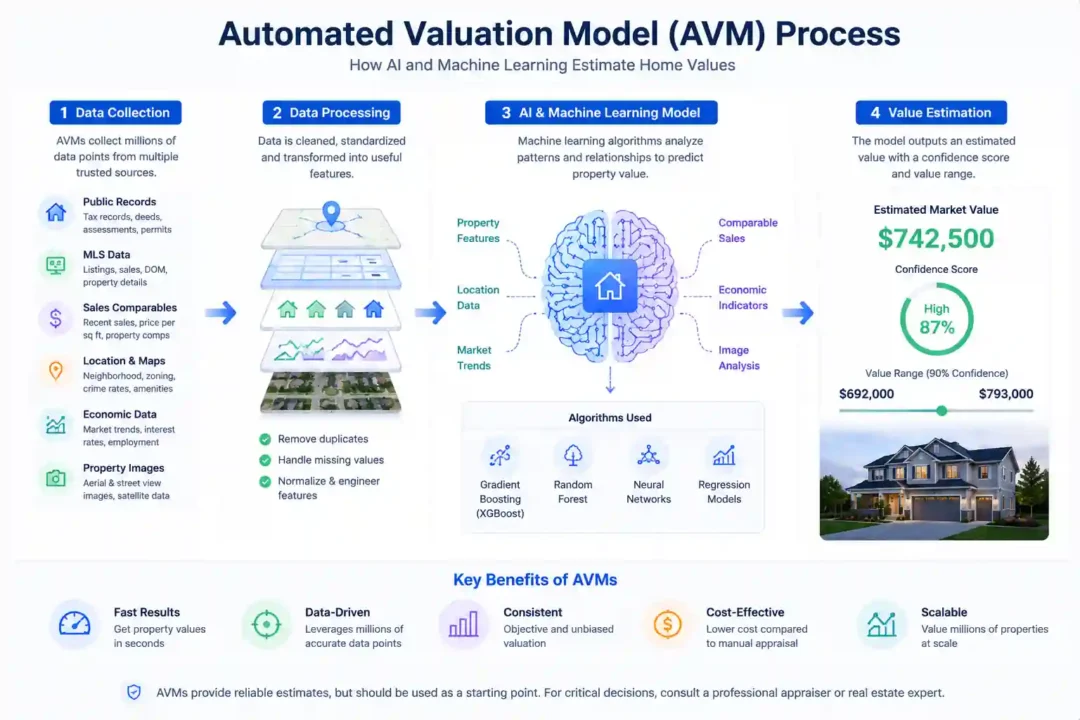
At the core of most of these platforms sits an Automated Valuation Model (AVM). An AVM is a mathematical model that compares a subject property against recent comparable sales (“comps”), then adjusts for differences in size, condition, location, and age. It’s the same basic logic a real estate agent uses when building a Comparative Market Analysis (CMA) — except the AVM does it instantly and at scale, across an entire county or country.
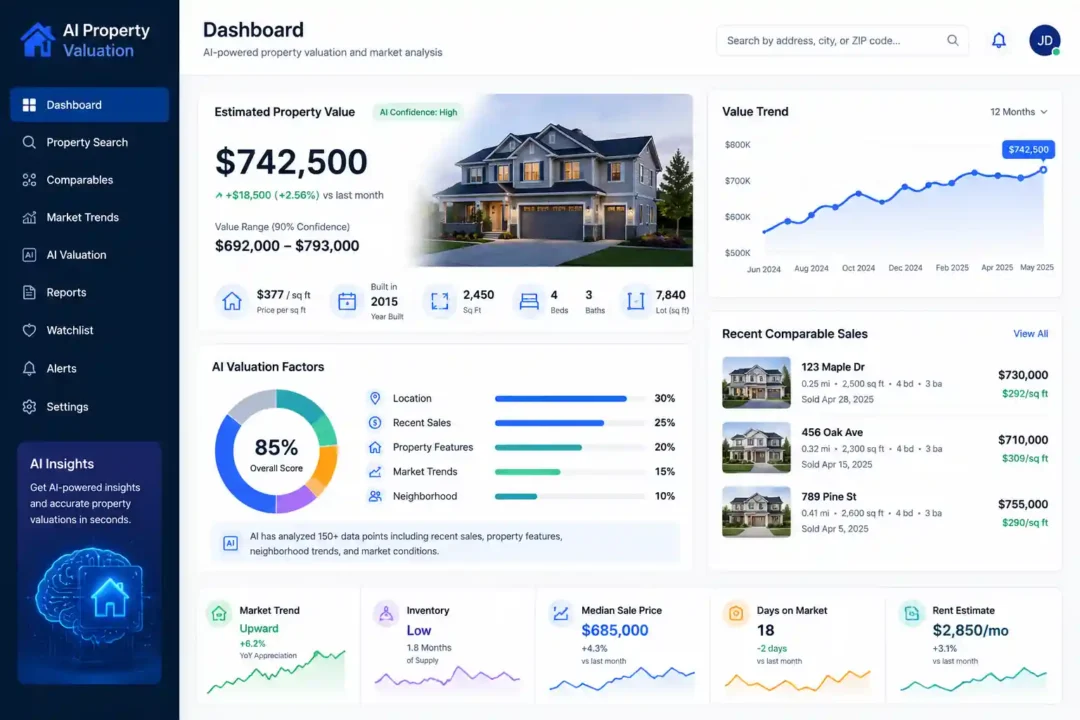
These platforms typically pull data from:
- Public records — county assessor and recorder data, deeds, permits
- MLS feeds — active listings, pending sales, days on market (DOM)
- Tax assessment history — assessed value trends over time
- Aerial and street-level imagery — used with computer vision to estimate condition, roof age, or lot features
- Economic and demographic data — population growth, employment trends, interest rates
- Rental and lease data — for cash flow and cap rate calculations on investment property
How Do AI Property Valuation Tools Actually Work?
Automated Valuation Models (AVMs)
An AVM ingests a property’s characteristics — square footage, bedroom and bathroom count, lot size, year built — and compares them against recently sold, similar properties nearby. Price per square foot is usually one of the first benchmarks the model leans on, then it adjusts up or down for condition, location, and other differences between the subject property and its comps. Machine learning models (often gradient boosting methods like XGBoost, or neural networks) weigh dozens to hundreds of variables to predict a fair market value. The output usually includes a point estimate plus a confidence range, since no model is certain about every property.
Comparative Market Analysis (CMA) Automation
Where an AVM gives a single number, a CMA-style tool builds a report: a list of recent comps, adjustments for differences, and a suggested price range. Many real estate market analysis tools now generate CMA reports automatically, cutting a process that used to take an agent an hour or more down to a few minutes.
Computer Vision & Property Condition Scoring
Traditional AVMs have one blind spot: they can’t see inside a home. Newer platforms address this with computer vision — AI that scans listing photos or aerial images to flag renovation quality, roof condition, or curb appeal, then folds that into the valuation. This is one of the biggest accuracy gains in AI property valuation over the last few years.
Predictive Market Analytics & Forecasting
Beyond a single valuation, many platforms forecast where a market is headed: rent growth, price appreciation, absorption rate, and inventory trends. This uses time-series data and economic indicators to project values months or years forward, which matters for investors and developers deciding when — not just where — to buy.
Best AI Tools for Real Estate Market Analysis & Property Valuation in 2026
Best for Free, Baseline Home Value Estimates
These tools are the fastest way to get a rough number. They’re free, widely recognized, and a reasonable first check — but not a substitute for a licensed appraisal or agent-prepared CMA.
Zillow Zestimate
Zillow’s Zestimate is the most recognized AI home value estimator in the U.S., covering over 100 million properties nationwide. It uses a neural network–based model built on MLS data, tax assessments, and prior sales. Zillow publishes its own accuracy figures: median error typically falls in the 1.9%–2.4% range for on-market homes and roughly 7%–7.5% for off-market homes, though this varies a lot by region — dense suburban markets with frequent turnover are far more accurate than rural areas or unique custom homes.
Pros
- Free and instant
- covers nearly every U.S. property
- easy to update with home facts to improve accuracy
- useful as a quick sanity check
Cons
- Off-market accuracy is meaningfully weaker than on-market
- can’t see interior condition or upgrades
- not accepted by lenders for underwriting
Best For
- Homeowners and buyers wanting a quick, no-cost starting number
Pricing
- Free
Redfin Estimate
Redfin’s equivalent tool performs comparably to Zillow’s, with slightly better on-market accuracy and slightly weaker off-market accuracy in most published comparisons. It draws from the same broad categories of data — MLS listings, public records, and recent sales.
Pros
- Free
- tightly integrated with active listing data
- updates frequently in hot markets
Cons
- Same fundamental limitation as any AVM — no interior visibility
- Accuracy swings by market
Best For
- Cross-checking a Zestimate before trusting either number
Pricing
- Free
Best for Agents, Lenders & Institutional-Grade Valuation
When the number needs to hold up for a listing price, a loan decision, or a portfolio valuation, agents and lenders lean on platforms built specifically for accuracy and defensibility.
HouseCanary (CanaryAI)
HouseCanary is built for investment firms, lenders, and valuation professionals, but individual agents also use its Property Explorer product for CMA reports. Its AVM reportedly achieves error rates under 3%, well ahead of typical consumer-facing tools, and it maintains around 40 years of historical data across roughly 136 million properties. Its standout feature is CanaryAI — a generative AI assistant that lets users ask plain-English questions about a property or market instead of navigating a traditional database interface.
Pros
- Institutional-grade accuracy
- deep historical data for trend analysis
- conversational AI interface speeds up research
- strong risk and forecasting tools for portfolios
Cons
- Full platform pricing is enterprise-level and requires a custom quote
- Overkill for a single agent doing occasional CMAs
Best For
- Lenders
- investment firms
- portfolio managers
- appraisers needing defensible
- large-scale valuations
Pricing
- Custom enterprise pricing; the standalone Property Explorer CMA report runs around $10 per report
Cotality (formerly CoreLogic)
CoreLogic rebranded to Cotality in 2025, but the underlying property data and analytics business is the same trusted source lenders, insurers, and agents have used for years. Cotality offers deep property value data, comparable sales analysis, and risk assessment (flood, wildfire, and other hazard data) layered with AI-driven analytics. It’s one of the primary data backbones that other AI valuation tools license from, alongside providers like ATTOM Data Solutions and Quantarium, which power AVMs used across the mortgage and lending industry.
Pros
- Extremely deep and long-standing property data set
- strong for risk and hazard analysis alongside valuation
- trusted in mortgage and insurance underwriting
Cons
- Pricing isn’t public and typically requires an enterprise agreement
- less consumer-friendly interface than newer challenger tools
Best For
- Lenders
- insurers
- appraisers
- agents who need market data with regulatory-grade credibility
Pricing
- Custom quote based on data access level
Best for Real Estate Investors & Deal Underwriting

Investors need more than a value estimate — they need cap rate, net operating income (NOI), cash-on-cash return, after-repair value (ARV), and rent projections in one workflow.
Homesage.ai
Homesage.ai positions itself as an all-in-one property analysis platform, combining property search, AI-driven valuation, comparable sales, and investment metrics (cap rate and ARV) in a single environment. It analyzes over 150 million properties and adds computer-vision-based condition analysis on top of standard AVM data — addressing the “can’t see inside the house” problem that limits tools like Zillow. A browser extension lets users pull analysis on listings from any real estate site.
Pros
- Combines search, valuation, comps, and investment metrics instead of requiring separate tools
- computer vision adds a condition layer most AVMs skip
- browser extension works across sites
Cons
- Newer entrant compared to legacy data providers, so track record is shorter; best results depend on data density in a given market
Best For
- Investors who want one workflow instead of stitching together multiple apps
Pricing
- Subscription-based; check current plans on the provider’s site
PropStream
PropStream is a long-running investor data platform built around lead sourcing — high equity, vacant, pre-foreclosure, absentee owner — paired with a built-in comps engine for a quick after-repair value estimate. Its valuation layer is more traditional (AVM plus historical comps) than predictive scoring.
Pros
- Extremely deep filtering for finding motivated sellers
- nationwide coverage
- built-in marketing tools (direct mail, texting)
Cons
- Single flat plan with several features priced as add-ons; valuation is comp-based rather than machine-learning-scored; interface has a learning curve
Best For
- Wholesalers and flippers who prioritize lead generation over predictive analytics
Pricing
- Around $99/month base plan, with add-ons like skip tracing and list automation priced separately
Mashvisor
Mashvisor focuses specifically on rental and short-term rental (Airbnb) market analysis. It estimates rental income, occupancy rate, and ROI by neighborhood, and is one of the more affordable entry points into AI-driven investment analysis.
Pros
- Purpose-built for rental and Airbnb investors
- Affordable entry-level plan
- strong neighborhood-level rental comps
Cons
- Less useful for buy-and-hold or commercial analysis outside the rental niche
- property management is a separate paid product
Best For
- Short-term rental and traditional rental property investors
Pricing
- Entry-level plans generally start in the $20–$30/month range
DealCheck
DealCheck is a fast, standalone underwriting calculator for rentals, house flips, BRRRR deals, multifamily, and commercial property. Users import a listing or manually enter numbers, then DealCheck runs cash flow, cap rate, and return projections.
Pros
- Fast, focused underwriting without unnecessary features
- offers a free starter plan
- works across multiple investment strategies (rental, flip, multifamily)
Cons
- Doesn’t source leads or provide the broad property database that PropStream offers
- best used alongside a separate data or sourcing tool
Best For
- Investors who already have a deal and need quick, reliable underwriting math
Pricing
- Free starter tier, with paid plans that scale with usage
Rentana
Rentana is built specifically for multifamily owners and managers, combining AI-driven rent pricing with market analysis for apartment communities. It’s a narrower tool than the others on this list but is one of the more capable options for multifamily-specific valuation and rent forecasting.
Pros
- Purpose-built for multifamily rent optimization
- combines pricing recommendations with market analytics
Cons
- Not designed for single-family valuation or general market research outside multifamily
Best For
- Multifamily owners, managers, and investors
Pricing
- Custom, based on portfolio size
Best for Commercial Real Estate (CRE) Market Analysis

Commercial deals hinge on ownership intelligence, lease data, and market-level analytics that residential-focused tools don’t cover.
Reonomy
Reonomy, owned by Altus Group, is a commercial real estate data platform covering roughly 53–54 million U.S. commercial properties. Its standout feature is AI-powered entity resolution — tracing ownership through LLCs and shell companies back to the actual decision-maker, then providing verified contact information. It pulls directly from county assessor records, Secretary of State filings, and partnerships with data providers like Cotality.
Pros
- Best-in-class for uncovering true property ownership behind LLCs
- direct integrations with thousands of county assessors keep data current
- useful for off-market deal sourcing
Cons
- Less useful for residential valuation
- pricing scales up quickly for full enterprise access
- coverage is stronger in major metros than rural areas
Best For
- Commercial brokers, lenders, and service providers sourcing off-market deals
Pricing
- Plans start around $49/month for basic web access
- full subscriptions typically run $400–$500/month, with enterprise data feeds priced separately
Cherre
Cherre is a real estate data management platform rather than a single valuation tool — it collects, cleans, and standardizes data from multiple sources so large organizations can build their own analytics, AI models, and reporting on top of it. It’s aimed at enterprises with complex, multi-source data challenges rather than individual agents or small investors.
Pros
- Strong data infrastructure for organizations combining many data sources
- supports custom AI model training and workflow automation
Cons
- Not a plug-and-play valuation tool
- requires significant implementation time and is priced for large organizations
Best For
- Large real estate enterprises building internal data and AI infrastructure
Pricing
- Custom enterprise pricing
- typically multi-year contracts
CoStar
CoStar is one of the most established commercial real estate information providers, covering a broad universe of properties, listings, comps, and market research across asset types. Its reach is significantly broader than Reonomy’s, though it comes at a higher price point and is generally sold as an enterprise subscription.
Pros
- Extremely broad property and market coverage across all commercial asset types
- strong for market and submarket-level research, not just individual property lookups
Cons
- Higher cost than more focused competitors; primarily built for professionals with recurring CRE research needs rather than occasional users
Best For
- Brokers, appraisers, and analysts needing comprehensive commercial market intelligence
Pricing
- Custom quote
- not publicly listed
Quick Comparison Table
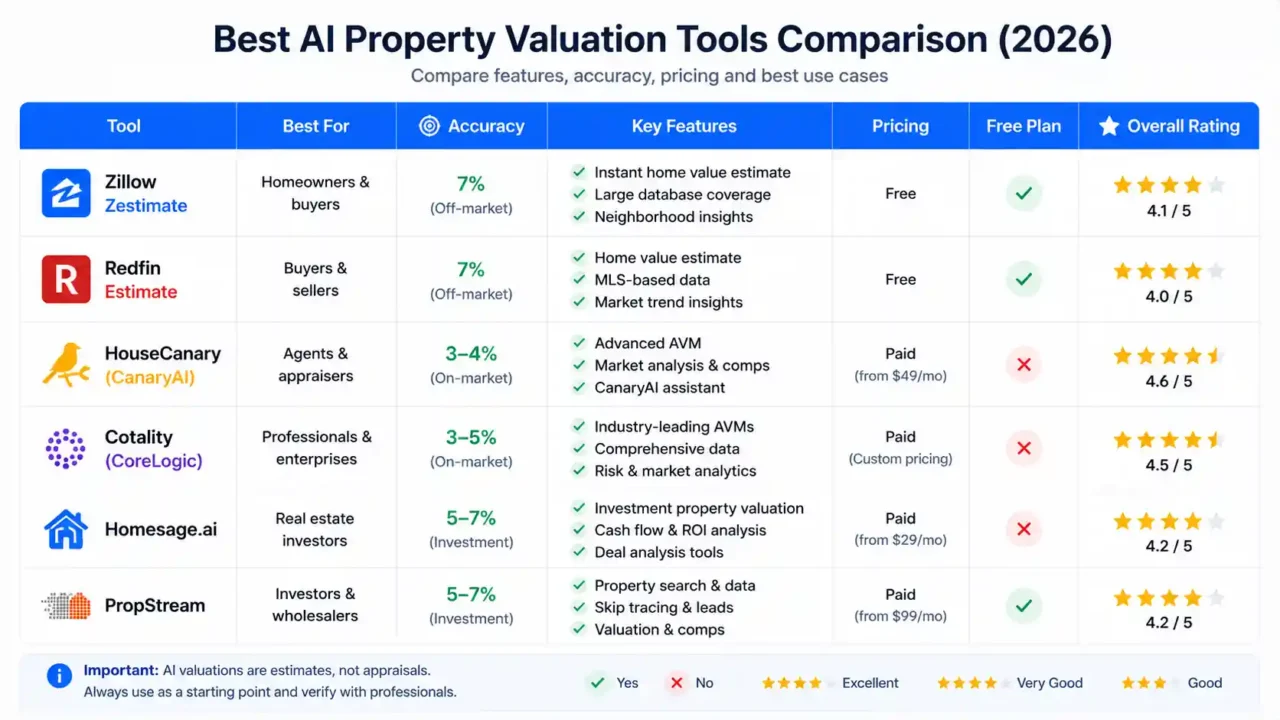
| Tool | Best For | Property Coverage | Starting Price |
|---|---|---|---|
| Zillow Zestimate | Free baseline home value | 100M+ residential | Free |
| Redfin Estimate | Cross-checking a Zestimate | Broad residential (MLS-linked) | Free |
| HouseCanary / CanaryAI | Institutional valuation & forecasting | 136M residential | ~$10/report (CMA); custom for full platform |
| Cotality (CoreLogic) | Lender & insurer-grade data | National, decades of history | Custom quote |
| Homesage.ai | All-in-one investor workflow | 150M+ properties | Subscription (check site) |
| PropStream | Lead sourcing + comps | Nationwide | ~$99/month |
| Mashvisor | Rental & Airbnb analysis | Nationwide rental data | ~$20–$30/month |
| DealCheck | Deal underwriting math | N/A (calculator-based) | Free tier + paid plans |
| Reonomy | CRE ownership intelligence | 53M+ commercial | ~$49–$500/month |
| Cherre | Enterprise data infrastructure | Multi-source, custom | Custom enterprise |
| CoStar | Broad CRE market research | National commercial | Custom quote |
Pricing changes frequently — confirm current plans directly with each vendor before budgeting.
How to Choose the Right AI Valuation Tool for Your Needs
- Homeowners checking their own value: Start with a free AVM (Zillow, Redfin), then compare two or three tools rather than trusting one number
- Listing agents pricing a home: Use an AVM as a starting range, then build a full CMA with recent local comps — HouseCanary’s Property Explorer or Cotality data can speed this up
- Investors underwriting deals: Prioritize a platform with cap rate, cash-on-cash return, and ARV calculations built in, like Homesage.ai, PropStream, or DealCheck
- Lenders and appraisers: Look for AVMs with published confidence scores and fair-lending compliance, since automated valuations used in lending fall under regulatory scrutiny
- Commercial real estate teams: Prioritize ownership and entity-resolution data (Reonomy) or broad market coverage (CoStar) depending on whether you’re sourcing deals or researching markets
Limitations of AI Property Valuation Tools
AI has closed a lot of the gap with traditional appraisals, but real limitations remain:
- Rural and low-transaction markets suffer. AVMs rely on nearby comparable sales — where sales are rare, error rates climb sharply, sometimes into double digits.
- Condition still matters more than most models admit. Even with computer vision, no AI has walked through the property. A renovated kitchen or a failing foundation can both go unaccounted for.
- AI can’t replace a licensed appraisal for lending. Mortgage underwriting still generally requires (or heavily weighs) a human appraiser. Regulators including the Consumer Financial Protection Bureau (CFPB) periodically review how AVMs are used in lending, since fair lending law requires valuation methods to be transparent and non-discriminatory.
- The number shown while a home is off-market is usually the least accurate version of that tool’s estimate. Once a home is listed, AVMs tend to shift toward the list price itself, which can make on-market accuracy look better than it really is.
AI Valuation vs. Traditional Appraisal vs. Agent CMA
| Factor | AI-Powered AVM | Licensed Appraisal | Agent CMA |
|---|---|---|---|
| Speed | Minutes to hours | Days to weeks | Hours |
| Cost | Free to a few dollars | $400–$800+ | Usually free from an agent |
| Sees property condition | Only if computer vision is used | Yes, in-person inspection | Sometimes, if agent has visited |
| Legally required for a mortgage | No | Yes, in most cases | No |
| Best use case | Quick screening, portfolio-level analysis | Loan underwriting, legal disputes | Setting a listing or offer price |
FAQs
What is the best AI tool for real estate market analysis and property valuation?
There’s no single “best” tool for everyone. HouseCanary and Cotality lead for institutional accuracy, Zillow and Redfin are the easiest free options, and Homesage.ai, PropStream, and DealCheck are stronger for investors who need cap rate and cash flow analysis alongside the valuation.
How accurate are AI property valuation tools?
It depends heavily on the tool and the market. Leading AVMs land within roughly 2%–7% of the eventual sale price in active markets with strong comp coverage. In rural or low-transaction areas, error rates can climb well into double digits, so always cross-check against recent local sales.
Can AI replace a real estate appraiser?
No. AI handles data analysis and pattern recognition at a scale humans can’t match, but appraisers, agents, and inspectors still handle on-site verification, negotiation, and legal compliance — especially for mortgage lending, where fair lending rules require transparent, auditable valuation methods.
Is Zillow’s Zestimate reliable enough to price a home for sale?
Treat it as a starting point, not a listing price. Zillow’s own published data shows meaningfully higher error rates for off-market homes than for actively listed ones, and it can’t account for renovations or condition unless a user manually updates that information.
What data do AI real estate valuation tools use?
Most combine public property records, tax assessment data, MLS listings and sale history, and increasingly, aerial imagery or listing photos analyzed with computer vision. Investment-focused tools also pull rental and lease data to calculate cap rate and cash flow.
How much do AI real estate valuation tools cost?
Consumer tools like Zillow and Redfin are free. Investor platforms typically run $20–$100+ per month depending on features. Institutional and commercial-grade platforms like HouseCanary, Cotality, Cherre, and CoStar generally require a custom enterprise quote.
What’s the difference between an AVM and a CMA?
An AVM (automated valuation model) is a single, algorithm-generated number based on comparable sales and property data. A CMA (comparative market analysis) is a broader report — typically built by an agent, sometimes AI-assisted — that lists specific comps, adjustments, and a recommended price range with reasoning behind it.
Conclusion
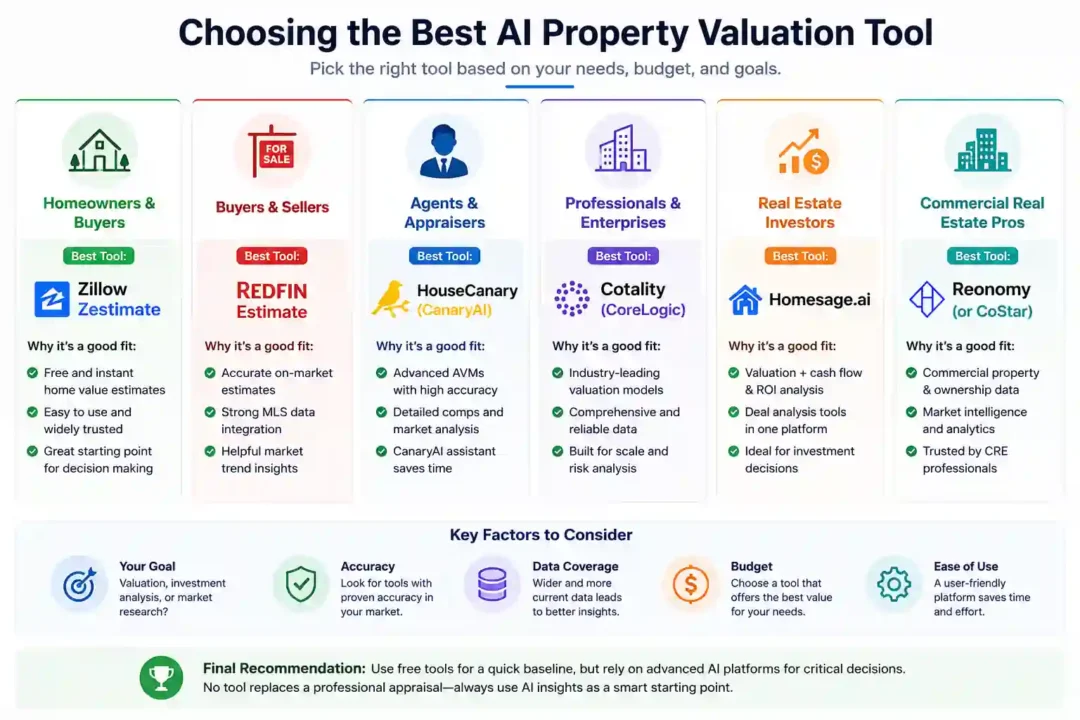
AI has made real estate market analysis and property valuation faster and more data-driven than it’s ever been, but “faster” isn’t the same as “final.” The right AI property valuation tool depends on your role: a free AVM is fine for a quick sanity check, an institutional platform like HouseCanary or Cotality earns its keep when the number needs to hold up under scrutiny, and investor-focused tools like Homesage.ai, PropStream, Mashvisor, and DealCheck save real time on underwriting.
Whichever tool — or combination of tools — you choose, cross-check the output against recent local sales, and remember that AI is there to inform the decision, not replace the judgment of an experienced agent or appraiser. If you’re building out a broader AI toolkit, this guide pairs well with a wider look at the best AI tools for real estate agents in 2026.