
Table of Contents
Quick Answer
The best AI analytics tools for Etsy sellers in 2026 are eRank, Marmalead, EverBee, Alura, EtsyHunt, InsightAgent, Sale Samurai, and Roketfy, each pulling real-time Etsy marketplace data instead of generic Google search data. If you want deep keyword research and SEO scoring, eRank and Marmalead lead the pack.
If product validation and sales estimates matter more to you, EverBee is the stronger pick. Alura works well as an all-in-one dashboard, EtsyHunt and Sale Samurai both suit sellers who want to research or track competitors closely, and Roketfy stands out if you want AI to write the actual listing copy, not just point you to keywords. Most sellers get the best results by pairing Etsy’s free native Stats dashboard with one paid third-party tool, since Etsy’s own analytics don’t show competitor data, trend forecasting, or keyword demand.
Below, we break down these AI analytics tools for Etsy sellers one by one: what each tool does, who it’s built for, and how to pick the right one for your shop’s size and goals.
Why Etsy Sellers Need AI Analytics Tools in the First Place
Etsy reported 5.6 million active sellers as of the end of 2025, down from over 8 million the year before after a seller verification fee pushed out a lot of inactive accounts. That’s still a lot of competition for the same pool of buyers. Guessing which keywords to use, which products to make, or why your conversion rate dropped last month just doesn’t cut it anymore. That’s exactly why AI analytics tools for Etsy sellers have gone from a nice-to-have to something closer to a baseline requirement.
Etsy’s own Stats dashboard gives you the basics: views, visits, conversion rate, revenue, and traffic sources. That’s useful, but it has real gaps.
What Etsy’s native Stats dashboard doesn’t show you:
- What your competitors are selling and how much they’re earning
- Which keywords are trending before they peak in search volume
- Real search demand data for the exact phrases buyers type into Etsy search
- Buyer demographics and shopping behavior patterns
- Predictive insights on which products are about to take off
This is exactly the gap AI-powered analytics tools were built to fill. They connect directly to Etsy’s marketplace data (not generic Google Trends numbers) and use machine learning to spot patterns a human scrolling through listings would miss.
What to Look For in AI Analytics Tools for Etsy Sellers
Before picking a tool, it helps to know what actually separates a good one from a gimmick, especially now that there are dozens of AI analytics tools for Etsy sellers competing for your subscription dollars. Here’s what matters most.
Data Source: Etsy-Specific vs Google-Based
Some tools estimate keyword search volume using Google search data. Others pull directly from Etsy’s own marketplace activity. Etsy shoppers search differently than Google users, so tools built on real Etsy search data tend to give more accurate keyword and trend insights.
Update Frequency
Etsy’s native Stats dashboard has a reporting delay of one to two days. Some third-party analytics platforms update in near real time, which matters a lot if you’re chasing a fast-moving trend or seasonal spike.
Core Features to Compare
- Keyword research: search volume, competition score, and click-through rate for specific terms
- Listing audits: automated grading of your titles, tags, and descriptions with fix-it suggestions
- Competitor tracking: visibility into what similar shops are ranking for and earning
- Trend forecasting: early signals on rising product categories or seasonal demand
- Product research: sales and revenue estimates across existing Etsy listings
- Rank tracking: monitoring where your listings sit in Etsy search results over time
Pricing and Free Tiers
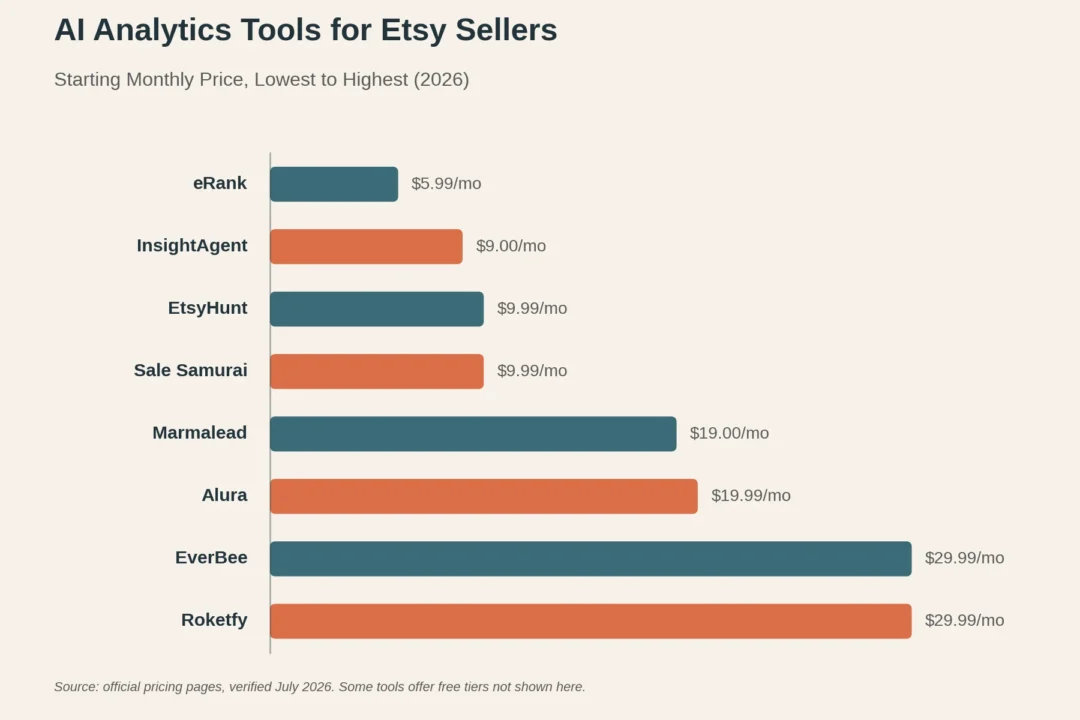
Most tools worth using offer a free plan with limited searches, which is a smart way to test before committing. Paid plans generally run anywhere from $6 to $50 a month depending on how much data and automation you need.
The Best AI Analytics Tools for Etsy Sellers, Reviewed
Here’s a closer look at the tools that consistently show up as top picks among active Etsy shop owners.
1. eRank
eRank is one of the most widely used Etsy SEO and analytics platforms, and for good reason. It analyzes your listings against Etsy’s search algorithm and gives specific, practical recommendations on title structure, tag selection, and keyword placement.
Its trend tracking feature flags rising search terms before they hit peak competition, giving early adopters a head start on seasonal products.
Key features:
- Keyword research with real Etsy search volume
- Listing audits with actionable scores
- Rank tracking across your product catalog
- Competitor keyword analysis
- Bulk listing analysis for larger shops
Pros:
- Generous free plan for beginners
- Affordable paid tier starting around $5.99/month
- Strong reputation and long track record with sellers
Cons:
- Interface can feel dated compared to newer tools
- Some advanced features are locked behind higher-tier plans
Best for: Sellers who want dependable, budget-friendly SEO analytics without a steep learning curve.
2. Marmalead
Marmalead is one of the oldest dedicated Etsy SEO tools on the market, and it built its reputation on predictive analytics. Its “Storm” brainstorming feature takes a single product idea and expands it into dozens of related keyword variations, each scored by search volume and competition.
Marmalead also runs 12-month historical trend data and generates 3-month forward predictions, which is genuinely useful for planning seasonal launches ahead of time.
Key features:
- AI-driven keyword scoring based on volume, competition, and engagement
- Listing audit and grading
- AI review sentiment analysis to understand what customers value
- Step-by-step AI coaching for new sellers
Pros:
- Trusted by over 260,000 Etsy shops
- Strong predictive trend forecasting
- Coaching mode is genuinely helpful for beginners
Cons:
- Pricing starts around $19/month, higher than some competitors
- No free tier, only a trial
Best for: Newer sellers who want structured, step-by-step guidance alongside solid keyword data.
3. EverBee
EverBee started life as a product research tool, and that’s still its strongest feature. It estimates sales and revenue across more than 180 million Etsy listings, which makes it a genuinely useful way to validate a product idea before you spend money on materials or design time.
Key features:
- Sales and revenue estimates for existing listings
- Keyword research and listing optimization (Growth plan)
- Chrome extension for research while browsing Etsy
- Product research across Etsy and print-on-demand niches
Pros:
- Excellent for validating ideas before production
- Trusted by over 900,000 creators
- Convenient browser extension workflow
Cons:
- Free plan caps monthly research lookups
- Full features require the Growth plan at $29.99/month
- Sales estimates are approximations, not guaranteed figures
Best for: Sellers who want to research demand before deciding what to actually make.
4. Alura
Alura positions itself as an all-in-one dashboard, combining keyword research, listing optimization, competitor analysis, AI customer response automation, and email marketing tools in a single platform.
Key features:
- Keyword and product research
- Listing optimizer with improvement scoring
- AI assistant for automating customer messages
- Chrome extension for on-page competitor data
Pros:
- Covers research, SEO, and shop management in one tool
- Free trial available before committing
- Saves time by reducing the need to juggle multiple tools
Pricing: Free trial, then $19.99/month (Starter) or $29.99/month (Professional)
Cons:
- Free plan search limits are fairly restrictive
- Advanced plans get pricey for very small shops
- Etsy-only, so it won’t help if you sell cross-platform
Best for: Sellers who want one dashboard instead of stitching together several separate tools.
5. EtsyHunt (eHunt)
EtsyHunt focuses heavily on competitor and trend analysis, with a Chrome extension that overlays keyword and sales data directly on Etsy search results pages as you browse.
Key features:
- Competitor listing analysis
- Trend and niche discovery
- In-browser keyword data overlay
- Free plan available
Pros:
- Free tier makes it accessible for new sellers
- Paid plans start low, around $9.99/month
- Convenient for sellers who prefer researching while browsing rather than in a separate dashboard
Cons:
- Less robust listing audit features compared to eRank or Marmalead
- Smaller user base and community compared to more established tools
Best for: Sellers who like doing research passively while shopping their own niche on Etsy.
6. InsightAgent
InsightAgent is a newer entrant that emphasizes real-time data pulled directly from Etsy’s marketplace rather than Google Trends, along with AI-powered recommendations for improving conversion rate.
Key features:
- Live marketplace data updates (versus Etsy’s 1-2 day reporting delay)
- Beginner-friendly low-competition niche filters
- AI-powered listing and conversion recommendations
- Shop benchmarking against similar sellers
Pricing: Free tier (15 credits, no card required), then $9/month (Essential) or $29/month (Empire)
Pros:
- Real-time updates instead of delayed reporting
- Free credits available to test before paying
- Useful benchmarking against comparable shops
Cons:
- Newer platform with a shorter track record than eRank or Marmalead
- Trend projections are approximations and can vary by niche
Best for: Sellers who want the freshest possible data and don’t mind trying a newer platform.
7. Sale Samurai
Sale Samurai leans into shop-wide auditing rather than just single-listing checks. Its Analytics tool scans your whole shop for SEO problems, including missing tags and thin images, while also surfacing what’s working on competitors’ titles, tags, and keyword choices.
The standout feature is the Competition Tracker. You pick specific sellers to watch, and it monitors their sales, active listings, likes, pricing changes over time, and shipping data in one view.
Key features:
- Shop-wide SEO audit, not just per-listing
- Competition Tracker for monitoring chosen sellers over time
- Single Listing lookup showing stock levels, monthly views, and last sale date
- Long-tail keyword suggestions tied to your search terms
Pricing: 3-day free trial, then $9.99/month (or $99/year), no permanent free plan
Pros:
- Genuinely useful for ongoing competitor monitoring, not just a one-time snapshot
- Good depth on listing-level diagnostics (missing tags, image count issues)
Cons:
- Less well known than eRank or Marmalead, smaller community and fewer tutorials
- Competition Tracker takes some setup time to get real value from
Best for: Sellers who want to watch specific competitors closely over weeks and months, not just run a one-off keyword search.
8. Roketfy
Roketfy is built around AI-generated listing copy rather than just keyword data. You describe your product, and its AI Writer produces a title, description, and tags based on what’s currently performing on Etsy. A separate Listing Checker grades your existing listings and points out exactly what to fix.
Key features:
- AI Writer for full listing copy (title, description, tags)
- Listing Checker with a grading system and specific fixes
- Market and trend analysis for spotting promising niches
- AI-automated responses for common customer questions
Pros:
- Saves real time on the actual writing, not just the keyword research
- Listing Checker gives concrete, actionable fixes rather than vague scores
Cons:
- Pricing runs higher than most SEO-focused tools on this list, $29.99/month (Hobby) or $49.99/month (Professional)
- AI-generated copy still needs a human pass to sound natural and match your brand voice
Best for: Sellers who want AI to draft the actual listing, not just tell them which keywords to use.
Etsy’s Native Stats Dashboard vs Third-Party AI Analytics Tools
It’s worth understanding what Etsy already gives you for free before deciding what to pay for.
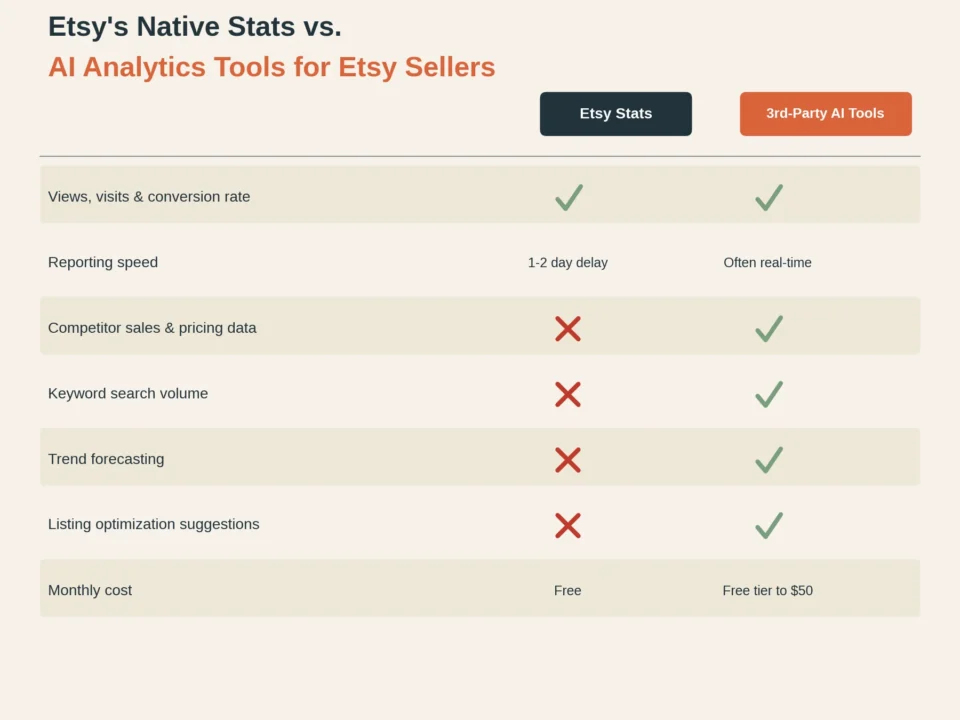
| Feature | Etsy Native Stats | Third-Party AI Tools |
|---|---|---|
| Views and visits | Yes | Yes (often duplicated) |
| Conversion rate | Yes | Yes |
| Reporting delay | 1-2 days | Often real-time |
| Competitor data | No | Yes |
| Keyword search volume | No | Yes |
| Trend forecasting | No | Yes |
| Listing optimization suggestions | No | Yes |
| Cost | Free | Free tier to $50/month |
A high views-to-visits gap in your Etsy Stats usually means your thumbnail image isn’t compelling enough, buyers are seeing your listing but scrolling past it. That’s a signal Etsy gives you natively. But knowing why a competitor’s similar listing is outselling yours, or which keyword variation has rising demand this month, requires a third-party tool.
Key Metrics to Track, With Actual Benchmarks
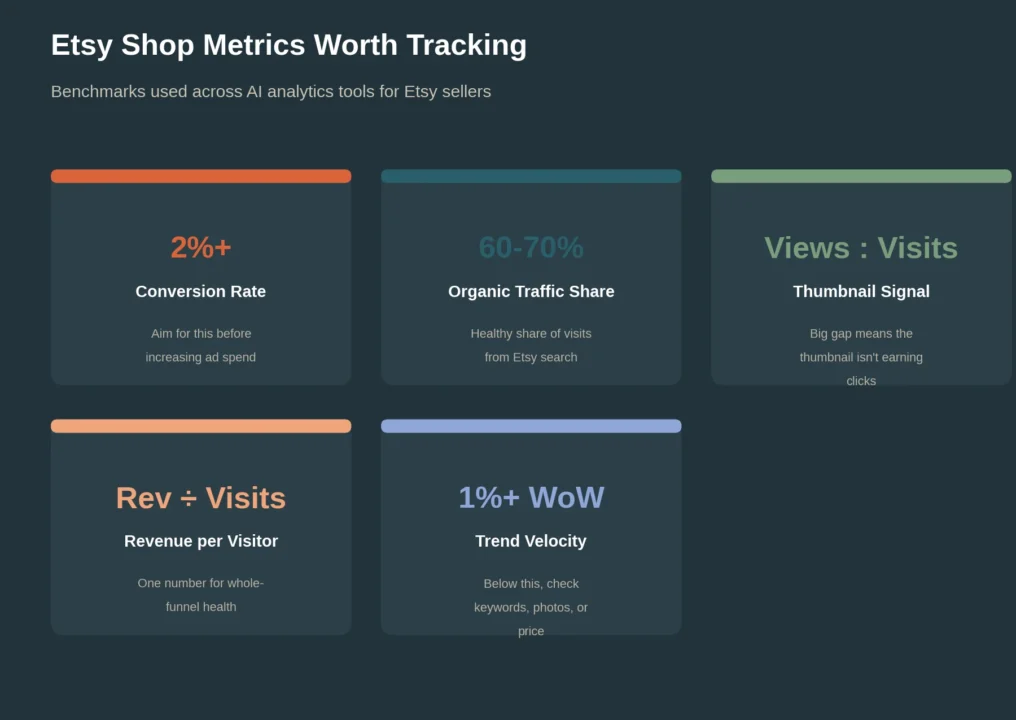
Whichever tool you use, these are the numbers that actually tell you something:
- Conversion rate: aim for 2% or higher before you increase ad spend. Below that, fix your listings first.
- Traffic source ratio: 60-70% of your traffic coming from Etsy organic search is a healthy sign. Below 40% usually means your SEO needs work.
- Views-to-visits ratio: a big gap between the two means your thumbnail isn’t earning the click, even though buyers are seeing it.
- Revenue per visitor: total revenue divided by total visits. One number that sums up how well your whole shop funnel is performing.
- Trend velocity: week-over-week growth in search demand for your category. Below 1% growth usually signals a listing problem, like a mismatched keyword or an outdated price, rather than a market problem.
Etsy’s Stats dashboard gives you the raw numbers. Third-party tools are what turn those numbers into a benchmark you can actually judge yourself against.
How to Choose the Right Tool for Your Shop’s Stage
Not every seller needs the same setup, and the right pick among these AI analytics tools for Etsy sellers really depends on where your shop is right now. Here’s a practical way to think about it.

If you’re just starting out:
- Use eRank’s free plan plus Etsy’s native Stats dashboard. This costs nothing and covers the fundamentals of keyword research and listing audits.
If you’re growing and have some budget ($9-30/month):
- Add a paid plan from eRank, Marmalead, or InsightAgent for deeper keyword data, trend forecasting, and rank tracking.
If you’re an established seller scaling up:
- Combine a strong analytics platform with a Chrome extension tool like Alura or EtsyHunt for quick competitor checks while browsing, plus EverBee if you’re regularly launching new products and need sales validation first. If you’re watching a handful of specific competitors closely, Sale Samurai’s Competition Tracker is worth the switch.
If listing copy is your bottleneck, not research:
- Roketfy’s AI Writer is worth a look if you know your keywords but dread writing titles and descriptions from scratch. Pair it with a general assistant like ChatGPT or Claude for a final polish so the copy sounds like you, not a template.
A quick rule of thumb on product type:
- Trend-driven products (digital downloads, print-on-demand, seasonal items) benefit most from real-time Etsy sales data tools like InsightAgent.
- Evergreen products (handmade goods, vintage items, custom orders) do fine with Google-based tools like the free tiers of eRank or Marmalead, since demand shifts more slowly.
One tip worth remembering: avoid paying for two tools that pull from the same data source. eRank and Marmalead both lean on similar keyword data, so running both rarely adds much value. Pick one SEO tool and one Chrome extension, and that combination covers most seller needs.
Frequently Asked Questions
What is the best free AI analytics tool for Etsy sellers?
eRank’s free plan is generally considered the strongest free option. It includes basic keyword research and listing audits, which covers the essentials for a new or small shop without any monthly cost.
Do I need a paid tool, or is Etsy’s free Stats dashboard enough?
Etsy’s Stats dashboard is enough if you only need to track your own shop’s views, visits, and conversion rate. But if you want to see what competitors are doing, spot trending keywords early, or get specific suggestions for improving your listings, you’ll need a third-party tool since Etsy doesn’t provide that data natively.
How accurate are the sales estimates from tools like EverBee?
These are approximations based on available marketplace signals, not exact figures pulled from Etsy’s internal sales records. They’re useful for spotting general demand and comparing products relative to each other, but treat exact revenue numbers as directional rather than precise.
Can ChatGPT or Claude replace Etsy-specific analytics tools?
Not for data. General AI assistants are excellent for writing compelling listing descriptions or brainstorming ideas, but they don’t have access to live Etsy marketplace data like search volume, competitor sales, or trend history. Many sellers use both together: an Etsy-specific tool for data and a general AI assistant for writing polished listing copy.
How much should I spend on Etsy analytics tools each month?
A reasonable guideline is 1 to 3 percent of your monthly shop revenue. Because it’s a part of Etsy AI tools, It not gonna cover your whole business. A new seller might spend nothing beyond free tiers, while an established shop doing several thousand dollars a month might reasonably spend $20 to $50 on a combination of tools.
Will using AI analytics tools actually increase my Etsy sales?
They won’t sell products for you, but they remove a lot of the guesswork around keyword choice, pricing, and timing. Sellers who use these tools consistently tend to make more informed decisions about what to list, when to list it, and how to describe it, which compounds into better visibility and, over time, more sales.
Conclusion
There’s no single “best” AI analytics tool for Etsy sellers that fits every shop. The right choice depends on your budget, how big your shop is, and what you’re trying to solve, whether that’s better keywords, sharper competitor insight, or product validation before you invest time in a new design.
If you’re just getting started, lean on Etsy’s free Stats dashboard paired with eRank’s free tier. As your shop grows and the stakes get higher, layering in a tool like Marmalead, EverBee, or InsightAgent gives you the competitor visibility and trend forecasting that Etsy’s own dashboard simply can’t provide. Start small, test the free tiers, and scale up only once you can see the tool is actually paying for itself in saved time or increased sales.
If you’re looking for a full package of AI tools for Etsy sellers, then you can follow our complete Best AI tools for Etsy sellers pillar guide.