
Table of Contents
Quick Answer
The best AI body composition analysis tool for trainers depends on what your studio actually needs. Evolt 360 is the strongest all-around pick for gyms that want fast, walk-in-friendly scans with built-in nutrition guidance. InBody 570 or 770 wins on clinical trust and detailed muscle-by-muscle data.
Fit3D SNAP is now the smartest buy for studios that want genuine AI-driven 3D scanning without spending five figures on hardware. Styku still leads on posture and circumference tracking. And if you want the closest thing to a verified number, booking an occasional DEXA scan through a provider like BodySpec gives you a solid checkpoint against your in-studio device.
None of these tools are interchangeable, and picking one and sticking with it matters more than chasing whichever machine claims to be “most accurate.” Below, I’ll walk through how each one works, what it actually costs, and which type of trainer it fits.
Why Body Weight Alone Isn’t Enough for Your Clients
A scale tells you one number. It doesn’t tell you if a client lost five pounds of fat and gained two pounds of muscle, or if they just lost water weight from a bad week of sleep. This is the exact problem that sends clients into a panic when the number on the scale goes up during a strength phase, even though they’re visibly leaner.
An AI body composition analysis tool solves this by breaking that single number into parts that actually matter for training decisions:
- Body fat percentage and fat mass
- Skeletal muscle mass and lean body mass
- Visceral fat (the fat around internal organs, tied closely to metabolic health)
- Segmental lean mass, meaning how muscle is distributed between arms, legs, and trunk
- Total body water, often split into intracellular and extracellular water
- In some tools, resting metabolic rate and a fat-free mass index (FFMI)
For a trainer, this data changes how you program. If a client’s segmental analysis shows a left-right imbalance in leg lean mass, that’s a coaching cue, not just a data point. If visceral fat is trending down while the scale barely moves, that’s the proof of progress a frustrated client needs to hear. This is also the core reason an AI body composition analysis tool has become standard equipment in serious training studios rather than a gimmick add-on.
How AI Body Composition Analysis Tools Actually Measure the Body
Not every AI body composition analysis tool works the same way. Understanding the underlying method helps you explain results to clients honestly, and it explains why two different machines can give two different numbers for the same person on the same day.
Bioelectrical Impedance Analysis (BIA)
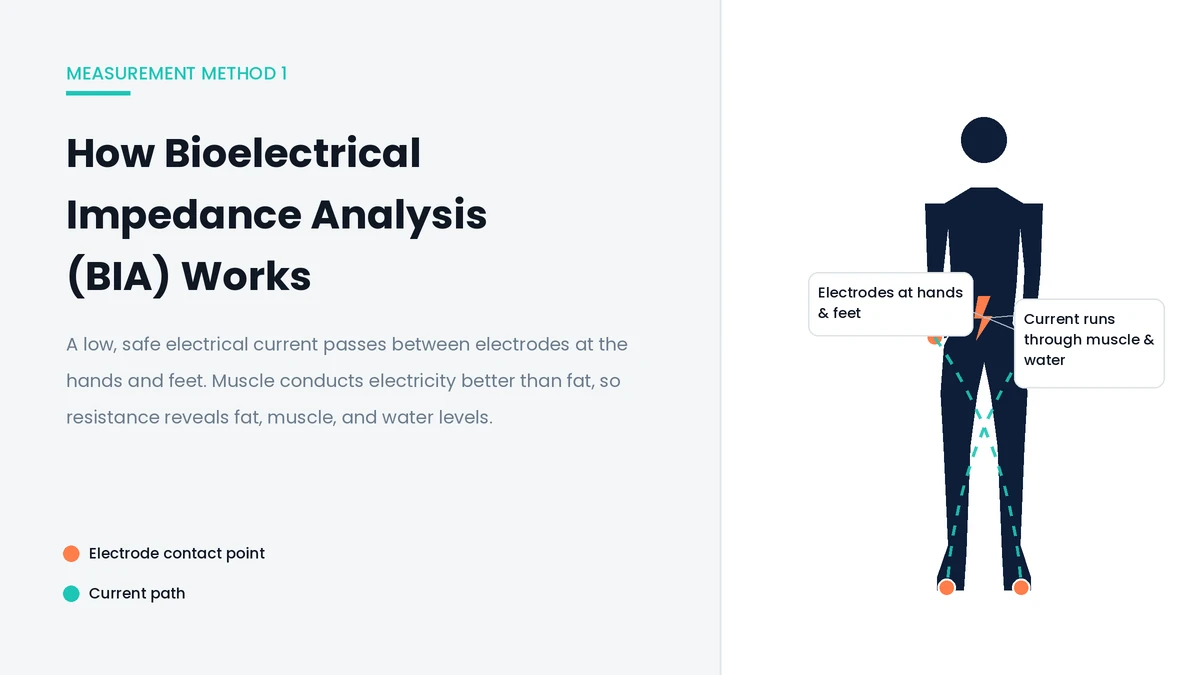
This is the most common method in gyms. The device sends a very low, safe electrical current through the body using hand and foot electrodes. Muscle holds more water than fat, so it conducts electricity more easily. The device measures resistance to that current and uses it, along with algorithms, to estimate fat, muscle, and water distribution.
Modern BIA devices like InBody and Evolt 360 use multiple frequencies and segmental electrodes to get a more detailed read than older single-frequency scales. The catch: hydration status, recent exercise, food intake, and even time of day can shift the reading by a few percentage points. Consistent testing conditions matter more with BIA than with any other method on this list.
3D Optical Scanning and Computer Vision
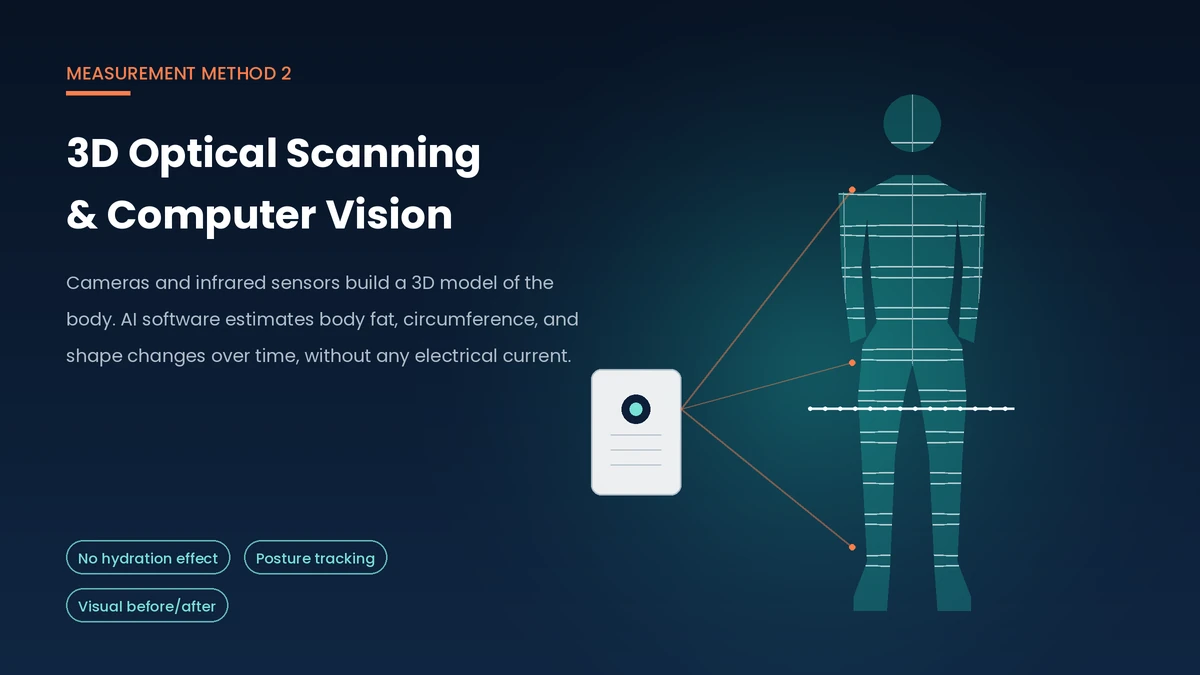
Instead of electricity, tools like Fit3D and Styku use cameras and infrared or structured light sensors to build a 3D model of the body. Software then estimates body fat percentage, circumference measurements, and body shape from that model. Newer versions, like Fit3D’s SNAP, use AI-driven computer vision on a standard tablet instead of a rotating turntable, which is a meaningful step forward for portability and cost.
3D scanning isn’t affected by hydration the way BIA is, and it’s excellent for circumference tracking and visual before-and-after comparisons. It’s generally not as precise as DEXA for absolute body fat values, but it correlates reasonably well with it in validation studies.
DEXA: The Clinical Benchmark
Dual-energy X-ray absorptiometry (DEXA) uses two low-dose X-ray beams to separate the body into fat, lean tissue, and bone mineral content. It’s widely treated as the gold standard for body composition testing because it directly measures tissue density rather than estimating it from resistance or shape. Whole-body precision in published research typically falls in the 1% to 2% range, and providers with strict quality assurance protocols, like BodySpec, aim tighter than that.
DEXA isn’t something most trainers own. It’s typically accessed through a clinic, university lab, or a mobile scanning service, and it’s the tool trainers reach for when they want to verify or calibrate what their in-studio scanner is telling them.
AI Photo-Based Body Fat Estimation
The newest category uses a smartphone camera and an AI vision model to estimate body fat percentage and muscle balance from one or two photos. Apps in this space are inexpensive or free, require no hardware, and are genuinely useful for daily or weekly client self-check-ins between sessions.
The trade-off is precision. These apps are best treated as a trend line, not a clinical measurement, and any accuracy claims a vendor publishes about matching DEXA should be read as marketing until backed by independent, peer-reviewed validation. Use them to keep clients engaged between visits, not to make programming decisions on their own.
What to Look For in an AI Body Composition Analysis Tool for Your Studio
Before you buy an AI body composition analysis tool, run through this checklist. It will save you from spending money on a feature set your business doesn’t actually need.
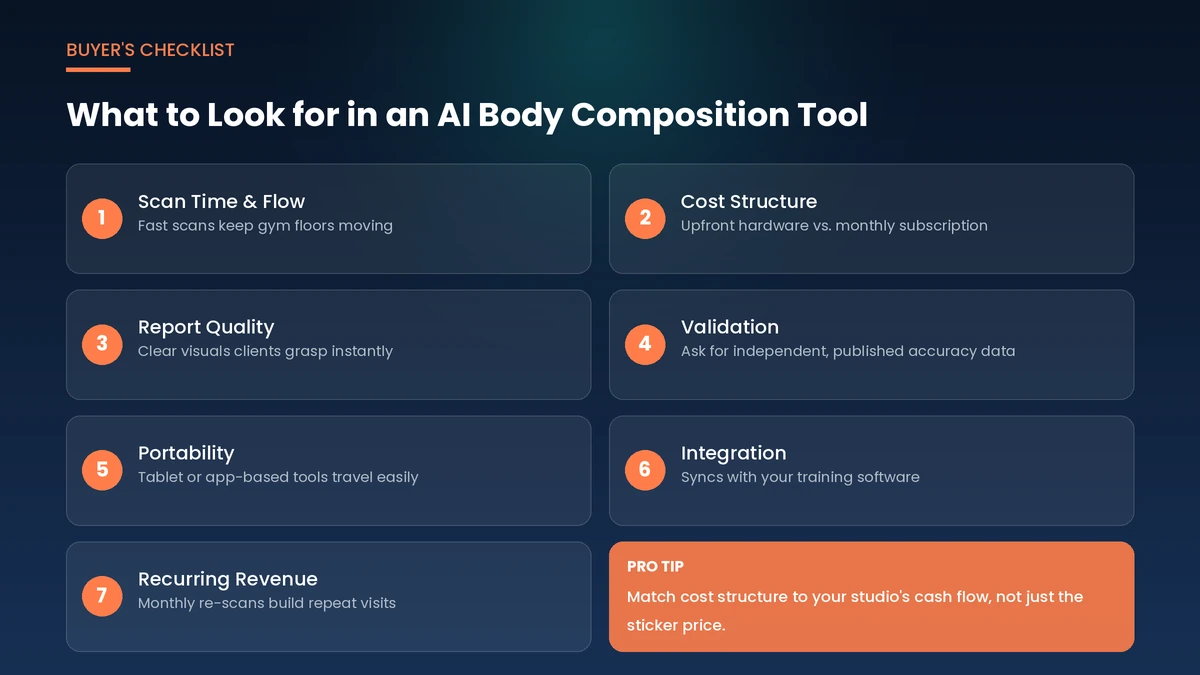
- Scan time and client flow. A 60-second scan works for a busy commercial gym floor. A 15-minute DEXA-style process fits a boutique studio better.
- Cost structure. Some tools are a large upfront hardware purchase (InBody, older Fit3D, Styku). Others use a lower hardware cost with a monthly software subscription (Fit3D SNAP). Match this to your cash flow, not just the sticker price.
- Report quality. Clients need to understand their results without you translating every line. A clean, visual report sells the next training package for you.
- Consistency and validation. Ask the manufacturer for published accuracy or reliability data, and be skeptical of numbers that only appear on the company’s own marketing pages.
- Portability. If you train at multiple locations or do in-home sessions, a tablet-based or app-based tool beats a 50-pound analyzer you can’t move.
- Integration. Some devices sync with training or client management software, which saves you from re-entering data by hand every session.
- Recurring revenue potential. A body composition analysis tool that clients want to use monthly turns into a built-in reason for them to keep training with you.
7 Best AI Body Composition Analysis Tools for Trainers
1. Evolt 360
Evolt 360 is a BIA-based scanner built specifically for the health and fitness industry, and it’s become a fixture in franchise gyms like Anytime Fitness. It sends a safe electrical current through the hands and feet and returns more than 40 body metrics in about 60 seconds, including skeletal muscle mass, visceral fat, and segmental muscle and fat breakdowns. It also generates outcome-driven suggestions based on the client’s goals, training frequency, and body composition results, which gives trainers an instant conversation starter after every scan.
Pros
- Fast, walk-in-friendly scan time
- Detailed segmental output for a BIA device
- Built-in nutrition and macro guidance clients can act on immediately
- Registered as a medical device in multiple countries, which adds credibility with clients
Cons
- Like all BIA tools, readings shift with hydration and recent activity
- Pricing is quoted directly to businesses rather than published, so budgeting takes a sales conversation
- Not ideal for clients with pacemakers or other electronic implants
Best for: Commercial gyms and training studios that want a fast, all-in-one scan-and-consult experience.
2. InBody 270, 580, and 770
InBody is the name most personal trainers already trust, and for good reason. It uses direct segmental multi-frequency BIA rather than the population-based estimations older scales rely on, which makes it more resistant to individual variation in age, gender, or body type assumptions. The InBody 270 is the portable, foldable option at roughly $7,800, useful for trainers who move between locations. The InBody 580 sits in the mid-range around $17,000, and the InBody 770 tops the studio-friendly lineup at about $23,700, adding deeper segmental lean analysis for a true muscle-by-muscle picture. (You’ll also see the InBody 570 sold in this same bracket, positioned close to the 580.)
Pros
- Long track record and strong trust with clients and healthcare-adjacent referrals
- Detailed printed result sheet clients can take home
- No estimation based on age or gender, only measured impedance
- Multiple models to fit different budgets and space constraints
Cons
- Higher upfront cost than most 3D or app-based alternatives
- Larger units are less portable
- Still a BIA device, so hydration timing matters for consistent tracking
Best for: Trainers and studios that want the most established name in BIA and don’t mind the higher investment.
3. Fit3D SNAP
Fit3D has been in the 3D scanning space for over a decade with its turntable-based ProScanner, but SNAP is the more interesting option for 2026. It replaces the rotating platform with AI-driven computer vision running on a standard Android tablet, so the client can move slightly during the scan and the software adjusts in real time. Hardware costs a fraction of the older ProScanner, with subscription pricing around $100 a month, making it one of the more accessible entries into genuine AI-powered 3D scanning.
Pros
- True AI computer vision, not just marketing language
- Much lower upfront cost than a traditional 3D scanner
- Proprietary Wellness Score gives clients an easy single number to track
- Validation research shows strong correlation with DEXA for body fat percentage
Cons
- Newer product, so long-term reliability data is still building
- A composite score like the Wellness Score is proprietary, so the exact weighting isn’t public
- Less precise than DEXA for absolute body fat values
Best for: Independent trainers and boutique studios that want modern AI scanning without a five-figure hardware investment.
4. Styku
Styku uses infrared 3D scanning to build a body model from roughly 600 images, without the handle-based obstruction some other scanners have. It’s particularly strong on posture analysis and precise circumference tracking, which makes it popular with studios that focus heavily on visual, motivational progress reporting.
Pros
- Strong circumference and posture data
- No handles or attachments interfering with the scan
- Well established in commercial gyms since 2015, with a large client base
Cons
- Hardware cost typically runs into the thousands, similar to or higher than Fit3D
- Independent comparisons have found more variability in certain circumference measurements than some competitors
- Requires dedicated floor space with controlled lighting
Best for: Studios that prioritize posture assessment and visual before-and-after marketing alongside body fat tracking.
5. BodySpec (DEXA)
BodySpec isn’t a device you buy for your gym. It’s a mobile and clinic-based DEXA scanning service, and it’s the benchmark trainers use to verify what their in-studio scanner is telling them. Scans start around $40, take under 15 minutes, and expose the client to a radiation dose roughly comparable to a couple of hours on a plane. The output includes fat mass, lean mass, bone density, and visceral fat, measured directly rather than estimated.
Pros
- Closest thing to a true gold standard available commercially
- Directly measures tissue density instead of estimating from resistance or shape
- Detailed, easy-to-read digital reports
- Mobile vans mean you can potentially host a scanning day at your own facility
Cons
- Not something you own or control day to day
- Less practical for weekly or biweekly check-ins compared to in-house tools
- Involves a small amount of radiation exposure, which some clients (like pregnant clients) can’t undergo
Best for: Trainers who want an occasional, highly credible reference point to validate their primary tracking tool.
6. Naked Labs
Naked Labs makes a 3D body scanning mirror built for home use, priced around $1,395. It’s not designed for the gym floor, but it’s worth knowing about because some trainers recommend it to serious, higher-budget clients who want to track changes between sessions on their own. It processes body data on-device rather than in the cloud, which is a genuine privacy advantage.
Pros
- Gives clients a way to self-track consistently at home
- On-device processing keeps scan data private
- Proprietary algorithm developed against DEXA comparisons
Cons
- Meaningful upfront cost for an individual client to absorb
- Not something a trainer uses across an entire client base
- Best suited to clients who are already highly engaged and tech-comfortable
Best for: Trainers with individual clients who want a private, at-home tracking option between in-person sessions.
7. AI Photo Check-In Apps (GainFrame, Spren, and Similar Tools)
This category covers smartphone apps that use AI image analysis, sometimes built on large vision models, to estimate body fat percentage and muscle balance from a front and side photo. They’re free or low-cost, require zero hardware, and work well as a between-session accountability tool for clients who can’t get to a scanner every week.
Pros
- No hardware cost, works from a phone
- Great for keeping clients engaged and consistent between in-person sessions
- Fast, private, and easy for clients to use on their own
Cons
- Less precise than BIA, 3D scanning, or DEXA
- Published accuracy claims often come from the vendor itself and should be treated cautiously until independently verified
- Best used for trend direction, not for clinical or nutrition-planning decisions
Best for: Supplementing an in-studio device with lightweight, frequent check-ins that keep clients motivated between visits.
Accuracy Compared: BIA vs 3D Scanning vs DEXA vs AI Photo Analysis
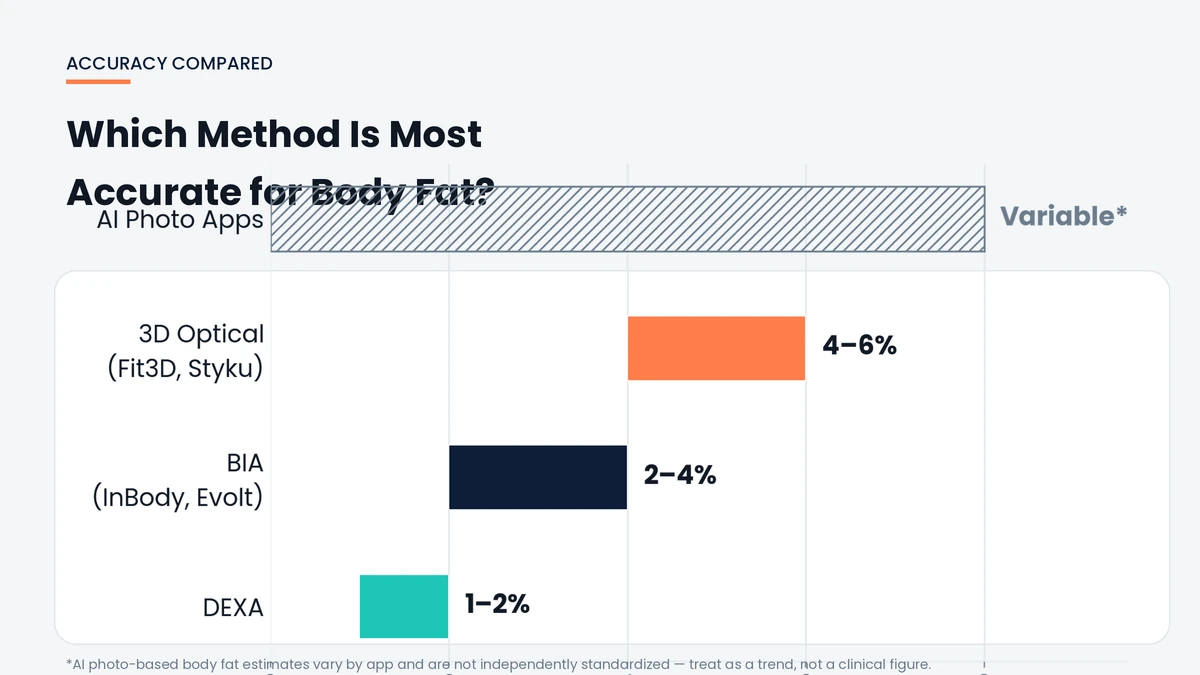
| Method | Typical Error Range | Scan Time | Hydration Sensitive? | Typical Cost |
|---|---|---|---|---|
| DEXA | ~1-2% (clinical literature) | 10-15 min | No | $40-$200 per scan |
| BIA (InBody, Evolt) | ~2-4% | 30-60 sec | Yes | $8,000-$24,000+ hardware |
| 3D Optical (Fit3D, Styku) | ~4-6% for body fat | 30-90 sec | No | $500-$10,000 depending on model |
| AI Photo Apps | Variable, vendor-reported | Instant | Somewhat | Free-$15/month |
The takeaway isn’t that one method is universally “right.” It’s that each method has a different margin of error, and comparing numbers across methods will always look confusing. The fix is simple: pick one AI body composition analysis tool as your primary tracking method per client, test under the same conditions every time, and treat DEXA as an occasional cross-check rather than a weekly habit.
How to Build These Tools Into Your Training Business
An AI body composition analysis tool pays for itself fastest when it’s built into your client experience, not treated as a side gadget.
- Use the first scan as your sales tool. A free or low-cost initial scan gives prospective clients a concrete reason their current approach isn’t working, and a clear baseline to work from.
- Schedule re-scans on a cadence, not randomly. Monthly is usually the sweet spot. Weekly scanning with BIA or 3D tools introduces more noise than useful signal.
- Bundle scans into premium packages. Clients who see hard data tend to stay longer and renew more often, because they can see the return on their investment.
- Use segmental data to justify programming changes. Showing a client their own left-right imbalance or lagging muscle group makes your programming decisions feel evidence-based instead of arbitrary.
- Get consent before using before-and-after data for marketing. This is both an ethical requirement and, in most places, a legal one.
Mistakes Trainers Make When Using Body Composition Tools
- Switching tools mid-program. Comparing an InBody reading to a DEXA reading to a phone app reading looks like the client’s progress stalled or reversed, when it’s really just three different measurement systems disagreeing.
- Over-testing. Daily or even weekly BIA scans mostly capture hydration noise, not real change. Give the body enough time between scans for actual tissue change to happen.
- Ignoring test conditions. Time of day, recent workouts, caffeine, and hydration all shift BIA and, to a lesser extent, 3D scan results. Standardize the protocol and stick to it.
- Presenting numbers without context. A body fat percentage means little to a client without a trend line and an explanation of the margin of error. Numbers reassure people when they understand them, and worry people when they don’t.
- Treating vendor accuracy claims as independent fact. Read validation studies carefully, and note whether the comparison was run by the company selling the product or by an outside lab.
FAQs
Which AI body composition analysis tool is the most accurate?
DEXA is the closest thing to a verified gold standard, with published precision typically in the 1% to 2% range. Among tools trainers can own and use daily, multi-frequency BIA devices like InBody and Evolt 360, and modern AI-driven 3D scanners like Fit3D SNAP, offer a reasonable balance of accuracy and practicality. No consumer-facing tool matches DEXA’s absolute precision.
How often should I scan clients?
Monthly is the standard recommendation for BIA and 3D scanning. This gives the body enough time to show real change while still keeping clients engaged. Photo-based AI check-ins can happen weekly since they’re lower effort, but treat those as motivational trend tracking rather than a precise measurement.
Can a phone app replace a dedicated body composition scanner?
Not for programming or nutrition decisions. AI photo apps are useful for keeping clients accountable between visits, but dedicated BIA, 3D, or DEXA tools give more reliable, repeatable numbers. Use apps to supplement your primary tool, not to substitute for it.
Do BIA scanners work for every client?
Not always. Clients with pacemakers or other electronic medical implants generally shouldn’t use BIA devices, since they involve passing a small electrical current through the body. 3D optical scanning or photo-based tools are safer alternatives for these clients.
Is it worth adding an occasional DEXA scan alongside my in-studio scanner?
Yes, if your budget allows it. A DEXA scan every few months gives you an outside reference point to check whether your primary in-studio tool is drifting or staying consistent. It’s not something most trainers need weekly, but it builds credibility with data-focused clients.
How much should I charge clients for a body composition scan?
This depends heavily on your device and market, but many studios price individual scans somewhere between $25 and $50, or bundle a set number of scans into higher-tier training packages. Some trainers offer the first scan free as part of an onboarding consultation, then charge for follow-ups.
Conclusion
There’s no single AI body composition analysis tools that’s right for every trainer. A high-volume commercial gym benefits most from something fast and walk-in-friendly like Evolt 360. A data-focused studio might lean toward InBody’s clinical reputation or Fit3D SNAP’s newer AI-driven approach at a lower entry cost. Independent trainers working with a smaller client base might get more value from pairing a lighter-weight 3D scanner with free AI photo check-ins between sessions, and reserving DEXA for occasional verification.
What actually matters more than which machine you choose is consistency. Pick one primary tool, test clients the same way every time, and use the data to guide real coaching decisions instead of just handing clients a printout. That’s what turns a body composition analysis tool from a nice gadget into something that genuinely improves your results and your business.
This article is part of our ongoing series on Best AI Tools for Personal Trainers & Fitness Coaches. For related reading, see our guides to Best AI Workout Plan Generator for Personal Trainers and AI Content Creation Tools for Fitness Coaches.