
Table of Contents
Quick answer
Etsy allows AI-generated products, but only under specific conditions. If you use generative AI tools such as DALL-E, Midjourney, or ChatGPT image tools to create a design, you must disclose this in your listing description and classify the item as “Designed by a seller” rather than “Made by a seller.”
Etsy does not allow AI prompt bundles to be sold as finished products, and you’re still fully responsible for making sure your AI-generated content doesn’t infringe on someone else’s copyright or trademark. Skipping disclosure or misclassifying a listing can get it removed, and repeated violations can put your whole shop at risk. This guide walks through exactly what Etsy’s AI disclosure policy requires, how to stay compliant, and where sellers most often get tripped up.
What Counts as “Using AI” on Etsy?
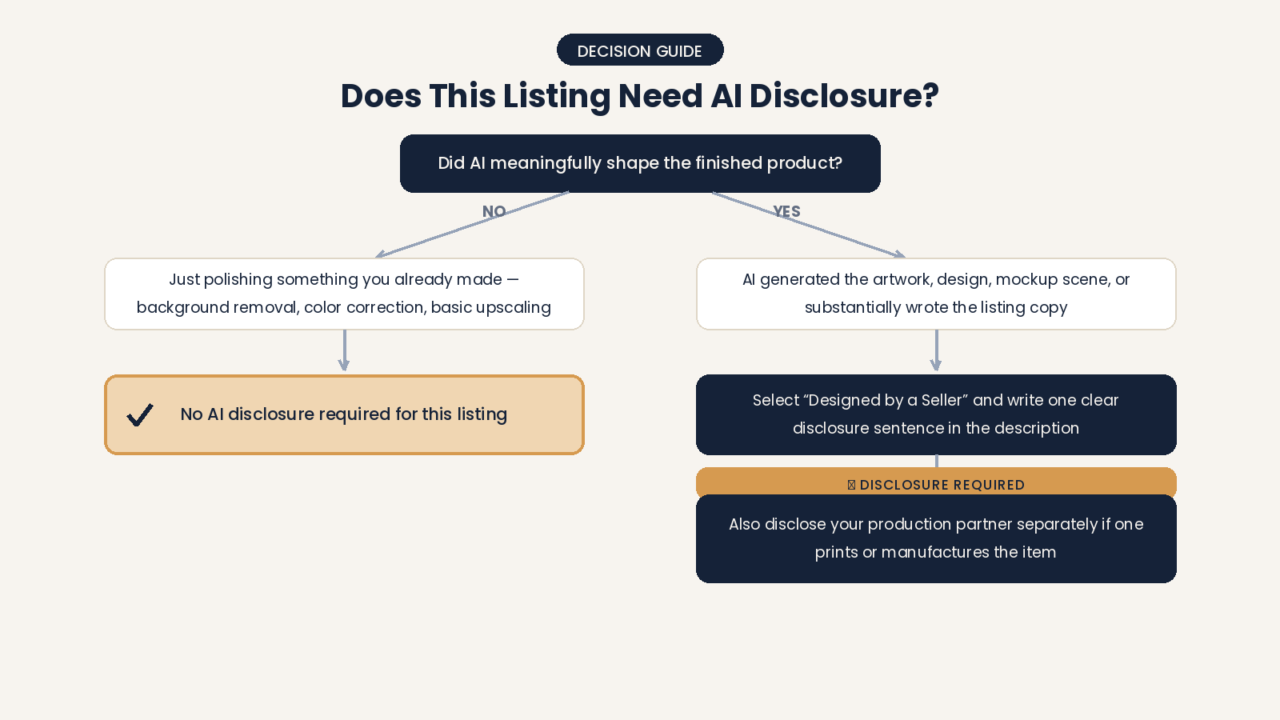
Not every tool with an AI feature triggers a disclosure requirement. The line Etsy draws comes down to one question: did the AI meaningfully shape the final product, or did it just polish something you already made?
Generative AI use that requires disclosure typically includes:
- Artwork or illustrations created with AI image generators (Midjourney, DALL-E, Adobe Firefly, Ideogram, ChatGPT’s image tools, and similar)
- Digital downloads, patterns, or SVG files where the design itself came from an AI prompt
- Listing descriptions or product copy written substantially by an AI writing tool, when the words themselves are part of what you’re presenting as your own creative voice
- Product mockups where AI generated the scene, not just placed your design onto a template
- AI-generated pet portraits, fantasy art, or custom illustrations based on a buyer’s request
Editing tools that use AI in the background, without changing the core creative content, generally sit in a grayer zone and don’t automatically require the same disclosure. Simple background removal, minor color correction, or basic upscaling of a photo you took yourself is different from letting AI regenerate parts of the product or invent details that weren’t there.
When in doubt, ask yourself: would a buyer feel misled if they knew AI was involved? If the honest answer is yes, disclose it.
Etsy’s Creativity Standards: Where AI Fits In
Etsy’s entire seller policy is built around a document called the Creativity Standards, part of its Terms of Use. It’s the framework that decides what can legally be listed on the platform, and it splits every item into one of four categories based on the seller’s actual role in creating it.
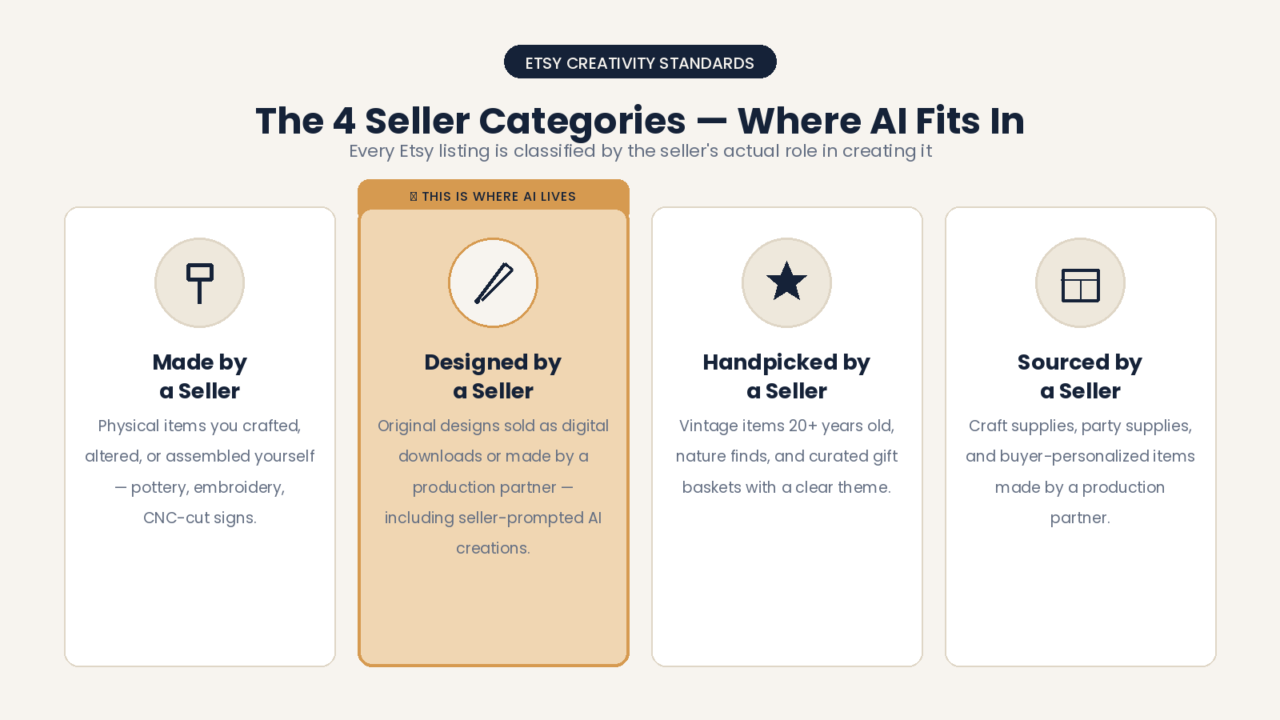
Made by a Seller
This category covers physical items you crafted, altered, or assembled yourself, either fully by hand or with personal tools like a sewing machine, laser cutter, 3D printer, or Cricut. Think hand-thrown pottery, hand-embroidered tote bags, or a wooden sign cut on your own CNC machine. AI-generated designs do not belong here, because “made by a seller” is about physical craftsmanship, not digital design origin.
Designed by a Seller (This Is Where AI Lives)
This is the category that matters most for this guide. “Designed by a seller” covers original designs that are either sold as digital downloads or produced by a third-party production partner. Etsy explicitly includes seller-prompted AI creations under this umbrella.
According to Etsy’s own policy, seller-prompted AI creations are pieces generated using AI tools based on a seller’s original prompts, things like a fantasy scene built from your own creative direction, or a custom AI-generated portrait of a buyer’s pet. The key phrase is “seller-prompted.” You need to be the one writing the prompts and curating the output, not simply reselling someone else’s AI-generated files.
If your item falls into this category because of AI involvement, disclosure is mandatory. You state that AI was used, directly within the listing description.
Handpicked by a Seller
This covers vintage items (20 years or older), items found in nature, and curated gift baskets with a clear theme. AI has no real overlap here, since these items are defined by the seller’s role in sourcing and selecting, not producing.
Sourced by a Seller
This category is for craft supplies, party supplies, and buyer-personalized items made by a production partner. If you sell blank tumblers for buyers to decorate, or personalized items where a production partner does the printing, AI disclosure rules apply if the underlying design itself was AI-generated, even though the item is “sourced” rather than “designed.”
How to Disclose AI Use on an Etsy Listing (Step by Step)
Sellers overcomplicate this more than they need to. Etsy’s own guidance keeps it simple: state clearly, in the listing description, that AI tools were used to create the item. Here’s what that looks like inside your actual workflow, from opening the listing to hitting publish.
In Shop Manager:
- Open Listings, then create or edit the item. Go to Shop Manager > Listings, and either start a new listing or open an existing one that uses AI-generated design elements.
- Find the “how was this made” section. Every listing asks you to classify how the item came to be. This is where you select Designed by a seller instead of Made by a seller, since seller-prompted AI creations fall under the “designed” category.
- Write the disclosure directly into the Description field. One clear sentence is enough: “This design was created using AI image generation tools based on my original prompts and creative direction.” No need for a lengthy disclaimer or apology.
- Scroll to the production partner section, if one applies. If a print-on-demand company physically manufactures or prints the item, disclose them separately here. This is a different requirement from the AI disclosure, not a substitute for it.
- Save, then check how it reads from a buyer’s point of view. Reopen the live listing and read the description as if you were a stranger deciding whether to buy. If the AI involvement isn’t obvious within the first few lines, move it higher.
- Mirror the same language in your shop’s About or FAQ section. If AI is a regular part of how you work across multiple listings, a short standing statement there reinforces the individual listing disclosures and builds buyer trust.
A good rule of thumb: the disclosure should be easy for a buyer to find and understand before they hit “buy,” not buried at the bottom of a wall of text. And avoid disclosure that reads like marketing spin, phrases like “100% original AI art” can work against you if a buyer or Etsy’s review team feels the wording is downplaying what actually happened.
What Etsy Does Not Allow, Even With Disclosure
Disclosure protects you in some situations, but it doesn’t make everything permissible. A few things stay off-limits no matter how clearly you label them.
AI Prompt Bundles
Etsy explicitly prohibits selling collections of AI prompts on their own, separate from a finished piece of art. The reasoning is straightforward: Etsy considers the prompt itself part of the creative process, not a finished product. If you’re selling “50 Midjourney prompts for fantasy landscapes” as a standalone digital download, that listing doesn’t qualify under the Creativity Standards, regardless of disclosure.
Nudity, Privacy, and Publicity Violations
AI-generated depictions of nudity or sexual content still fall under Etsy’s Prohibited Items Policy, the same as any other content. AI doesn’t create an exception. Similarly, content that infringes on someone’s privacy, publicity rights, or personal likeness, such as AI-generated images of real, identifiable people without permission, is not allowed.
Non-Original, Templated Designs
Etsy has tightened its stance on items built from purchased templates, design bundles, or generic clip art, even when a commercial license was paid for. This matters for AI specifically because running someone else’s pre-written prompt through an AI tool, or lightly editing an AI output someone else already generated and sells in bulk, doesn’t meet the bar for “original” the way a seller’s own prompt and curation does.
AI and Production Partners: Do You Need Both Disclosures?
Yes, and this is one of the most common compliance gaps for print-on-demand sellers. AI disclosure and production partner disclosure address two separate questions:
- AI disclosure answers: “Who or what created the design?”
- Production partner disclosure answers: “Who physically manufactured or printed the item?”
If you designed a graphic using an AI tool and then had it printed on a T-shirt by a company like Printify or Printful, both disclosures apply to that single listing. You need to:
- Disclose the AI involvement in the design within your listing description
- Name your production partner and describe their role accurately (their name, location, and what they specifically do)
- Choose the correct “how was this made” selection in your listing details, indicating a production partner was involved
Skipping either one, not just the AI part, is a common reason POD listings get flagged. Etsy wants a complete, honest picture of how an item moved from concept to the buyer’s doorstep.
Copyright, Trademark, and the Legal Side of AI Art
This is where a lot of sellers get into trouble that has nothing to do with disclosure at all. Even a perfectly disclosed AI listing can still violate someone else’s intellectual property.
Why “the AI Made It” Isn’t a Legal Shield
If your prompt includes a recognizable brand, character, or trademarked term, such as asking for “a Disney princess in watercolor style” or “a Nike-inspired logo,” the output can still infringe on that company’s copyright or trademark. It doesn’t matter that a machine generated the image instead of a human hand. Brand owners and Etsy’s intellectual property enforcement process treat AI-assisted infringement the same as any other kind.
For copyright specifically, Etsy handles claims through the notice-and-takedown process required by the Digital Millennium Copyright Act (DMCA). If a rights holder files a valid copyright report, Etsy typically removes the listing immediately, often without warning, and notifies the seller of the claim. From there, you can either accept the removal or file a DMCA counter-notice if you genuinely believe you have the rights to use the content. Trademark claims go through a separate reporting process rather than the DMCA, since trademark and copyright are different legal protections, but the practical result for a seller (a removed listing and an explanation) looks similar either way.
Practical ways to reduce this risk:
- Avoid naming specific brands, characters, franchises, or living artists in your prompts
- Steer clear of phrases like “inspired by,” “in the style of [brand],” or “official [character]” in titles, tags, and descriptions
- If you’re unsure whether a design resembles protected material too closely, don’t list it
- Keep records of your prompts and creative process in case you ever need to demonstrate originality
Can You Copyright AI-Generated Work?
This is a genuinely unsettled area of law, and it’s worth understanding even though it’s separate from Etsy’s own rules. Copyright protection generally requires human authorship. Purely AI-generated output, with no meaningful human creative input, may not qualify for copyright protection in the United States. That means an AI-generated design with minimal human involvement could, in theory, be freely copied by someone else, since there may be no copyright to enforce. The more creative direction, editing, and curation you personally contribute, the stronger your claim to authorship. This is a legal question separate from Etsy’s disclosure requirement, but it’s worth knowing if you’re building a business around AI-assisted products.
What Happens If You Don’t Disclose AI Use
Non-compliant listings are subject to removal under Etsy’s Creativity Standards, and Etsy’s trust and safety systems actively review listings for signs of undisclosed AI use, misclassified attribution, or unoriginal templated content. Consequences generally scale with severity and repetition:
- First-time, minor issues: A single listing gets removed or temporarily deactivated, often with a notice explaining the policy area involved.
- Repeated or pattern violations: Etsy may issue formal warnings against the shop, and repeated non-compliance can affect your account standing.
- Serious or repeated IP violations: These carry a higher risk of shop suspension, separate from the AI disclosure rules themselves.
Etsy’s Appeal Process
If you believe a listing was removed in error, Etsy has been expanding listing appeals, starting with Creativity Standards removals. If this happens to you, review the removal notice carefully, correct the underlying issue (add the missing disclosure, fix the attribution, adjust the description), and use the appeal option in Shop Manager if you believe the removal was a mistake rather than a genuine policy gap.
The most reliable way to avoid all of this is simple: disclose proactively, rather than waiting to see if Etsy notices.
Pros and Cons of Using AI Tools in Your Etsy Shop
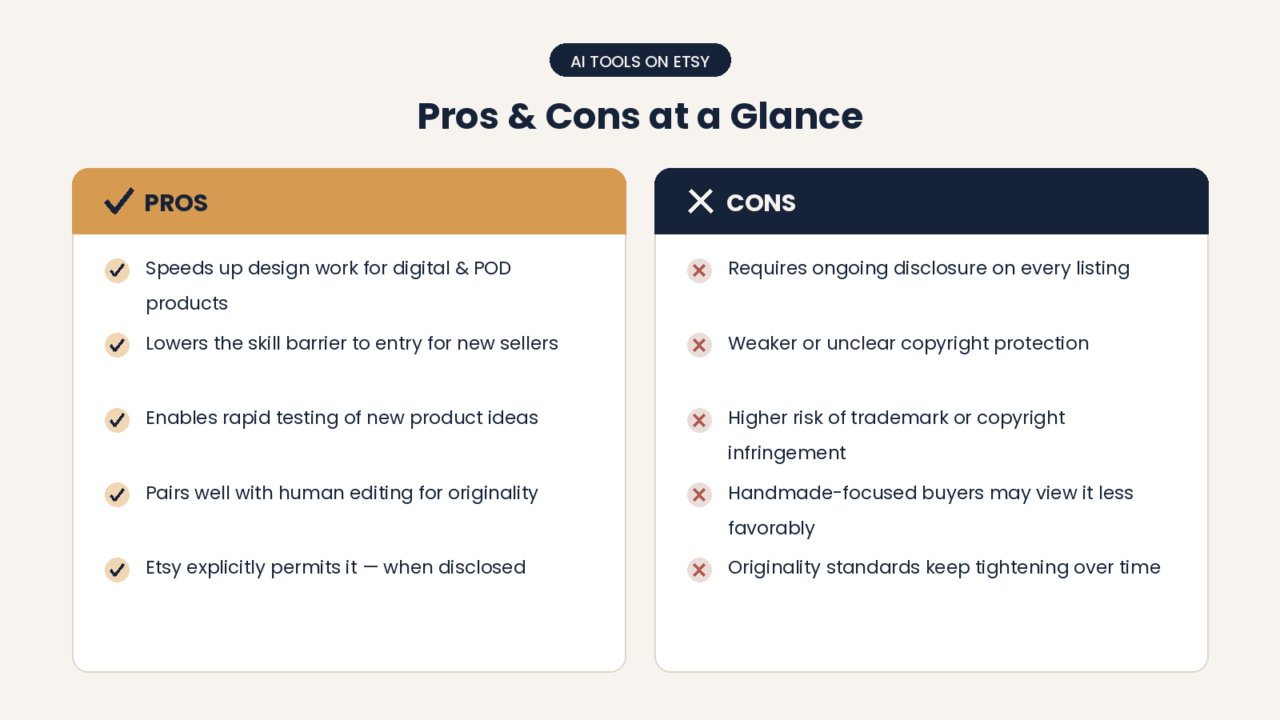
| Pros | Cons |
|---|---|
| Speeds up design work, especially for digital downloads and print-on-demand niches | Requires clear, ongoing disclosure on every affected listing |
| Lowers the barrier to entry for sellers without traditional art skills | AI-generated work may have weaker or unclear copyright protection |
| Allows rapid testing of new product ideas and niches | Higher risk of accidental trademark or copyright infringement from prompts |
| Can be combined with human editing for a genuinely original final product | Buyers in handmade-focused categories may view AI use less favorably |
| Etsy explicitly permits it when done transparently | Etsy’s originality standards keep tightening, so compliance needs regular review |
Etsy AI Disclosure Compliance Checklist
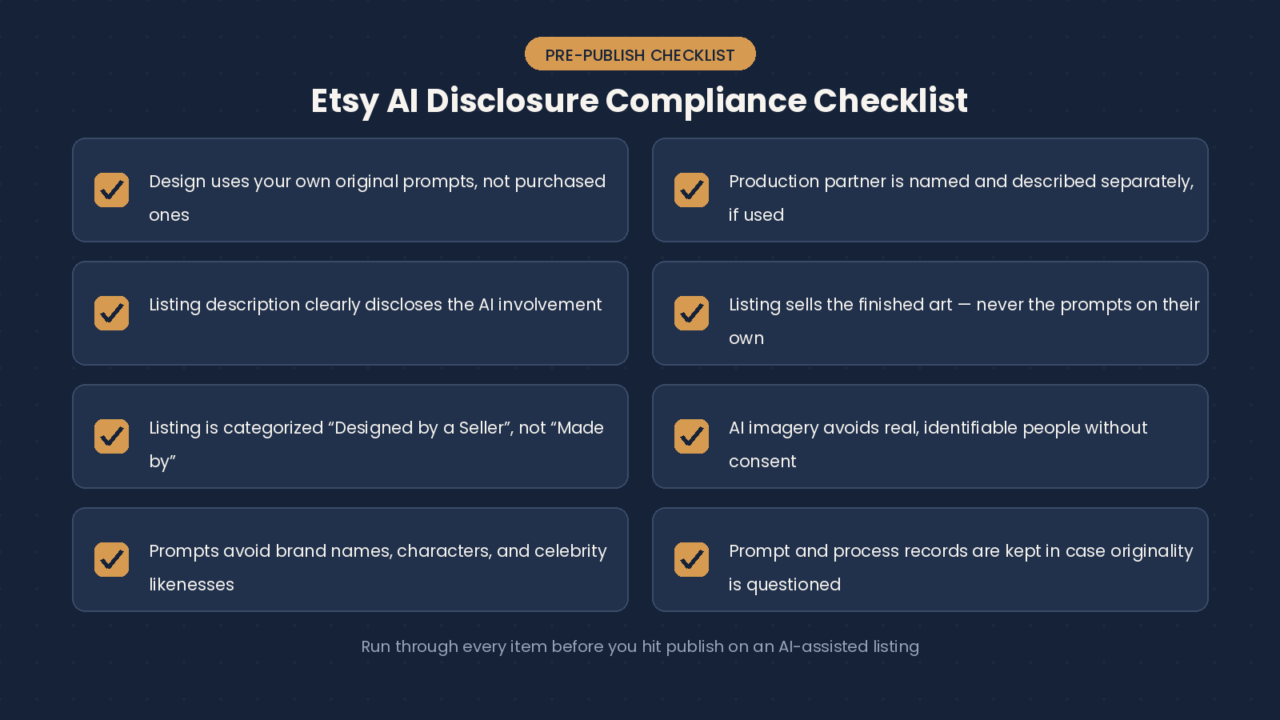
Run through this before you hit publish on any AI-assisted listing:
- The design was generated using your own original prompts, not purchased or copied prompts
- The listing description includes a clear, factual sentence disclosing AI involvement
- The listing is categorized as “Designed by a seller,” not “Made by a seller”
- Your prompt and final design avoid brand names, copyrighted characters, celebrity likenesses, and trademarked terms
- If a production partner is involved, they’re named and accurately described separately from the AI disclosure
- The listing doesn’t sell prompts on their own, only the finished creative output
- Any AI-generated imagery involving people avoids depicting real, identifiable individuals without consent
- You’ve kept a record of your prompt and process in case originality is ever questioned
Frequently Asked Questions
Does Etsy allow AI-generated products?
Yes. Etsy permits seller-prompted AI creations under its “Designed by a seller” category, as long as the seller contributed original prompts and creative direction, and disclosed the AI use in the listing description.
Where exactly do I put my AI disclosure on an Etsy listing?
The listing description is the required location. You should also set the item’s attribution to “Designed by a seller” rather than “Made by a seller” so the classification matches how the item was actually created.
Can I sell a pack of AI prompts on Etsy?
No. Etsy prohibits selling AI prompt bundles as standalone products. Prompts are considered part of the creative process, not a finished item, so they need to be paired with the actual artwork they produced, not sold separately.
Do I need to disclose AI use if I only used it to remove a background from my product photo?
Generally, no. Minor AI-assisted photo edits, like clean background removal or basic color correction on your own product photography, are treated differently from AI that generates or substantially alters the creative content itself. If the AI changed shadows, regenerated parts of the product, or added elements that weren’t really there, that crosses into disclosure territory.
What’s the actual difference between “Made by a seller” and “Designed by a seller”?
“Made by a seller” is for physical items you personally crafted, altered, or assembled by hand or with your own tools. “Designed by a seller” is for original designs that are sold as digital downloads or produced by a third party, including AI-generated art made from your own prompts.
Will Etsy suspend my whole shop for one undisclosed AI listing?
A single first-time issue typically results in the listing being removed or deactivated, not an automatic shop suspension. Repeated violations, or serious intellectual property infringement, are what tend to escalate to account-level consequences.
Do print-on-demand sellers need AI disclosure and production partner disclosure at the same time?
Yes, if both apply. AI disclosure covers who or what created the design. Production partner disclosure covers who physically manufactured the item. A POD listing with an AI-generated design needs both pieces of information stated clearly.
Is AI-generated art protected by copyright?
It’s a genuinely unsettled legal question, but current guidance in the U.S. generally requires meaningful human authorship for copyright protection. The more original creative input and editing you personally add, the stronger your claim to ownership over the final piece.
Final Thoughts
Etsy’s approach to AI is more permissive than a lot of sellers assume, but it comes with real conditions attached. The platform isn’t trying to ban AI outright. It’s trying to preserve the idea that a real person is behind the creative decisions, and that buyers get an honest picture of how an item was made. If you write your own prompts, curate the output with genuine creative judgment, disclose that AI was involved, classify the listing correctly, and steer clear of other people’s trademarks and copyrighted characters, you’re operating well within Etsy’s rules.
The sellers who run into trouble are usually the ones treating disclosure as optional or hoping nobody notices, not the ones actually using AI as part of a legitimate creative process. Build the habit of disclosing upfront, keep your prompts and process documented, and revisit Etsy’s Creativity Standards periodically, since this is an area of policy that keeps evolving as the technology does.
If you’re looking for a full package of AI tools for Etsy sellers, then you can follow our complete Best AI tools for Etsy sellers pillar guide.
[Note: This guide reflects Etsy’s published Creativity Standards and Seller Handbook guidance as of 2026. Etsy’s policies are updated periodically, so it’s worth checking Etsy’s official Creativity Standards page directly before making major changes to your shop.]