
Table of Contents
Quick Answer
The best AI listing description writer for real estate depends on what you already have in your tech stack. If you want something free and flexible, ChatGPT or Claude will draft a solid listing description in under a minute — but you’ll still need to edit it for MLS accuracy and Fair Housing wording yourself. If you want a tool built specifically for real estate, with compliance checks, MLS-ready formatting, and one-click versions for social media and email, purpose-built options like ListingAI, Write.Homes, and Epique AI go further out of the box.
No AI tool should publish a description untouched. Every draft still needs a quick human read-through, mainly to catch Fair Housing language and confirm the facts are actually correct. Below, we break down eight tools worth knowing, how to prompt them properly, and the compliance rules that trip up even good AI-generated copy.
Why Agents Are Turning to AI for Listing Copy
Writing a fresh, non-generic description for every listing is one of those tasks that eats an hour agents don’t have — especially when you’re juggling five active listings and a stack of showing feedback to send. That’s the practical reason AI adoption in this part of the job has climbed so fast.
Estimates vary by survey. The National Association of Realtors puts the share of agents who now treat AI as part of their daily workflow at around 72%, while other industry surveys put overall adoption closer to 80–85%. Either way, content creation — listing descriptions, social captions, and follow-up emails — consistently ranks as the single most common use case. It’s the easiest entry point into AI for one simple reason: you already have the property facts. You’re just asking a tool to turn them into readable copy faster than you’d type it yourself.
That said, speed isn’t the only thing that matters here. A generic AI description that sounds like every other AI description doesn’t help a listing stand out — and a description that accidentally uses Fair Housing–risky language can create real legal exposure for the agent and the brokerage. That’s exactly why the type of AI tool you pick matters more than whether you use one at all.
What Actually Makes a Good AI Listing Description Writer for Real Estate
Every tool in this space runs on the same underlying technology — natural language processing (NLP), the branch of AI that turns structured property data into readable sentences. But not every tool built on top of that technology is built the same way, and the differences show up the moment you try to publish the output. Here’s what separates a tool that saves you time from one that just moves the editing work somewhere else.
Fair Housing Awareness Built Into the Draft
A general-purpose chatbot has no idea what the Fair Housing Act is unless you tell it. A real estate-specific AI property description generator should flag risky phrasing — references to family status, religion, ethnicity, disability, or coded “safety” language — before you ever copy the text into your MLS.
MLS-Ready Length and Formatting
Every MLS board sets its own character limit for the public remarks field, and they range from around 500 characters to over 2,000, depending on the board. A tool worth using should let you set a target length so the output fits your board’s field without getting cut off mid-sentence.
Real Estate Vocabulary, Not Generic Marketing Language
General AI models default to broad, safe-sounding marketing copy. Tools trained specifically on real estate content tend to use terminology buyers actually search for — “open-concept kitchen,” “primary suite,” “cul-de-sac lot” — rather than vague filler like “amazing home in a great location.”
The Ability to Repurpose One Draft Across Platforms
A listing description isn’t a one-time piece of writing anymore. It becomes the MLS remarks, a shorter Zillow-facing version, an Instagram caption, and a line in a buyer email. The strongest tools generate all of these from a single input instead of making you rewrite it four times.
Photo-Aware Drafting
A newer capability worth knowing about: some tools can read your listing photos and pull out details — kitchen finishes, flooring, natural light — that you might forget to mention in your notes. This is especially useful for agents who take their own photos and don’t always write down every feature as they shoot.
8 Best AI Tools for Writing Real Estate Listing Descriptions
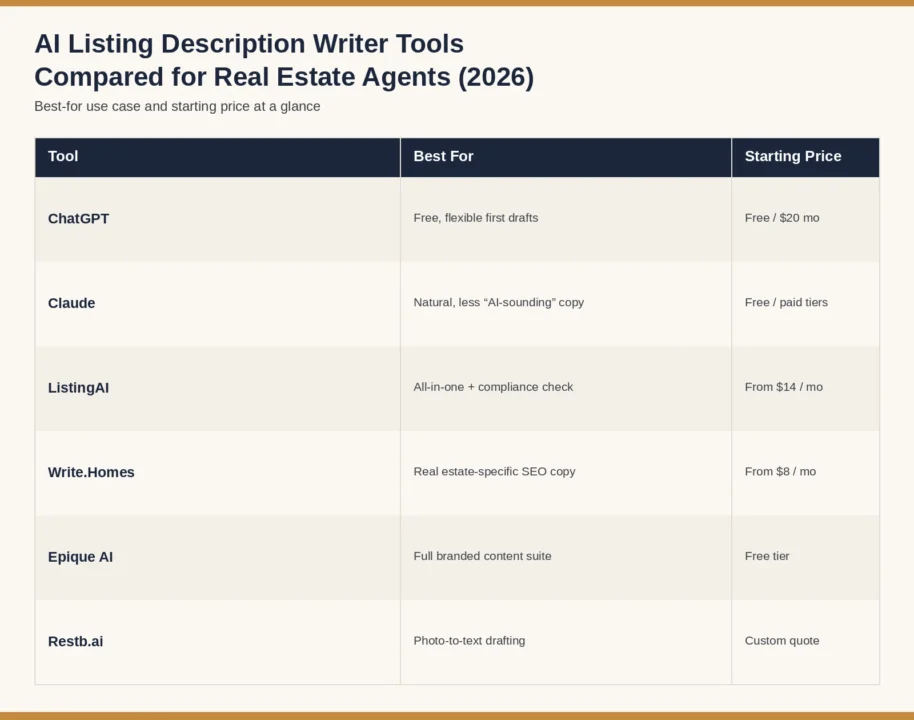
Here’s how the main options compare, from general-purpose AI assistants to platforms built specifically for the real estate listing description workflow.
1. ChatGPT — Best Free, General-Purpose Option
ChatGPT remains the most widely used AI writing tool among agents, largely because most people already have an account and the free tier is genuinely capable of drafting a decent listing description. You paste in your property notes — beds, baths, square footage, upgrades, neighborhood details — and ask for an MLS-style description in a specific tone and word count.
- Best for: Agents who want a no-cost option and don’t mind editing for compliance and MLS accuracy afterward
- Limitation: Not trained on real estate terminology or Fair Housing rules specifically, so every draft needs a compliance pass
- Cost: Free tier available; ChatGPT Plus (roughly $20/month) unlocks more advanced models, file uploads, and web browsing
2. Claude — Best for Natural-Sounding, Less “AI-Voiced” Copy
Claude tends to produce copy that reads less like a template and more like something a person actually wrote — useful for listing descriptions, since generic-sounding AI text is exactly what makes buyers scroll past a listing. It also handles rewriting the same property facts into different formats well: one prompt for the full MLS remarks, a follow-up prompt for a shorter social caption.
- Best for: Agents who’ve noticed their AI drafts all sound the same and want copy that reads more naturally
- Limitation: Same as any general-purpose model — no built-in Fair Housing screening or MLS field-length awareness unless you specify it
- Cost: Free tier available through claude.ai; paid plans unlock higher usage and more capable models
3. ListingAI — Best All-in-One With Compliance Checking
ListingAI is built specifically around the listing workflow: descriptions, social posts, virtual staging, CMAs, and a simple agent website, all from one property record. What sets it apart for this specific use case is a built-in compliance monitor that scans each description for potential Fair Housing issues and suggests alternative wording before you publish.
- Best for: Agents who want compliance checking without hiring a separate reviewer, and who’d rather consolidate several marketing tools into one subscription
- Notable feature: Access to multiple underlying AI models (including Claude, ChatGPT, and Gemini) from a single account
- Cost: Free plan available; paid plans start around $14/month
4. Write.Homes — Best Purpose-Built Real Estate Writer
Write.Homes is trained specifically on real estate language and workflows rather than being a general chatbot adapted for the industry. It covers MLS listing templates, social posts, and blog content, with SEO optimization and multilingual support baked in — useful for agents working multicultural or international buyer pools.
- Best for: Agents who want output that needs minimal editing because it already reads like real estate copy, not generic marketing text
- Notable feature: Direct MLS and CRM integration, so property data flows into the description generator without manual re-entry
- Cost: Free tier for shorter content; paid plans typically range from about $8 to $80/month depending on volume and features
5. Epique AI — Best for Full Content Suites and Realtor Branding
Epique bundles a property description generator alongside realtor bio writing, a 12-month automated email campaign builder, newsletter templates, and social content tools — twelve tools in total. The description generator specifically leans on real estate terminology and market data to keep the tone professional rather than salesy.
- Best for: Agents who want their listing descriptions, bios, and drip campaigns to share one consistent voice across every touchpoint
- Limitation: Some advanced features (legal and broker-advice tools) are restricted to agents affiliated with Epique Realty
- Cost: Generous free tier for core content tools
6. ValPal — Best for Agents Who Also Want Valuation and Lead Capture
ValPal, based in the UK, pairs an AI property description generator with an instant home valuation tool and a lead-capture chatbot called ChatPal. It’s a strong pick for agents (particularly outside the US) who want listing copy and lead generation bundled into one PropTech platform rather than managed as separate subscriptions.
- Best for: UK and international agents already using ValPal’s valuation tools who want the description writer in the same ecosystem
- Limitation: Less flexible than a chat-based tool for fine-tuning tone or trimming word count through natural-language instructions
- Cost: Contact ValPal directly for current pricing; it’s typically positioned as part of a broader lead-gen package
7. HAR AI Property Description Tool — Best Regional MLS Integration
HAR.com’s built-in AI tool is a useful example of where the whole industry is heading: MLS boards embedding description generation directly into the listing input software (in this case, Matrix), so agents never have to leave their workflow to get a draft. It uses natural language processing to turn the physical property details you enter into a finished description you can edit and push straight back into the MLS record, plus matching social posts.
- Best for: Houston-area agents on the HAR MLS system who want a description generator wired directly into their existing listing input screen
- Note: Access and feature depth can vary by membership tier — check with your local MLS board, since more boards are rolling out similar embedded tools
- Cost: Included for HAR members at applicable subscription tiers
8. Restb.ai — Best for Photo-to-Text Drafting
Restb.ai uses computer vision to analyze your listing photos and generate a first-draft description automatically, pulling out details like flooring type, countertop material, and room features directly from the images. It’s a strong starting point for agents who have great photos but thin written notes.
- Best for: Agents who often forget to jot down every finish detail and want a tool that can “see” it in the photos instead
- Limitation: Best used as a first draft — it won’t know your neighborhood context, school ratings, or lifestyle angle the way a human (or a well-prompted chatbot) would
- Cost: Enterprise and API-based pricing; typically sold through MLS or brokerage-level integrations rather than individual agent sign-up
Comparison Table: AI Listing Description Tools at a Glance
| Tool | Best For | Fair Housing Check | Real Estate-Specific | Starting Price |
|---|---|---|---|---|
| ChatGPT | Free, flexible drafting | No (manual review needed) | No | Free |
| Claude | Natural-sounding copy | No (manual review needed) | No | Free |
| ListingAI | All-in-one + compliance | Yes | Yes | ~$14/month |
| Write.Homes | Purpose-built copy, SEO | Partial | Yes | ~$8–$80/month |
| Epique AI | Full content suite | Partial | Yes | Free tier available |
| ValPal | Descriptions + valuation + leads | No | Yes | Custom quote |
| HAR AI | Regional MLS integration | Partial | Yes | Included w/ HAR membership |
| Restb.ai | Photo-to-text drafting | No | Yes | Custom/enterprise |
Pricing and features change often — confirm current details on each provider’s site before subscribing.
How to Prompt ChatGPT or Claude for a Listing Description That Doesn’t Sound Generic
If you’re using a general AI assistant instead of a real estate-specific tool, the quality of your output depends almost entirely on the quality of your prompt. Vague prompts get vague, forgettable descriptions. Specific prompts get copy that sounds like it was written for that one house.
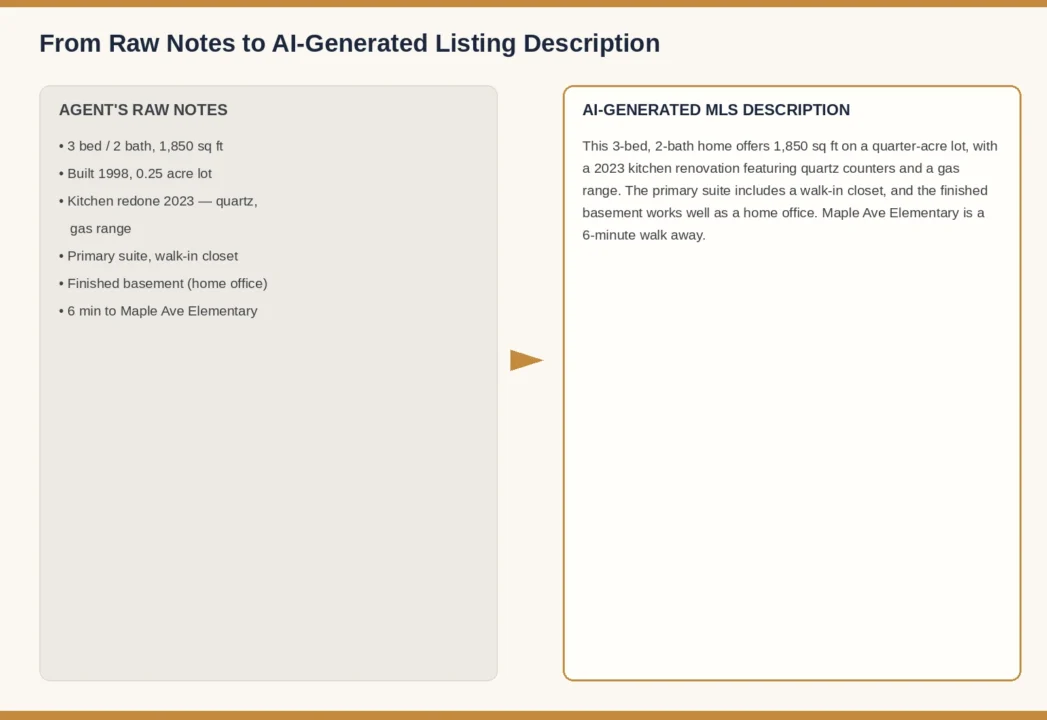
A prompt that works well usually includes:
- The hard facts first — beds, baths, square footage, lot size, year built, recent upgrades with dates
- One or two details that are genuinely unique to this property, not generic (“original 1920s crown molding still intact,” not “charming character”)
- The target buyer — first-time buyer, growing family, downsizer, investor — so the tool knows which features to lead with
- A word count or character limit that matches your MLS field
- A tone instruction (“warm but factual, no exclamation points, no clichés”)
Example prompt:
Write an MLS-ready listing description for a 3-bedroom, 2-bath single-family home, 1,850 sq ft on a 0.25-acre lot in [neighborhood]. Built in 1998, kitchen renovated in 2023 with quartz counters and a gas range, primary suite with a walk-in closet, finished basement currently used as a home office. Target buyer: a first-time buyer upgrading from an apartment. Tone: warm, specific, no hype words like “stunning” or “must-see.” 180–200 words, formatted for MLS public remarks.
Run the same base facts through a second prompt for a shorter, punchier social caption, and a third for a slightly more formal version for a buyer’s agent email. One good input, three usable outputs.
Fair Housing Compliance: What AI Tools Catch (and What They Still Miss)
Fair Housing Compliance is the part of the workflow where an AI listing description writer earns or loses your trust. The Fair Housing Act (42 U.S.C. § 3604(c), with implementing regulations at 24 C.F.R. § 100.75) prohibits advertising language that expresses a preference, limitation, or discrimination based on a protected class in the sale or rental of housing. Federally, that covers seven categories:
- Race
- Color
- Religion
- Sex
- Disability (referred to as “handicap” in the statute)
- Familial status
- National origin
Many states and cities add more protected classes on top of the federal list — things like sexual orientation, gender identity, marital status, ancestry, age, and source of income (including Section 8 vouchers). If you work across state lines or in a city with expanded protections, your compliance bar is higher than the federal minimum.
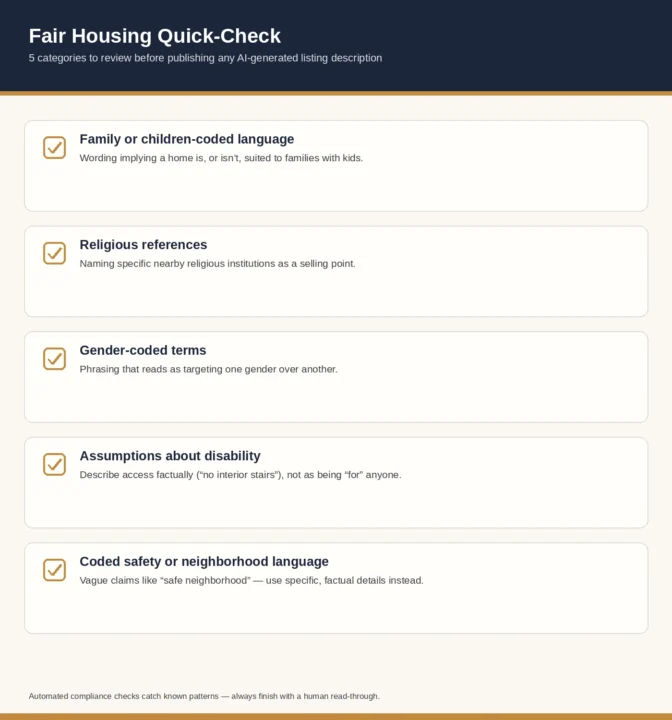
There used to be a widely circulated two-page list of “banned words” for real estate listings, built around old HUD guidance from 1989. That specific memo was withdrawn years ago and no longer represents HUD’s current position, but the underlying categories of risk are still exactly the ones to watch for. In practice, that means being careful with:
- Family or children-coded language — phrasing that implies a home is or isn’t suited to families with kids
- Religious references — naming nearby churches, temples, or similar institutions as a selling point, rather than describing walkability generally
- Gender-coded terms — phrases that read as targeting one gender over another
- Assumptions about disability — describing accessibility features factually (“no interior stairs,” “ground-floor unit”) rather than framing them as being “for” a particular group of people
- Coded safety or neighborhood language — vague claims like “safe neighborhood” can be read as coded language and are safer replaced with specific, factual details
The honest caveat: even the best AI tools built for real estate can miss context that a human would catch instantly. Automated compliance checks are pattern-matching against known risky phrases — they’re a strong first filter, not a substitute for a final human read-through, especially on anything that references people rather than the property itself.
MLS Character Limits and the Ideal Listing Description Length
MLS public remarks fields aren’t unlimited, and the limit you’re working with will shape how your description gets written. These fields trace back to older database software with fixed-width text limits, and boards have modernized at different speeds — which is why two neighboring counties can have wildly different limits.
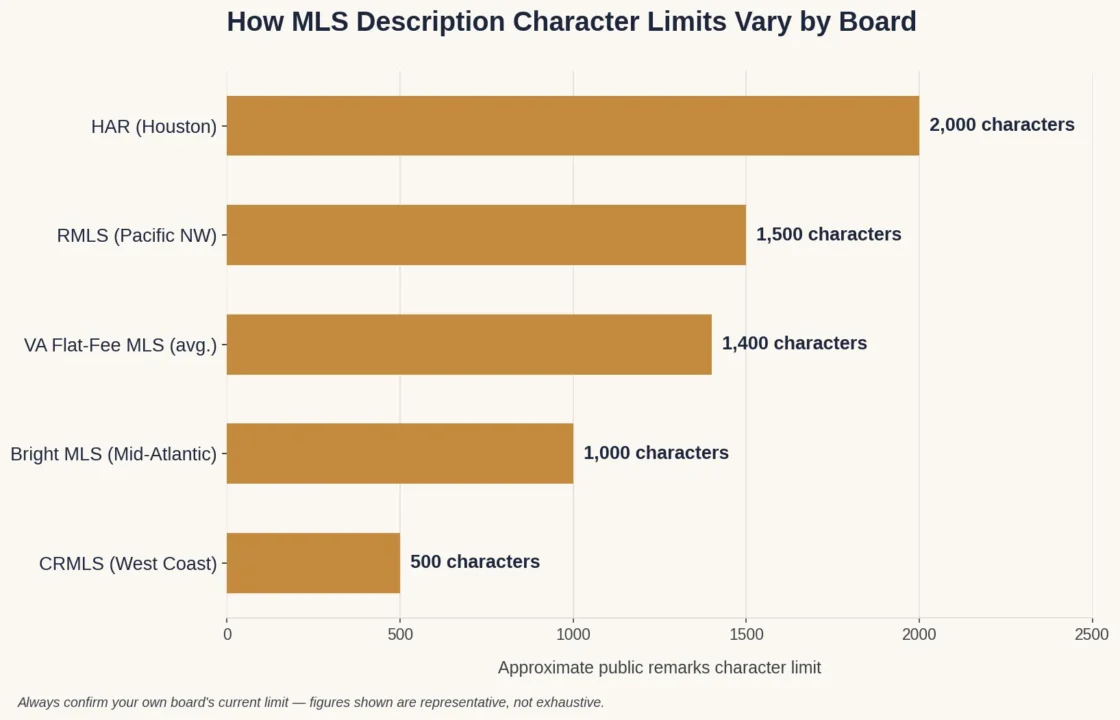
Some representative examples (always confirm your own board’s current limit, since these change):
| MLS or Region | Approximate Character Limit |
|---|---|
| CRMLS / similar West Coast boards | ~500 characters |
| Bright MLS (Mid-Atlantic) | ~1,000 characters |
| RMLS (Pacific Northwest) | ~1,500 characters |
| HAR (Houston) | ~2,000 characters |
| Various Virginia flat-fee MLS boards | 750–2,048 characters |
Beyond the MLS limit itself, remember that portals like Zillow and Realtor.com truncate what buyers see in search results — Zillow shows roughly the first 250 characters before a “Read more” link, and Realtor.com shows a similar range. That means your opening sentence is doing double duty: it’s the first thing a buyer decides whether to click on, not just the start of a longer paragraph.
Zillow’s own research (published in the book Zillow Talk) recommends keeping a full description around 250 words, both because of these platform limits and because buyers don’t read much longer than that. The same research found specific word choices measurably affect outcomes — homes described as “luxurious” or “captivating” sold for meaningfully more than expected relative to comparable homes, while words like “fixer,” “TLC,” “investor,” and “potential” correlated with lower-than-expected sale prices. The takeaway for AI-generated copy is the same as for human-written copy: specific, positive, factual language consistently outperforms vague hype or anything that signals the property needs work.
Common Mistakes Agents Make When Using AI for Listing Descriptions
- Publishing the first draft unedited. AI output is a starting point, not a finished product — always read it once for accuracy and once for compliance.
- Feeding it thin input. “3 bed 2 bath, nice yard” produces a generic description because that’s all the tool has to work with. More detail in, more specific copy out.
- Ignoring your MLS’s actual character limit. A description that gets auto-truncated mid-sentence looks worse than a shorter, complete one.
- Using the same prompt and tone for every listing. If every description you generate sounds interchangeable, buyers notice — and so do other agents scrolling the same MLS.
- Skipping the neighborhood context. AI tools default to describing the property; you often have to explicitly ask for neighborhood, school, or commute details to be included.
- Assuming compliance checking means zero risk. Automated flags catch known patterns, not every possible phrasing — a final human read is still worth the ninety seconds it takes.
Frequently Asked Questions
What is the best AI tool for writing real estate listing descriptions?
There isn’t a single best tool for every agent — it depends on budget and whether you want compliance checking built in. ChatGPT and Claude are strong free options if you’re comfortable editing for Fair Housing language yourself. ListingAI, Write.Homes, and Epique AI are purpose-built alternatives that add MLS formatting and compliance screening out of the box.
Is ChatGPT good enough for real estate listing descriptions?
Yes, for most agents it’s a perfectly capable starting point, especially with a detailed prompt that includes property facts, target buyer, tone, and word count. The main gap is that it wasn’t trained specifically on Fair Housing rules or your MLS’s character limit, so you need to check both manually.
Do AI listing description tools check for Fair Housing compliance automatically?
Some do and some don’t. General-purpose assistants like ChatGPT and Claude have no built-in compliance screening unless you ask. Real estate-specific tools like ListingAI include a compliance monitor that flags risky phrasing, but no automated tool should be treated as a full legal review.
How long should an AI-generated MLS description be?
Aim for roughly 200–250 words as a general target, then adjust to your specific MLS board’s character limit, which can range from about 500 to over 2,000 characters. Zillow’s own research recommends staying near 250 words total since buyer attention and platform truncation both favor shorter, tighter copy.
Can AI write a listing description just from property photos?
Yes — tools like Restb.ai use image recognition to identify finishes and features directly from your photos and draft a description from them. It’s a useful first pass, but it won’t know local context like school ratings or commute times unless you add that separately.
Are AI-written real estate descriptions bad for SEO because they’re not unique?
Not inherently. Search engines don’t penalize AI-assisted writing — they penalize thin, low-value, or duplicate content. A description built from your property’s actual, specific details (not generic filler) reads as unique regardless of whether AI helped draft it.
How much do AI real estate listing description tools cost?
General assistants like ChatGPT and Claude offer usable free tiers, with paid plans around $20/month for expanded features. Purpose-built real estate tools typically range from free (for limited word counts) up to $80/month or more, depending on volume and how many marketing features are bundled in alongside the description generator.
Should I always edit an AI-generated listing description before publishing it?
Yes, every time. Check it for factual accuracy against your actual listing sheet, confirm it fits your MLS’s character limit, and read it once specifically for Fair Housing language. This takes a few minutes and is the difference between a tool that saves you time and one that creates new risk.
Conclusion
Picking the right AI listing description writer for real estate comes down to one honest question: do you want speed, or do you want speed plus compliance and formatting built in? Free tools like ChatGPT and Claude get you a strong first draft fast, provided you’re willing to do the compliance and formatting check yourself. Purpose-built tools like ListingAI, Write.Homes, and Epique AI cost a little more but hand back a description that’s closer to publish-ready — MLS-formatted, screened for Fair Housing risk, and already repurposed for social and email.
Either path works. What doesn’t work is treating any AI draft as finished the moment it’s generated. A quick human read-through — for accuracy, for compliance, and for whether it actually sounds like this specific house — is the step that turns a fast draft into a listing description that actually helps a property sell.
Looking to build out the rest of your AI stack beyond listing copy? Our complete guide to the Best AI Tools for Real Estate Agents covers lead qualification, CRM automation, virtual staging, and market analysis tools as well.