
Table of Contents
Quick Answer
If anyone is confused about which AI to choose ChatGPT vs Claude for Real Estate Agents? The simple answer is – For most real estate agents, ChatGPT is the easier tool to start with — it’s the most widely adopted AI assistant in the industry, quick for short tasks like listing captions and quick replies, and costs $20/month on the Plus plan. Claude is the stronger pick for anything long or detail-heavy — comparative market analysis (CMA) narratives, lease and disclosure review, buyer presentations, and client emails that need to sound like you wrote them, not a robot.
Neither tool replaces you. Both are built to absorb the repetitive writing, summarizing, and research that quietly eats up your week, freeing up hours for prospecting, showings, and negotiation — the parts of the job that actually close deals. A lot of top producers end up running both side by side: ChatGPT for fast turnarounds, Claude for anything client-facing where tone and accuracy matter.
Why Real Estate Agents Are Adding AI to Their Workflow
Real estate is a writing-heavy, document-heavy, deadline-heavy business — whether you call yourself an agent, a broker, or a realtor. Every transaction generates emails, listing copy, disclosures, market updates, and social posts — and almost none of that work requires you personally to type it out.
That’s exactly the gap AI assistants like ChatGPT and Claude have moved into. According to a February 2026 survey from Realtors Property Resource (RPR) and the National Association of REALTORS® (NAR), 82% of agents now use AI daily, and roughly a third report saving four or more hours a week because of it.
Where agents are actually using AI day to day:
- Drafting property listing descriptions and MLS remarks
- Writing buyer and seller follow-up emails
- Summarizing comparable sales (comps) into a CMA narrative
- Reviewing leases, disclosures, and inspection reports for key terms
- Building social media captions and content calendars
- Drafting scripts for cold calls, open houses, and objection handling
- Translating documents for international or non-native-English clients
- Summarizing client call notes for your CRM
The tools handle the busywork. You still handle the relationship, the negotiation, and the local market judgment no chatbot has.
ChatGPT vs Claude for Real Estate: At a Glance
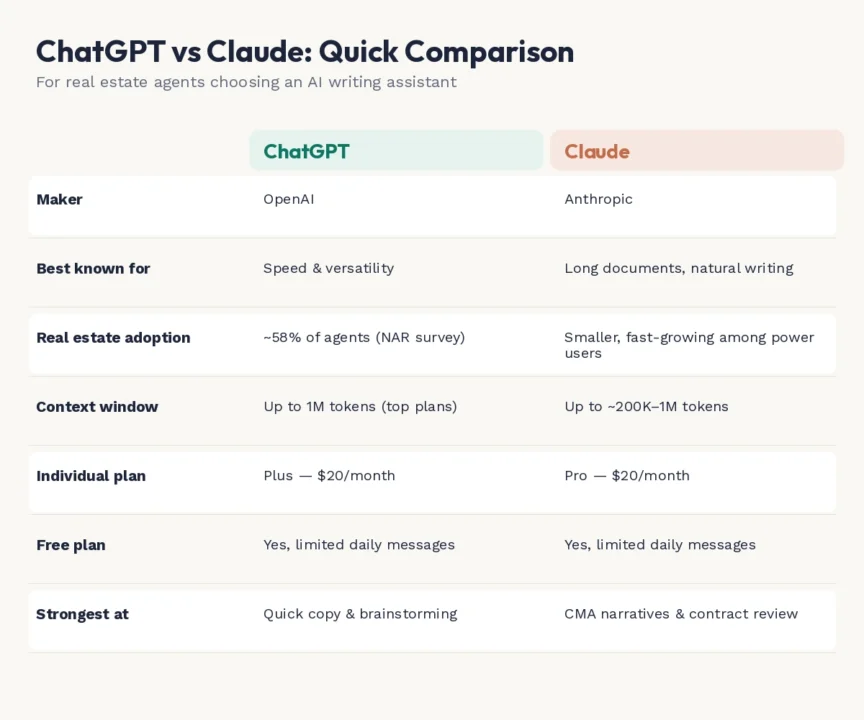
| ChatGPT | Claude | |
|---|---|---|
| Maker | OpenAI | Anthropic |
| Best known for | Speed, versatility, huge ecosystem of plugins/GPTs | Long-document handling, natural-sounding writing |
| Real estate adoption | ~58% of agents (NAR survey), most widely used | Smaller but fast-growing among power users |
| Context window | Up to 1M tokens on top-tier plans | Up to ~200K–1M tokens depending on plan/model |
| Individual paid plan | Plus, $20/month | Pro, $20/month |
| Free plan | Yes, limited daily messages | Yes, limited daily messages |
| Strongest at | Quick copy, brainstorming, image generation | CMA narratives, contract review, brand-consistent writing |
| Weakest at | Long-session consistency, generic-sounding prose | Smaller plugin/integration ecosystem |
Before comparing the two, it helps to know what you’re actually working with. Both ChatGPT and Claude are generative AI tools built on large language models (LLMs) — natural language processing (NLP) systems trained to recognize patterns in text and generate human-like responses. Neither one is a search engine or a live database. They write based on patterns learned during training (plus whatever you paste into the conversation), not a real-time lookup of MLS listings or today’s interest rates, unless you’ve specifically turned on a web-search feature.
What Is ChatGPT?
ChatGPT is OpenAI’s conversational AI assistant, built on its GPT family of large language models (currently the GPT-5.6 series as of mid-2026). It’s the most recognized generative AI product on the market, with a broad ecosystem of custom GPTs, image generation, voice mode, and third-party integrations. For agents, ChatGPT is often the first AI tool they try, because it’s fast, familiar, and easy to bolt onto an existing workflow.
What Is Claude?
Claude is Anthropic’s AI assistant, built around what the company calls “Constitutional AI” — a training approach focused on producing careful, honest, well-reasoned output rather than just the fastest plausible answer. Claude’s current consumer models include Sonnet 5, the default model on both the free and Pro plans, and Opus, the higher-reasoning flagship available on Pro and Max plans for more complex analysis and longer writing tasks. Its standout trait for real estate work is a large context window that lets it read and reason over long documents — full contracts, lease packages, or a stack of comps — in a single conversation.
ChatGPT for Real Estate Agents
Where ChatGPT Shines
- Speed on short tasks. Listing captions, a quick email reply, a social post — ChatGPT produces a usable draft in seconds.
- Versatility. One subscription covers writing, basic image generation, quick research, and light coding if you ever need to tweak a website or spreadsheet formula.
- Familiarity and ecosystem. With roughly 900 million weekly users worldwide, ChatGPT has the largest library of tutorials, custom GPTs, and third-party integrations built around it — useful if you want plug-and-play templates instead of building your own prompts from scratch.
- Image and visual tools. Built-in image generation is handy for simple flyer graphics, mood boards, or social media visuals without opening a separate design app.
Where ChatGPT Falls Short
- Drift on long, multi-step instructions. Give it a five-part prompt (tone, structure, required points, call to action, length) and it can lose track of a step or two by the end of a long session.
- Generic-sounding first drafts. Agents frequently report editing out stock phrasing — the kind of warm-but-hollow language that reads like a template rather than a person who actually knows the property or the client.
- No persistent brand memory on lower tiers. Without deliberate setup, it can feel like re-introducing yourself and your voice guidelines every new conversation.
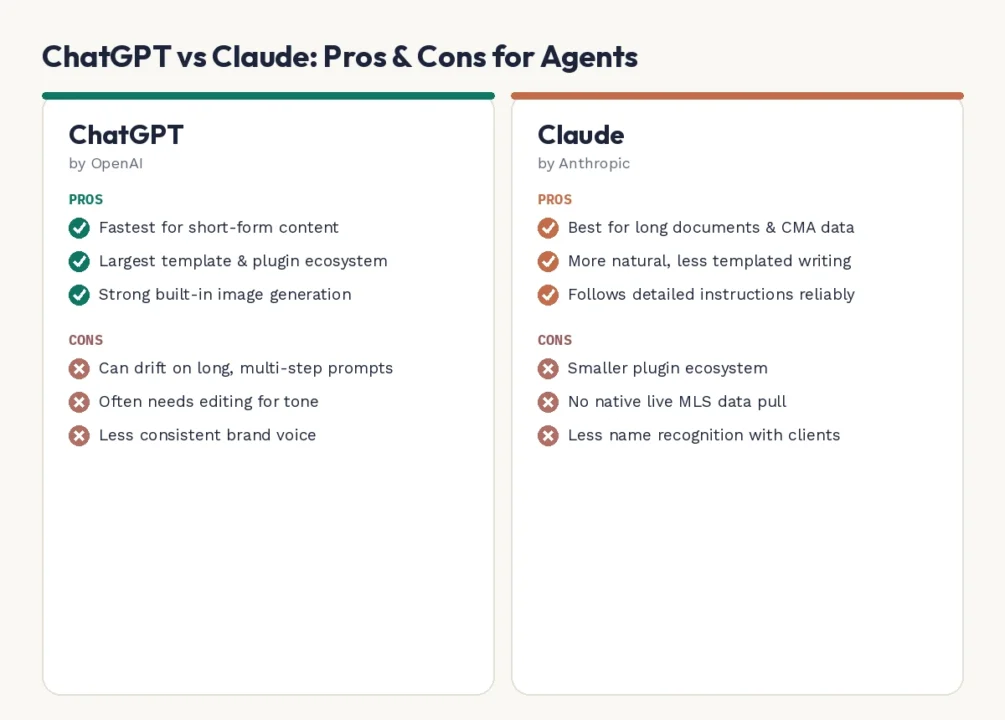
ChatGPT Pros and Cons for Agents
Pros:
- Fastest option for short-form content
- Lowest learning curve
- Massive template and prompt-sharing community
- Strong image generation built in
- Highest brand-name recognition with clients and vendors
Cons:
- Can require more editing on longer, nuanced writing
- Tends to drift on complex, multi-step instructions
- Less consistent at holding a specific brand voice across sessions
- Smaller effective context window on entry-level plans
Claude for Real Estate Agents
Where Claude Shines
- Long-document handling. Paste in an entire lease, a disclosure packet, or a spreadsheet of comps, and Claude can process and reason across the whole thing in one pass — genuinely useful for due diligence and CMA work.
- Writing quality. Claude’s prose tends to read as more natural and less templated, which matters when the output is a seller update, a price-reduction email, or anything else where tone directly affects trust.
- Instruction-following on complex prompts. Give Claude a detailed brief — specific tone, required talking points, a particular structure — and it tends to follow all of it, consistently, rather than drifting halfway through.
- Memory and Projects. Claude’s Projects feature lets you store your brokerage’s voice guidelines, standard disclosures, and neighborhood notes once, so it applies them automatically in future sessions instead of you re-explaining context every time.
Where Claude Falls Short
- No live MLS or web-connected data by default in every plan. Claude reasons well over data you provide, but it isn’t pulling real-time listings on its own the way an MLS portal does.
- Smaller plugin ecosystem. Fewer third-party integrations and community-built templates compared to ChatGPT’s footprint.
- Lower brand familiarity with clients. If you’re sharing AI-assisted content with clients or vendors, more people recognize “ChatGPT” as a name than “Claude,” which occasionally matters for perception, not capability.
Claude Pros and Cons for Agents
Pros:
- Strongest option for long documents (leases, disclosures, comp sheets)
- More natural, less templated writing quality
- Reliable at following detailed, multi-step instructions
- Projects feature retains your brand voice and standard templates
- Large context window handles an entire transaction’s paperwork at once
Cons:
- Smaller ecosystem of plugins and pre-built templates
- No native live MLS data pull
- Less name recognition among clients unfamiliar with AI tools
- Fewer built-in multimedia features (image/video generation) than ChatGPT
Head-to-Head: ChatGPT vs Claude for Core Real Estate Tasks
Listing Descriptions and Property Marketing Copy
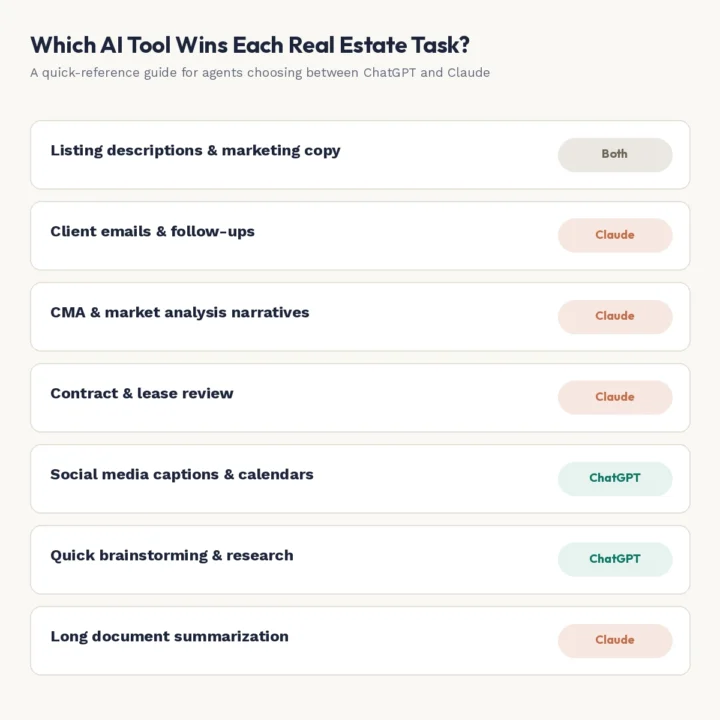
Both tools generate solid first drafts once you feed them square footage, layout, upgrades, and neighborhood highlights. ChatGPT is a hair faster for a quick, single-paragraph MLS remark. Claude tends to produce copy that needs less rewriting when you want several distinct versions — for example, one draft emphasizing the yard and outdoor space, another emphasizing the renovated kitchen — because it holds nuance across a longer prompt more reliably.
Practical tip: ask either tool for three variations, each built around a different selling point, then pick and blend rather than accepting the first output.
Client Emails and Follow-Ups
This is where tone matters most, and it’s a category Claude generally wins on for anything sensitive — a price-reduction conversation, a buyer who’s nervous about a school district, a seller frustrated after 47 days on market with no offers. ChatGPT handles routine, low-stakes follow-ups (touring recap, showing confirmation) just as well and just as fast.
Market Analysis and CMA Narratives
Paste in eight or ten comparable sales and ask for a narrative that explains adjustments and supports your pricing recommendation. Claude’s ability to hold an entire spreadsheet’s worth of comps in context and reason across all of it in one response makes it the stronger fit here. Neither tool pulls live data from Zillow, Redfin, or your MLS on its own — you still supply the comp data yourself.
Contract, Lease, and Disclosure Review
For skimming a long document to flag key terms, deadlines, or unusual clauses, Claude’s longer effective context window is the more capable option — it can process a full inspection report, listing agreement, or lease package in one session instead of needing it split into chunks. This applies whether you’re reviewing paperwork before an offer or tracking terms through escrow to closing. Important caveat: neither tool should be treated as legal advice. Always have a licensed attorney or broker review anything contractual before you or your client rely on it.
Social Media and Content Calendars
Both tools handle a month of captions, a neighborhood spotlight post, or a “just listed” announcement well. ChatGPT’s built-in image generation gives it a slight edge if you want quick accompanying visuals in the same conversation.
Pricing for Individual Agents and Brokerages
Both companies price their entry-level individual plan at $20/month, and both offer a usable free tier for occasional, low-volume use. Team and brokerage-level pricing scales from there — see the full breakdown below.
Pricing Comparison (2026 Snapshot)
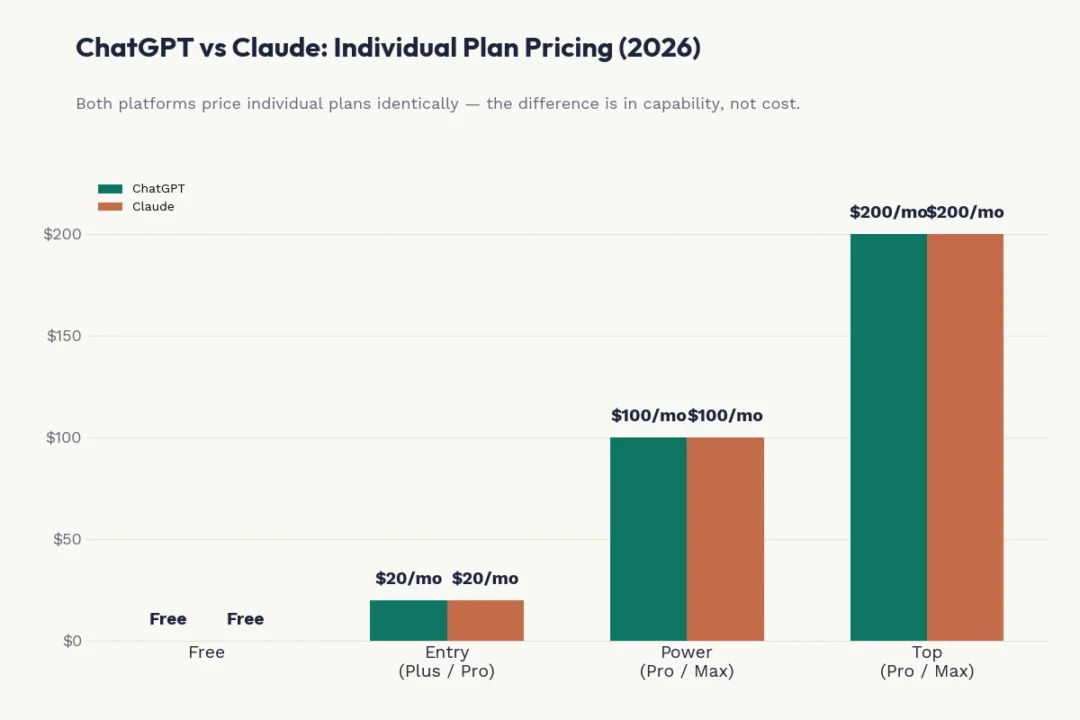
Prices and limits change often on both platforms, so treat this as a snapshot and confirm current numbers directly with each provider before budgeting.
| Plan Tier | ChatGPT | Claude |
|---|---|---|
| Free | $0, limited daily messages, ads on some free responses in the US | $0, limited daily messages |
| Entry paid (individual) | Plus — $20/month | Pro — $20/month |
| Mid/power tier | Pro — $100/month (5x usage) | Max — $100/month (5x usage) |
| Top individual tier | Pro — $200/month (20x usage, video generation) | Max — $200/month (20x usage) |
| Team/brokerage | Business — around $20–25/seat/month, 2-seat minimum | Team Standard — around $20–25/seat/month |
| Team premium | — | Team Premium — around $100–125/seat/month |
| Enterprise | Custom, 150-user minimum | Custom, negotiated per organization |
For most solo agents, a single $20/month subscription to either platform is enough to handle daily writing, brainstorming, and research tasks. Before choosing, compare the official ChatGPT pricing plans and Claude pricing plans to see which features best match your workflow. Brokerages managing multiple agents often get better value from a Team plan instead of separate individual subscriptions because it includes shared workspaces and centralized billing.
One naming detail is worth noting before you subscribe. OpenAI currently uses the name Pro for both its $100 and $200 individual tiers. Always review the official ChatGPT pricing page and verify the exact plan name and price in your account’s billing settings before subscribing, so you know exactly which plan you’re paying for.
Which One Should Real Estate Agents Choose?
Choose ChatGPT If You…
- Want the fastest possible drafts for short, low-stakes content
- Already rely on custom GPTs or third-party integrations
- Want built-in image generation for quick flyer or social graphics
- Are just starting out and want the tool with the most tutorials and community templates
Choose Claude If You…
- Regularly work with long documents — leases, disclosure packets, inspection reports
- Want writing that sounds like you, with less editing afterward
- Need consistent output across detailed, multi-step instructions
- Want to store your brand voice and standard templates once and have them carry across sessions
Or Use Both
Plenty of working agents don’t pick a side. A common split: ChatGPT for quick-turnaround content and anything needing an image, Claude for client-facing writing, CMA narratives, and document review. At $20/month each, running both costs less than a single lead-gen subscription from most portal services — and you’re not locked into either one.
What AI Can’t Do for Real Estate Agents
It’s worth being direct about the limits, because the industry has already seen what happens when agents forget them. In early 2026, real estate press reported a high-profile deal that nearly fell apart after both the buyer’s and seller’s side separately consulted a general AI chatbot for last-minute negotiation advice — without giving it any context on the deal’s history, prior concessions, or relationship between the parties. The AI wasn’t wrong given what it knew; it simply didn’t know enough.
That’s the core limitation, and it applies equally to ChatGPT and Claude:
- No local market judgment. Neither tool knows which streets flood, which builders cut corners, or which HOA is a nightmare to deal with.
- No read on the room. In-person negotiation, a nervous first-time buyer, a seller who needs reassurance more than data — that’s relationship work, not a writing task.
- No deal context unless you provide it. Every AI response is only as good as what you paste in. It doesn’t remember your last three conversations with a client unless you’re using a memory or Projects feature deliberately.
- Not a substitute for legal or financial advice. Contract interpretation, tax implications, and disclosure requirements should go through a licensed attorney, accountant, or broker.
AI wins on tasks that are repetitive, structured, and have clear inputs. You win on everything that requires trust, judgment, and being physically present.
Frequently Asked Questions
Which is better, ChatGPT or Claude, for real estate agents?
Neither is universally “better” — they’re suited to different tasks. ChatGPT is faster and more versatile for short-form content and has the largest ecosystem of templates and integrations. Claude produces more natural, less templated writing and handles long documents like leases and CMA comp sheets more reliably. Many agents use both.
Can AI actually write my listing descriptions for me?
Yes, both tools can generate a strong first draft from basic property details — layout, upgrades, neighborhood highlights. Treat the output as a draft, not a final version: add your own local knowledge, double-check every factual claim (square footage, school zones, HOA details), and make sure it complies with Fair Housing Act requirements and your MLS’s advertising rules before publishing.
Is it safe to upload contracts or client information to ChatGPT or Claude?
Both companies offer business-tier plans (ChatGPT Business/Enterprise, Claude Team/Enterprise) with stronger data-handling commitments than free consumer tiers, including options to exclude your conversations from model training. If you’re regularly handling sensitive client documents, review each provider’s current data-privacy policy and consider a paid business plan rather than a free account.
Can ChatGPT or Claude pull live MLS data?
Not directly, on their own. Neither tool has a built-in live connection to your local MLS by default. You supply the data — comps, listing details, market stats — and the AI analyzes, summarizes, or writes based on what you provide. Some brokerages are beginning to connect their listing databases directly to AI systems, but that’s still an emerging setup, not the default experience for most agents.
Do I need a paid plan, or is the free version enough?
The free tier of either tool is enough to test the waters — a handful of listing descriptions, a few emails, some social captions. Agents using AI daily for real client work typically hit free-tier message limits within days and move to the $20/month paid plan, which is still far cheaper than most lead-generation or portal subscriptions.
Can AI replace a real estate agent?
No. AI replaces the repetitive writing, summarizing, and research that consumes hours of an agent’s week. It doesn’t replace in-person negotiation, local market expertise, or the trust built across a transaction — the parts of the job that actually get deals to the closing table.
Which tool is better for CMA reports and market analysis?
Claude generally has the edge here in CMA reports and Market analysis. Its ability to hold a full set of comparable sales in context and reason across all of them in one response makes it well-suited to turning raw comp data into a clear, client-ready CMA narrative. ChatGPT can do this too, but tends to need more back-and-forth on longer data sets.
Conclusion
The honest answer to “ChatGPT vs Claude for real estate agents” isn’t one tool beating the other across the board — it’s that they’re good at different things. ChatGPT is the faster, more familiar option for quick content and everyday tasks. Claude is the stronger fit when the work is long, detail-heavy, or needs to sound genuinely like you rather than a template.
Start with whichever one matches the task you do most often. If your week is full of quick listing captions and social posts, ChatGPT gets you moving fastest. If you’re regularly buried in comps, leases, and client emails that need a careful tone, Claude will save you more editing time. Either way, at $20 a month, the real risk isn’t picking the “wrong” one — it’s not using either one at all while your competition already is.
If you’re building out your full AI marketing stack, this page pairs naturally with our complete Best AI Tools for Real Estate Agents 2026 pillar guide.