
Table of Contents
Quick Answer
There’s no single “best” AI tool for real estate agents in 2026 — the agents winning the most business are running a small stack, not one all-in-one platform. For lead qualification, tools like Structurely and Ylopo text, call, and nurture online leads before an agent ever picks up the phone. For CRM and follow-up, Follow Up Boss, BoldTrail, and Lofty use AI to score leads and trigger the right message at the right time.
For content, ChatGPT and Claude draft listing descriptions and client emails in seconds, and Canva’s AI handles marketing graphics. For empty listings, AI virtual staging tools furnish rooms for a few dollars each instead of thousands. For paperwork, ListedKit and Dotloop use AI to read contracts and track deadlines automatically.
Most top producers combine three to five of these tools rather than buying one “AI suite.” Whether you search for this as AI tools for real estate agents, AI tools for realtors, or real estate AI software, the shortlist below is the same.
What Counts as an “AI Tool” for Real Estate Agents?
Not every piece of real estate AI software works the same way, and knowing the difference helps you pick the right one instead of buying whatever has the flashiest demo.
- Generative AI creates new content from a prompt. ChatGPT, Claude, and Gemini fall here — they write listing descriptions, emails, and social captions but don’t know anything about your actual leads or transactions unless you tell them.
- Predictive AI analyzes existing data to forecast an outcome. SmartZip and Top Producer’s Smart Targeting use this to flag which homeowners in your farm area are likely to sell in the next six to twelve months.
- Conversational AI holds a two-way exchange with a lead or client by text, chat, or voice. structurely, Ylopo, Roof AI, and voice platforms like Retell AI live in this category.
- Agentic AI goes a step further — it doesn’t just respond when prompted; it monitors your pipeline and acts on your behalf. This is the newest category, and it’s where platforms like Lofty’s AOS and a handful of transaction-coordination tools are heading in 2026.
Most agents don’t need all four types. They need one or two that fix their biggest bottleneck.
Why Real Estate Agents Are Adopting AI Right Now
AI adoption in real estate went from a fringe experiment to standard practice in about three years, and the pace is still accelerating.
The Adoption Numbers
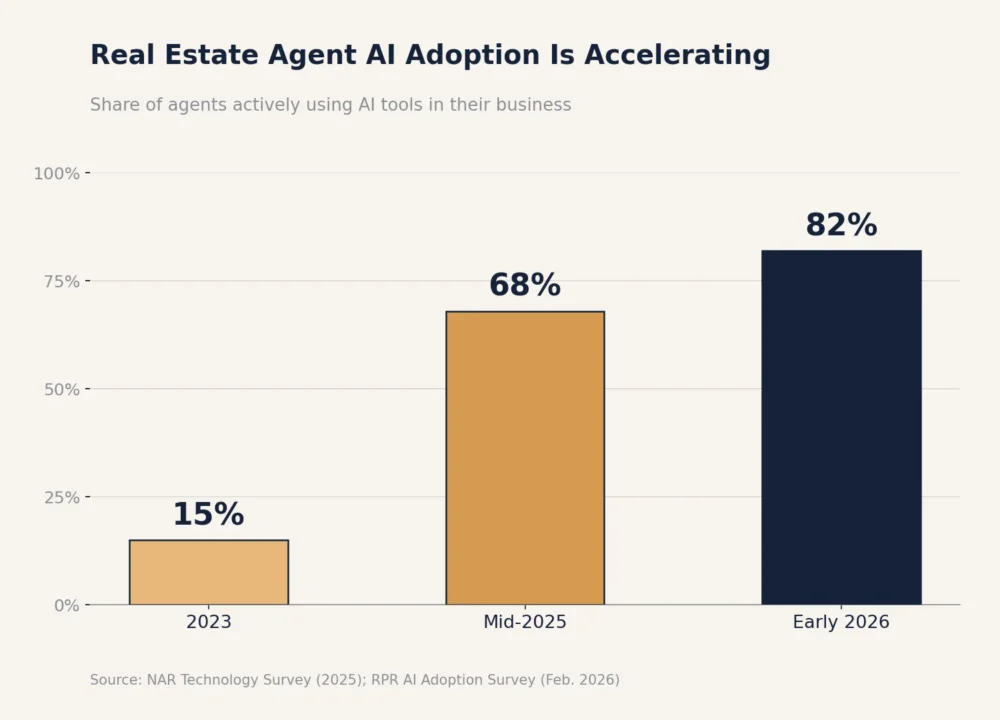
- Roughly 15% of agents used AI in any meaningful way in 2023.
- By mid-2025, the National Association of REALTORS® (NAR) Technology Survey put that figure at 68%.
- By February 2026, a survey from Realtors Property Resource (RPR), an NAR-owned data subsidiary, found adoption had climbed to 82%, with most of those agents using AI daily or several times a week.
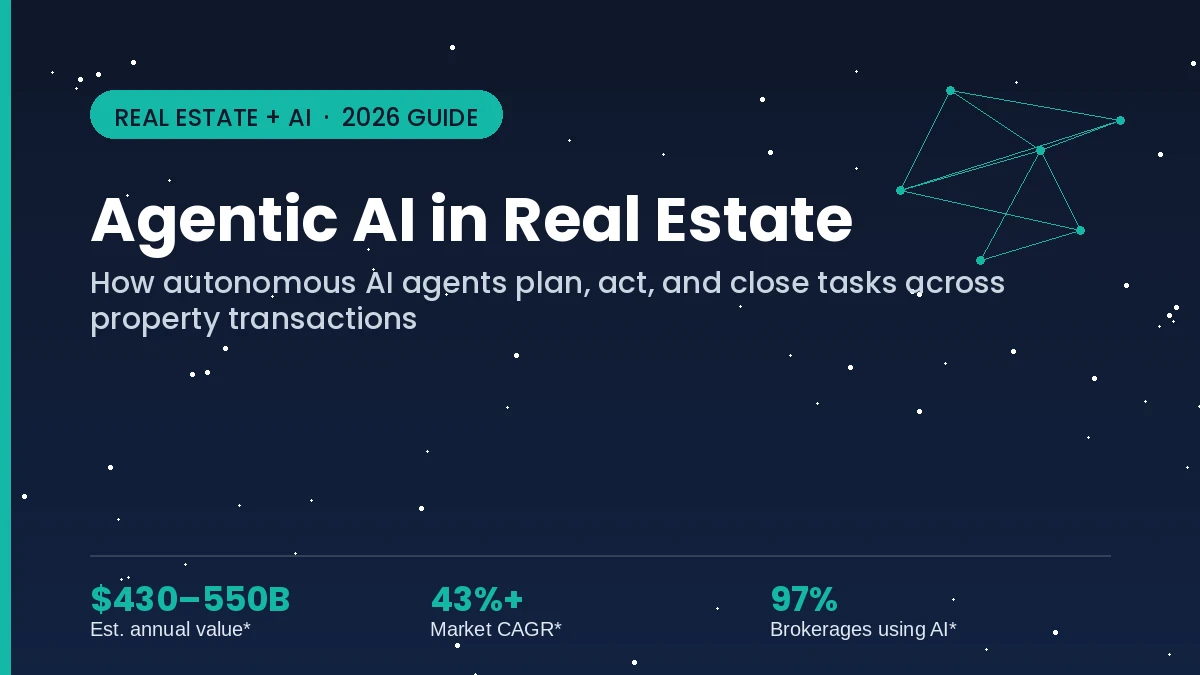
- Among brokerage leaders specifically, 97% report their agents are actively using AI tools in some form.
Where Agents Trust AI — and Where They Don’t
This is the part most “AI is taking over real estate” headlines skip: adoption and impact are two different numbers.
According to the RPR survey, only 17% of agents say AI has had a significant positive impact on their business, and 46% report no noticeable difference at all. The gap makes sense once you see where agents are actually applying AI:
- Writing tools are the most-used category (used by roughly 78% of surveyed agents), mainly for listing descriptions, social posts, and email drafts.
- Chatbots and AI assistants come next, used by about 47%.
- Market analysis and pricing tools sit around 39%.
Confidence drops sharply, though, when AI touches anything client-facing and high-stakes. Top concerns cited by agents include:
- Accuracy of AI-generated output (63%)
- Compliance or legal exposure (49%)
- Misinterpretation of market data (47%)
- Fair housing risk in AI-written content (28%)
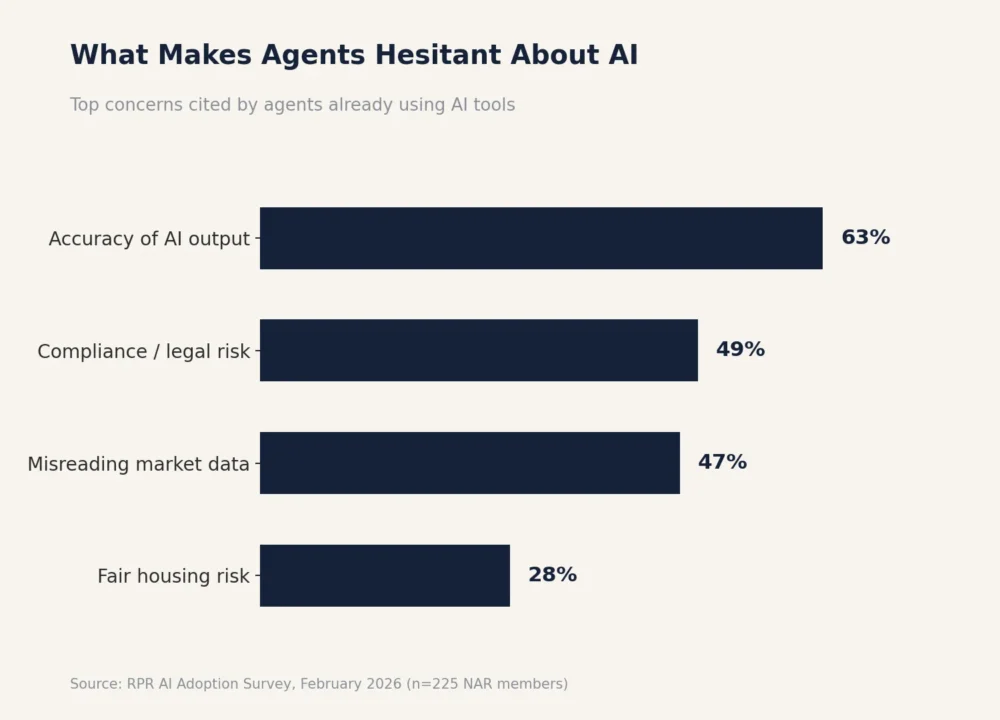
That’s the real takeaway for anyone shopping for AI tools in 2026: use AI aggressively for drafting and busywork, and keep a human hand on anything involving pricing advice, contract interpretation, or fair housing language.
The Best AI Tools for Real Estate Agents, Organized by Workflow
Real estate isn’t one job — it’s lead generation, client communication, marketing, transaction management, and market analysis stacked together. The most useful way to evaluate AI tools is by which of those workflows they actually fix, not by a generic “top 10” ranking.
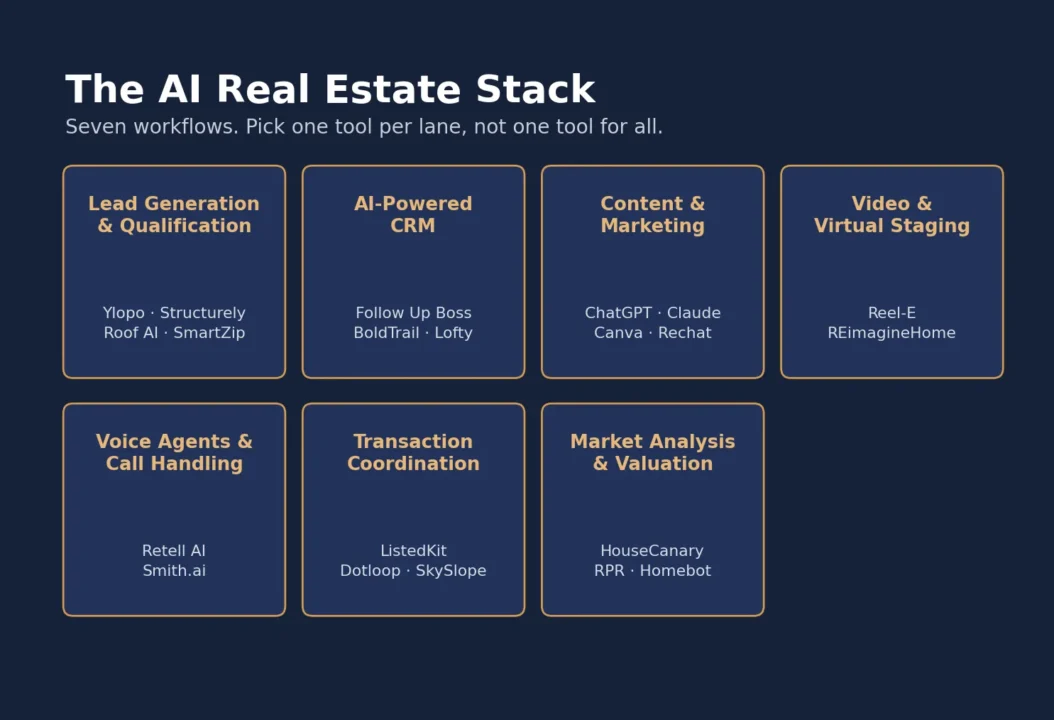
1. AI Tools for Lead Generation and Qualification
Speed-to-lead is the single biggest lever in real estate. Buyers who fill out an online form typically talk to whichever agent responds first, and the average agent’s response time is measured in hours, not minutes. This is the category where AI has the clearest, most measurable ROI.
- Ylopo combines AI-driven digital advertising with automated voice and text follow-up, calling and texting leads repeatedly over their first 90 days, so a human only steps in once a lead is warm.
- structurely runs an AI inside-sales agent that engages new leads across SMS, email, and voice, then keeps nurturing them for up to a year until they’re ready to transact.
- Roof AI sits on a brokerage’s website as a 24/7 chat assistant, qualifying visitor intent and routing serious leads to the right agent automatically.
- SmartZip and Top Producer’s Smart Targeting work differently — instead of talking to leads, they score homeowners in your farm area on likelihood to sell in the next six to twelve months, using public records and behavioral data, then hand you a targeted mailing or call list.
The distinction that matters: chatbots and predictive scoring tools hand you a list or a warm contact. AI lead intake actually interviews the prospect — timeline, motivation, financing — and builds a profile you can act on immediately.
2. AI-Powered CRMs for Real Estate
A CRM is where leads go to either get nurtured or die quietly. AI-powered CRMs add lead scoring and behavior-based triggers on top of standard contact management.
- Follow Up Boss is one of the most widely adopted CRMs among top producers, with AI-assisted routing and follow-up sequencing for internet leads.
- BoldTrail (from Inside Real Estate) builds its AI around behavioral nurturing — if a lead views several listings, they automatically receive a targeted text message; if they save a property, a matching-listings email goes out without the agent lifting a finger.
- Lofty, formerly Chime, launched an agentic operating system in early 2026 to monitor an agent’s entire database and surface which past clients are showing signs of being ready to sell again.
- KvCORE remains a common choice for teams that want IDX websites, CRM, and marketing automation bundled together.
One limitation worth knowing before you buy: most behavior-based AI CRMs are optimized for converting cold, anonymous leads from your website or ad spend. They’re generally weaker at surfacing your existing sphere and past clients — which is where the majority of repeat and referral business actually comes from.
3. AI Content and Marketing Tools
This was the first real estate AI category to go mainstream, and it’s still the easiest entry point for agents who’ve never used AI before.
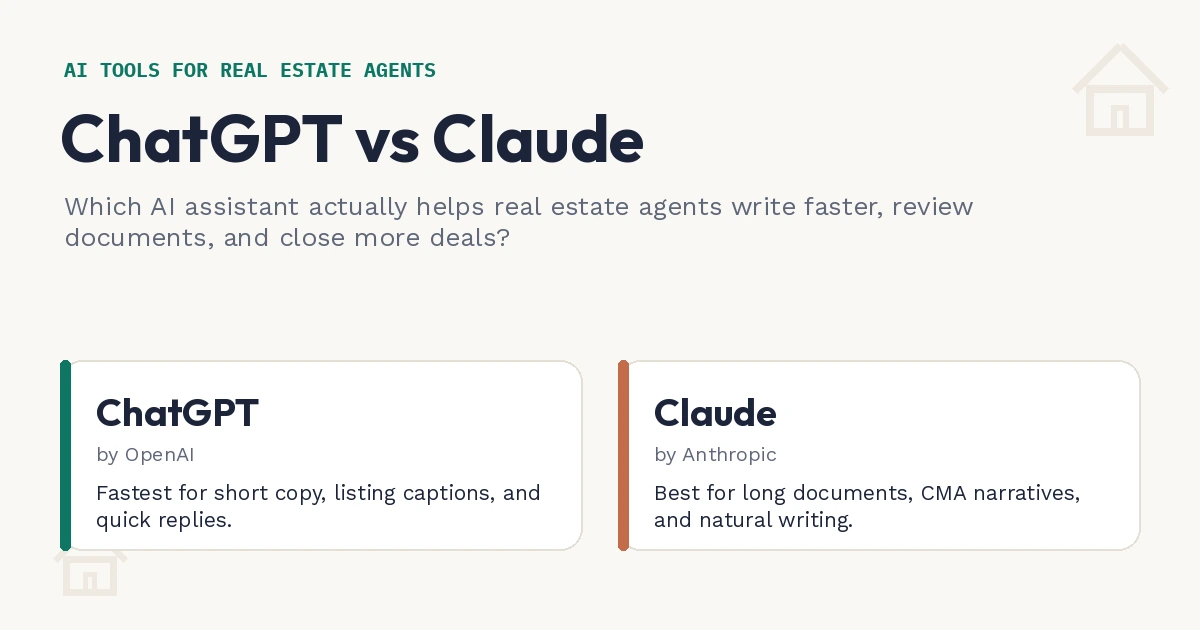
- ChatGPT and Claude remain the fastest, cheapest ways to draft listing descriptions, email campaigns, and social captions. Give the tool square footage, key features, and your target buyer, and you’ll usually get a usable first draft in under a minute — expect to lightly edit it before publishing.
- Canva, through its AI-powered design suite, turns those drafts into branded graphics, flyers, and social posts using a large template library, which matters if you don’t have a designer on staff.
- Rechat’s AI assistant, nicknamed Lucy, works behind the scenes to build listing marketing materials, branded microsites, and personalized outreach directly from a phone.
- Epique and similar purpose-built real estate copywriting tools are trained specifically on real estate language and can hold a consistent brand voice better than a general-purpose chatbot with no prior context.
The honest limitation here: general AI tools have zero memory of your business. Every session starts from scratch, and you have to supply all the context yourself. That’s fine for one-off content, but it’s why purpose-built real estate tools exist for anything recurring.
4. AI Video and Virtual Staging Tools
Listings with video get dramatically more inquiries than photo-only listings, and staged homes consistently sell faster than vacant ones — but traditional videography and physical staging both carry real costs and multi-day turnarounds. AI has closed that gap.
- Reel-E generates a cinematic listing video with realistic camera motion from a set of still photos in under two minutes, at a fraction of the cost of hiring a videographer.
- REimagineHome (built by Styldod) stages a vacant room in under a minute across dozens of design styles and also handles exterior and renovation-preview edits.
- Virtual Staging AI (now under Zillow) is one of the fastest browser-based options, generating a staged room in roughly 15 seconds with no design experience required.
- BoxBrownie uses a human-assisted workflow — AI does the initial pass, then a real editor reviews it, which suits agents who want more creative control.
- Collov AI stands out for furniture removal on occupied or cluttered listings, not just for adding furniture to empty ones.
A compliance note that matters here: virtual staging is legal in every U.S. state, but it must be disclosed. Most MLS systems require a “virtually staged” caption on the photo itself and in the listing remarks, and staging can’t misrepresent structural condition — you can’t use AI to hide damage or add square footage that doesn’t exist.
5. AI Voice Agents and 24/7 Call Handling
This is the fastest-growing category in 2026. Voice AI has gotten good enough to hold a real phone conversation, qualify a caller, and book a showing directly into an agent’s calendar — including at 11 p.m., when a lot of serious buyers are actually browsing.
- Retell AI is a voice agent platform built for inbound and outbound real estate calls, with direct CRM and calendar integration.
- Smith.ai offers a hybrid model — AI handles routine calls and spam filtering, and complex or high-stakes calls (like a pre-listing consultation) escalate to a live receptionist.
- Structurely’s Aisa Holmes assistant extends into voice on top of its SMS and email nurturing, so a lead can be worked across every channel by the same AI persona.
Pricing in this category tends to be usage-based (per minute or per call) rather than a flat monthly fee, which makes it easier to test with a small budget before committing.
6. AI Transaction Coordination and Contract Tools
A single residential contract can run 30-plus pages with multiple addendums, and a single transaction can generate 40-plus documents overall. This is the least glamorous category, but the AI tools here save real, measurable hours.
- ListedKit uses an AI assistant that reads an uploaded purchase agreement, extracts key dates and party details, and auto-builds a task list and timeline — turning what used to be 20-plus minutes of manual data entry into a couple of minutes.
- Dotloop (owned by Zillow) centralizes forms, e-signatures, and document storage in one collaborative workspace and has started layering in AI document analysis.
- SkySlope is the enterprise standard for brokerage compliance, with an AI-driven audit feature that flags missing documents before they reach a human reviewer.
- Brokermint is built for larger brokerages that need commission automation and compliance reporting across many agents at once.
Pricing models differ meaningfully by tool: some charge per transaction, others charge a flat monthly subscription per user or per brokerage seat. If your deal volume swings month to month, a per-transaction tool is usually the better financial fit than a fixed monthly plan.
7. AI Tools for Market Analysis, Pricing, and Valuation
Market Analysis and Property Valuation is the category where agents are, appropriately, most cautious — pricing advice carries real liability, and AI-generated valuations are a starting point, not a final answer.
- HouseCanary uses predictive analytics to forecast property values and market trends, which helps with pricing strategy and investor-facing analysis.
- RPR (Realtors Property Resource), the NAR-owned data platform available to all REALTOR® members at no extra cost, layers AI-assisted market reports and valuation tools on top of a database covering more than 160 million U.S. properties.
- Homebot delivers ongoing, AI-personalized home value and equity updates to past clients, which doubles as a low-effort database nurture tool.
None of these tools should be the final word on a listing price or a client-facing valuation. They’re a starting data point for the conversation an agent still needs to have in person.
How Much Do AI Tools for Real Estate Agents Cost in 2026?
Pricing varies enormously by category, and vendors update pricing often enough that you should always confirm current numbers directly on their site before subscribing. Sometimes, many tools give you a free subscription or some free credit to use. Or as a general guide:
| Stack Level | Typical Monthly Cost | What’s Included |
|---|---|---|
| Starter | $35–$80 | A general AI chatbot (ChatGPT Plus or Claude), Canva Pro, and a free-tier CRM |
| Mid-tier | $150–$350 | A dedicated real estate CRM, one virtual staging subscription, and a transaction-coordination tool |
| Full agent stack | $400–$900+ | CRM with AI nurture, a voice/lead-qualification tool, staging, transaction management, and market data |
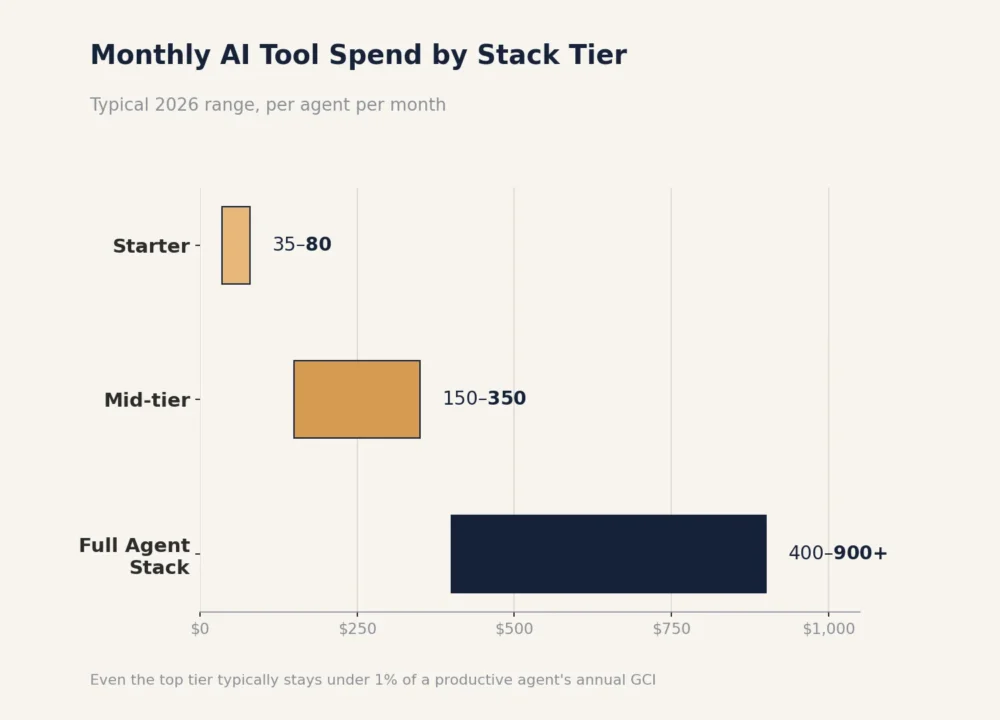
Even at the top of that range, the full stack typically runs comfortably under 1% of a productive agent’s gross commission income (GCI) — which is the number most agents should be measuring against, not the sticker price of any individual tool.
How to Choose the Right AI Stack for Your Business
Skip the temptation to buy an “AI real estate suite” that claims to do everything. As of 2026, no single platform is genuinely best-in-class across lead generation, CRM, marketing, staging, and transaction management all at once. Instead:
- Identify your actual bottleneck first. If leads go cold because you can’t respond fast enough, start with a lead qualification or voice tool — not a content generator. If you’re spending hours on paperwork, start with a transaction tool instead.
- Pick one tool per workflow, not several. Agents who consolidate too early often end up with a mediocre version of every function instead of one thing that actually works well.
- Start with the highest-leverage gap. For most agents new to AI in 2026, that’s replacing a static website contact form with a conversational lead-intake tool — the point where the most deals are currently being lost.
- Layer in the rest gradually. Nurture, listing content, staging, and transaction tools all matter, but they only add value once a lead has already been qualified upstream.
- Test before you commit annually. Most tools in every category above offer a free trial, a free tier, or usage-based pricing specifically so you can validate fit with real leads and real contracts before signing a long-term contract.
What AI Can’t Do: The Limits of AI in Real Estate
AI is a leverage layer, not a replacement for the agent. The parts of the job that actually justify a commission are still entirely human:
- Negotiation. No AI tool reads a room, senses a seller’s real bottom line, or knows when to push versus when to pause.
- Fiduciary advice. An agent has legal and ethical obligations to a client that a chatbot cannot hold.
- Local, on-the-ground expertise. Knowing which streets flood, which school boundary just changed, or why a particular block is quietly overpriced doesn’t live in a dataset.
- The emotional weight of the transaction. Buying or selling a home is usually the largest financial decision a family will make. That conversation needs a person, not a script.
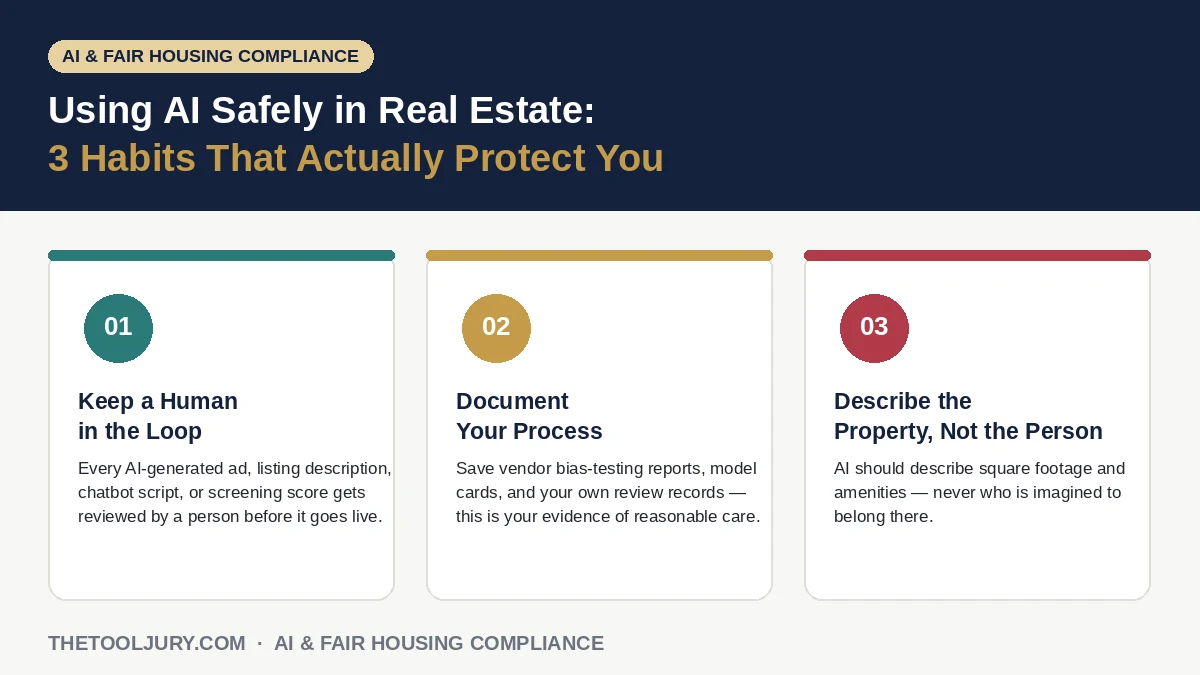
- Compliance judgment. Fair housing law, disclosure requirements, and contract nuance still need a licensed professional’s sign-off — AI drafts should always be reviewed, not published unchecked.
The agents getting real value from AI in 2026 use it to clear out the busywork — qualification, follow-up cadence, first-draft content, contract data entry — so they have more time for the parts of the job that actually require a human.
FAQs
What are the best AI tools for real estate agents in 2026?
There’s no single winner. The strongest picks by category are Structurely or Ylopo for lead qualification, Follow Up Boss or BoldTrail for CRM, ChatGPT or Claude for content, an AI virtual staging tool like REimagineHome for listing photos, and ListedKit or Dotloop for transaction management.
Is there a difference between AI apps for real estate agents and AI software for real estate agents?
Not really — the terms get used interchangeably. “App” usually implies something installed on a phone, like a mobile CRM or voice assistant, while “software” or “platform” more often points to a browser-based tool used at a desk. Functionally, real estate AI tools in either format solve the same handful of problems: lead response, content creation, staging, and paperwork.
Do I need a CRM if I already use ChatGPT for my real estate business?
Yes, if you’re generating any real lead volume. ChatGPT and similar tools write content but have no memory of your contacts, no follow-up automation, and no pipeline tracking. A CRM and a content tool solve different problems and work well together.
Can AI replace a real estate agent?
No. AI cannot replace a real estate agent. AI can automate qualification, follow-up, first-draft content, and paperwork, but it can’t negotiate, provide fiduciary advice, or handle the emotional and legal weight of a real estate transaction. Surveys consistently show buyers still want a human professional to verify AI-generated information before making a final decision.
Is virtual staging with AI legal and MLS-compliant?
Yes, in every U.S. state, provided it’s disclosed. Most MLS rules require a “virtually staged” label on the photo and a note in the listing description, and the staging can’t misrepresent the property’s actual structural condition.
What’s the difference between an AI chatbot and an AI lead qualification tool?
A chatbot typically answers basic questions and captures the same contact fields a web form would. A true AI lead-intake tool conducts a structured conversation covering timeline, motivation, and financing, producing a profile an agent can act on within minutes rather than a name and email address.
How do I start using AI in my real estate business if I’ve never used it before?
Start with one tool that fixes your single biggest bottleneck — usually lead response time or content creation — rather than adopting several tools at once. Most platforms in every category above are built for non-technical users and have a usable learning curve of about a week.
Do AI-generated listing descriptions violate fair housing laws?
They can, if published without review. AI models don’t inherently understand fair housing law, and roughly a third of agents surveyed by RPR cite this as a specific concern. Always read AI-drafted listing copy before publishing, and avoid language that could be read as excluding or steering buyers based on a protected class.
Conclusion
AI adoption among real estate agents crossed 82% in early 2026, but the agents actually seeing results aren’t the ones who bought the most tools — they’re the ones who matched a specific tool to a specific bottleneck.
Realtor or agent, solo practitioner or team lead, the fastest path forward is the same: pick real estate AI tools that fix your actual bottleneck instead of chasing every new AI for realtors that hits the market.
Start with whichever workflow is costing you the most deals right now, whether that’s slow lead response, thin marketing, or paperwork that eats your evenings. Add one tool, use it consistently for a month, and only then layer in the next one. The technology has genuinely gotten good enough to save agents real hours every week. What it hasn’t done, and won’t do, is replace the negotiation, judgment, and trust that were always the real job in the first place.